
Acrylic Scratch-Prevention Packaging
For IP owners, merchandise planners, and EC operators, we help define protective film, individual bags, cushioning, multi-SKU control, packaging QC, and Japan DDP delivery for acrylic goods.
What should be decided first for scratch-prevention packaging
Scratch-prevention packaging is not just putting acrylic goods into bags. Print surface, protective film, bag material, cushioning, in-carton movement, SKU matching and shipping documents all need to be defined before mass production.
1. Protect the surface
Print surface, clear surface, protective film, PE bag and adhesive residue risk are checked at sample stage.
2. Stop in-carton movement
EPE, bubble film, dividers, corner protection and carton direction are selected by product shape.
3. Match SKU and carton
SKU sheet, JAN, carton count sheet, carton label and destination are reconciled under one rule set.
We define the safe public scope by project conditions
Packaging specifications depend on product size, thickness, print method, sales format and transport method. Instead of unsupported certification claims, fixed numbers or absolute guarantees, we define what can be checked before production.
Project-specific control items
Protection method: film, PE bag, OPP bag, EPE, bubble film, dividers and cartons are confirmed by product.
Inspection scope: scratches, chips, dust, bubbles, wrinkles, sealing, JAN placement and carton count are defined first.
Document check: RoHS, REACH, food-contact or other documents are confirmed by material and usage when needed.
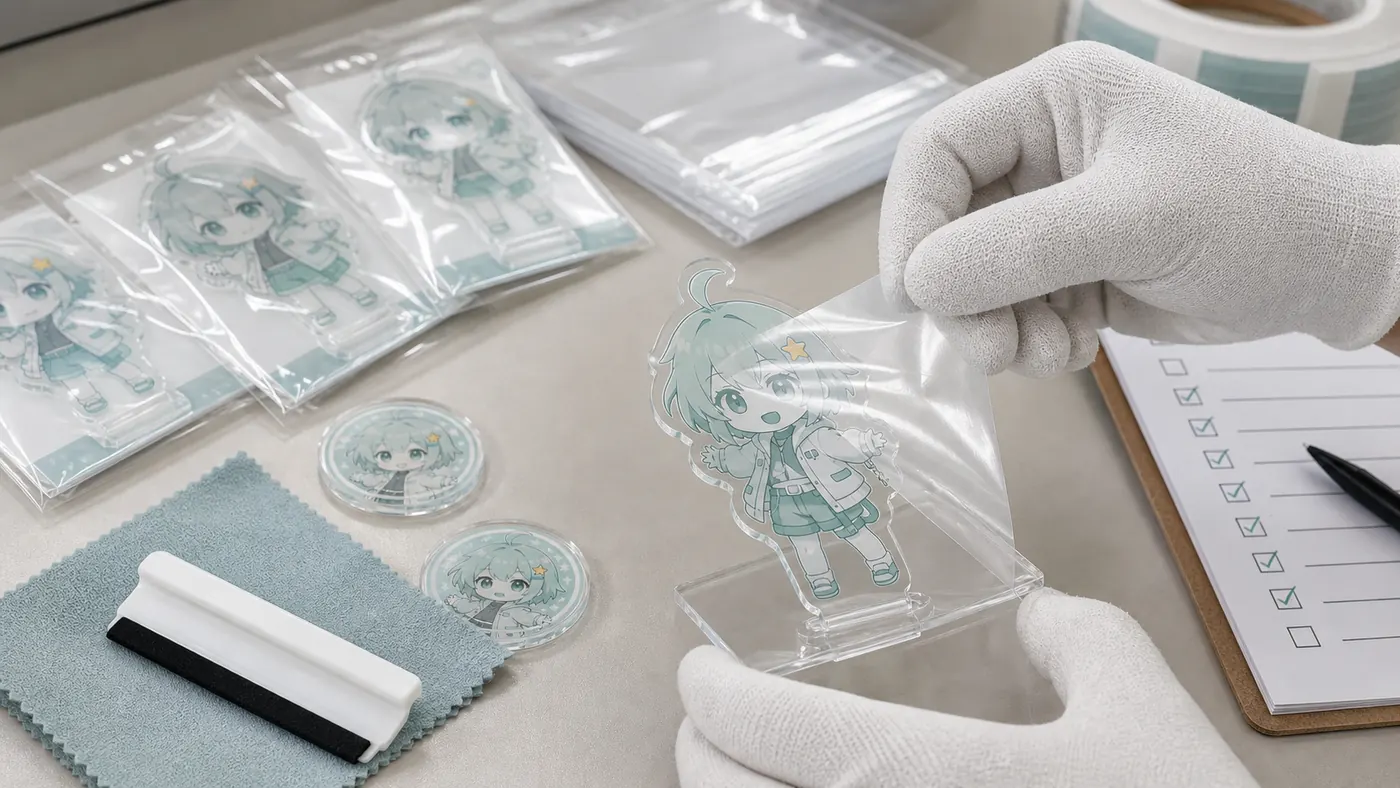
Protective film and individual bags reduce surface rubbing
Acrylic surfaces are clear, so small rub marks, dust, fingerprints and friction inside bags can be visible. Protective film, individual PE bags, backing cards and seal positions are checked at sample stage.
Three layers of protection are combined by product shape
We do not use one packaging method for every item. Surface protection, cushioning protection and carton protection are combined. Thin sheets, irregular shapes, hardware, bases and mixed sets have different risk points.
Level 1 Surface protection
Protective film, individual PE bags, OPP bags and backing cards reduce rubbing and dust. Removability and surface appearance are checked by sample.
Level 2 Cushioning protection
EPE, bubble film, foam and dividers reduce contact and movement inside cartons. Exposed edges or fragile parts may need individual fixing.
Level 3 Carton protection
Inner cartons, outer cartons, dividers, carton labels and carton numbers support transport and delivery matching, especially for Japan DDP shipments.
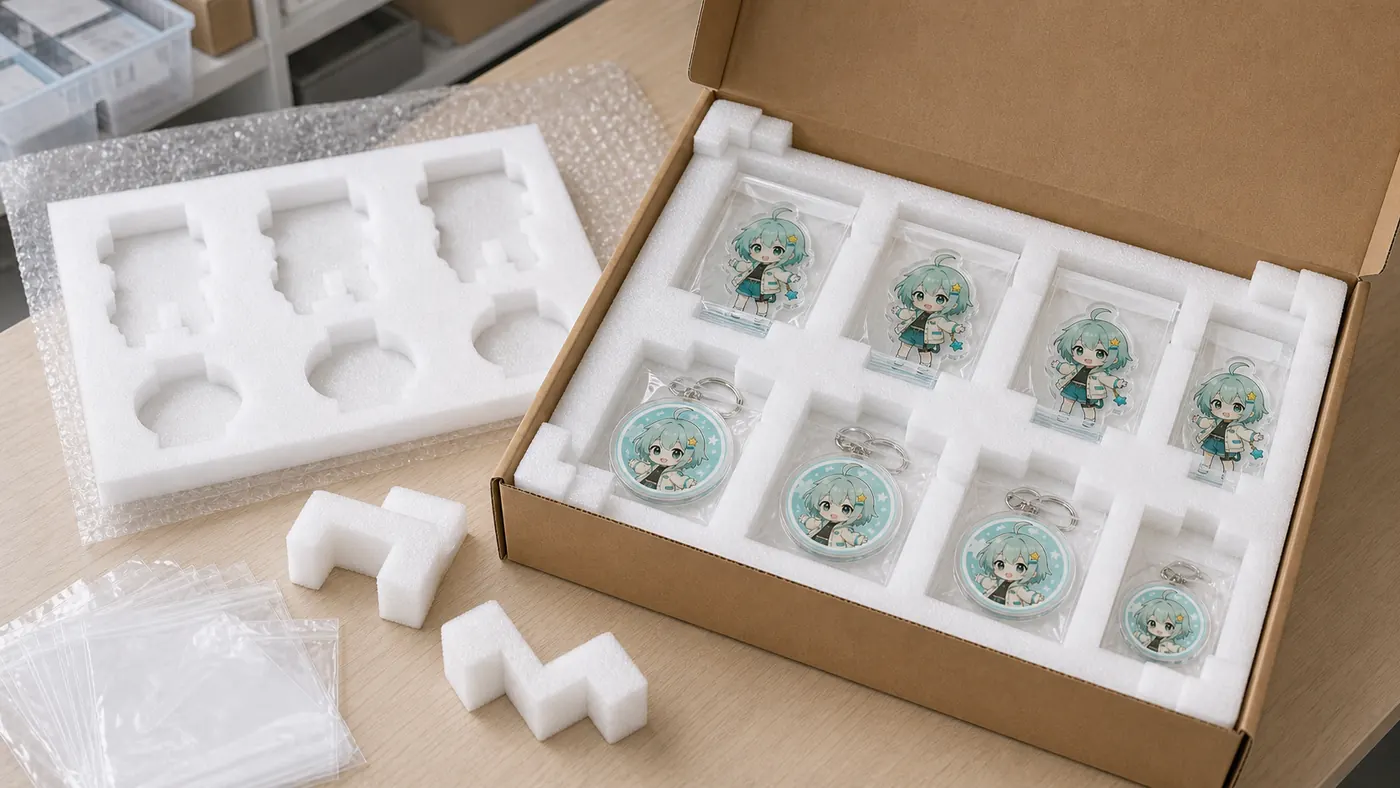
Buyer concerns are converted into packaging and QC checkpoints
| Common issue | Before production | Before shipment |
|---|---|---|
| Surface rubbing during transport | Protective film, bag material, backing card, in-carton movement. | Surface scratches, film lifting, dust, in-bag direction. |
| Corner chipping or breakage | EPE, bubble film, corner protection, dividers, carton direction. | Edges, holes, stand base slots and hardware contact points. |
| Multi-SKU mix-up | SKU sheet, trays, color cards, JAN, carton quantity, destination. | SKU quantity, carton count sheet, carton labels, photo record. |
| Packaging cost mismatch | Required protection level, retail display packaging and shipping packaging separation. | No missing key protection and no unnecessary over-packaging. |
| DDP documents do not match cartons | Carton number, carton list, destination and required documents. | Carton label, carton count, documents and destination match. |
Multi-SKU packaging is managed before and after bagging
When acrylic stands, keychains, cards, backing cards and JAN labels have multiple variants, mix-ups and shortages can happen during packaging. SKUs are separated by trays before packing and reconciled by carton sheets after packing.
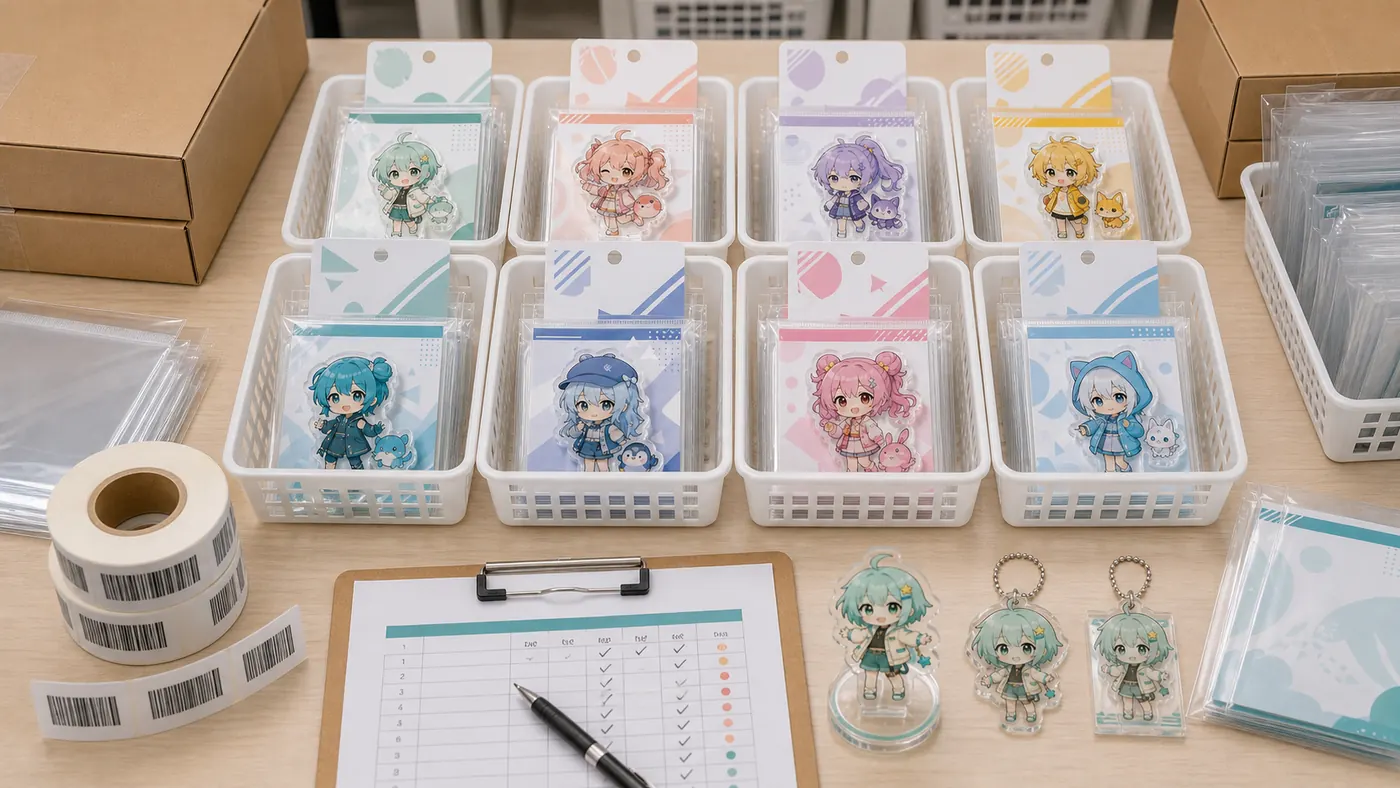
Packaging materials are selected by protection goal and sales format
| Packaging material | Suitable use | Key checks |
|---|---|---|
| Protective film | Clear surface and printed surface scratch prevention | Removability, adhesive residue, bubbles, applied side and opening ease. |
| Individual PE bag / OPP bag | Individual packing, EC shipment, event sales | Bag size, seal position, backing card, JAN placement and in-bag movement. |
| EPE / bubble film | Thin sheets, fragile shapes, long-distance transport | Thickness, fixing method, edge protection, carton voids and over-packaging. |
| Dividers and inner cartons | Multiple pieces per carton, set goods, carton fixing | SKU separation, carton quantity, removal ease and outer carton size. |
| Outer carton and carton label | Japan DDP delivery, warehouse delivery, EC inventory | Carton number, SKU, JAN, quantity, destination and required markings. |
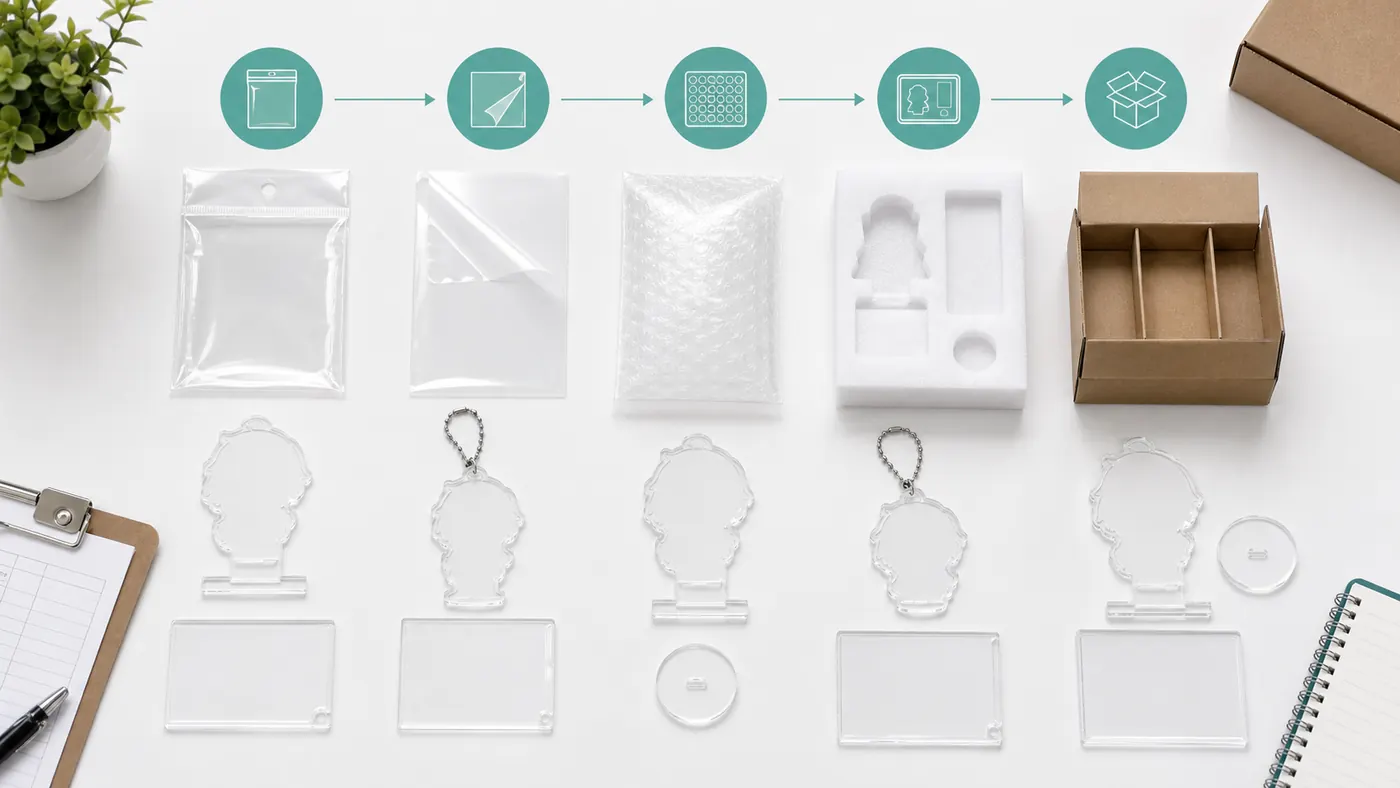
Suitable product categories and packaging notes
| Category | Examples | Packaging notes |
|---|---|---|
| Acrylic stands / keychains | Character stands, acrylic charms | Clear surface, print surface, hardware contact and base packing method. |
| Acrylic cards and thin parts | Trading-card style acrylic, bonus parts | Warping, corner chips, in-bag rubbing, quantity match and backing-card fixing. |
| Acrylic figures / objects | Display parts, insertion-style goods | Protrusions, edges, slots, bases and in-carton fixing. |
| Can badge and paper card inserts | Mixed sets, lottery prizes, EC sets | Rubbing between materials, contact with acrylic, and in-bag order. |
| Acrylic tableware and tumblers | Cups, tumblers, food-contact goods | Material documents, individual packing, cushioning and target-market checks. |
| LED bases and electrical mixed goods | Light stands and speaker-type goods | Electrical parts, static protection, packing order, individual protection and documents. |
| Full blind-box sets | Box, inner bag and acrylic insert | Outer box, inner bag, SKU mix prevention, carton allocation and JAN match. |
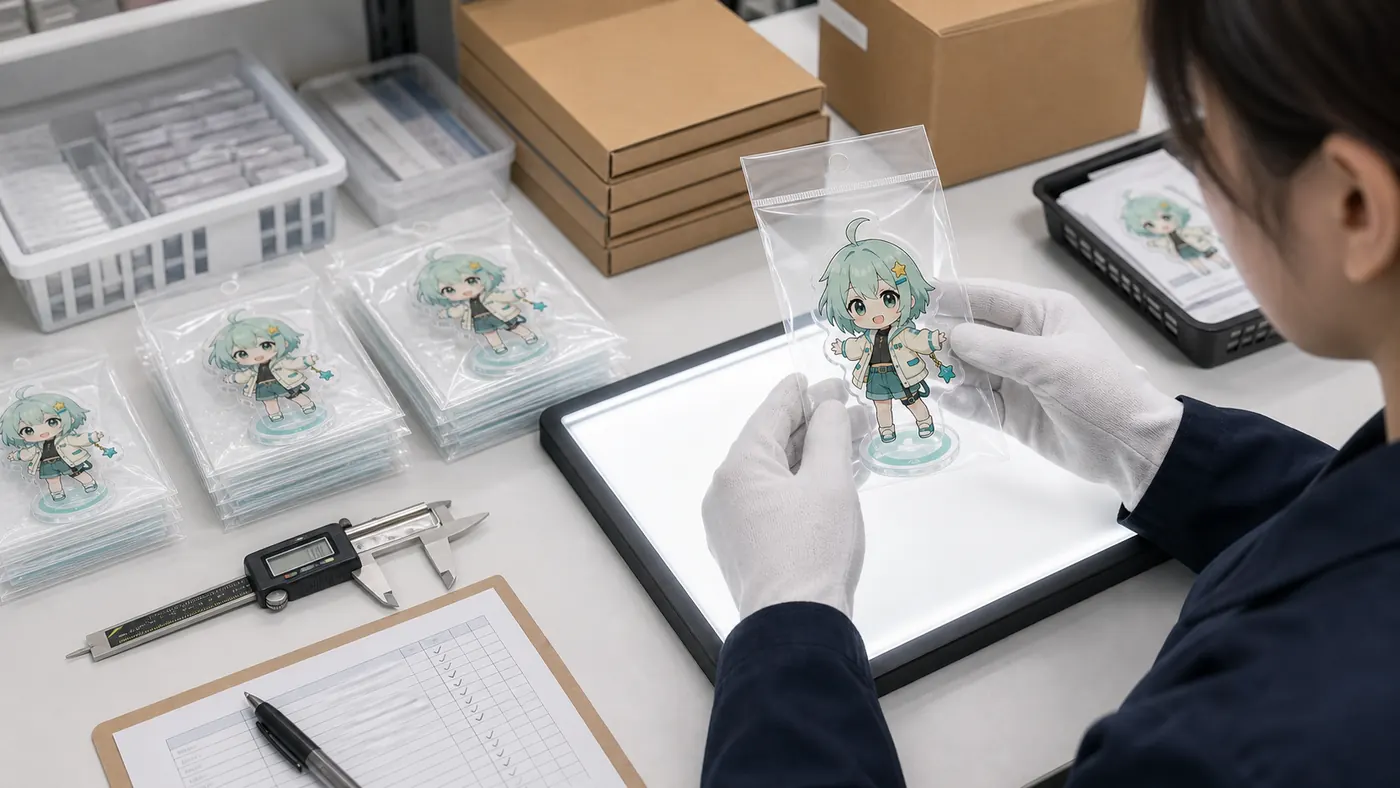
QC checks scratches, dust, sealing and quantity before and after packaging
Inspection covers not only the acrylic item but also the packaged appearance. Film lifting, dust inside bags, missed sealing, JAN placement and carton-count errors should be found before shipment.
Appearance: surface scratch, edge chip, print rubbing, dust and fingerprints.
Packaging: bag size, sealing, protective film, cushioning and in-carton fixing.
Reconciliation: SKU, JAN, carton count, carton label and destination.
Carton numbers, labels and documents are matched for Japan DDP delivery
For Japan-bound delivery, goods must be protected and carton data must also match. Carton number, carton list, destination, carton label and required documents are organized for warehouse, event venue or EC delivery.
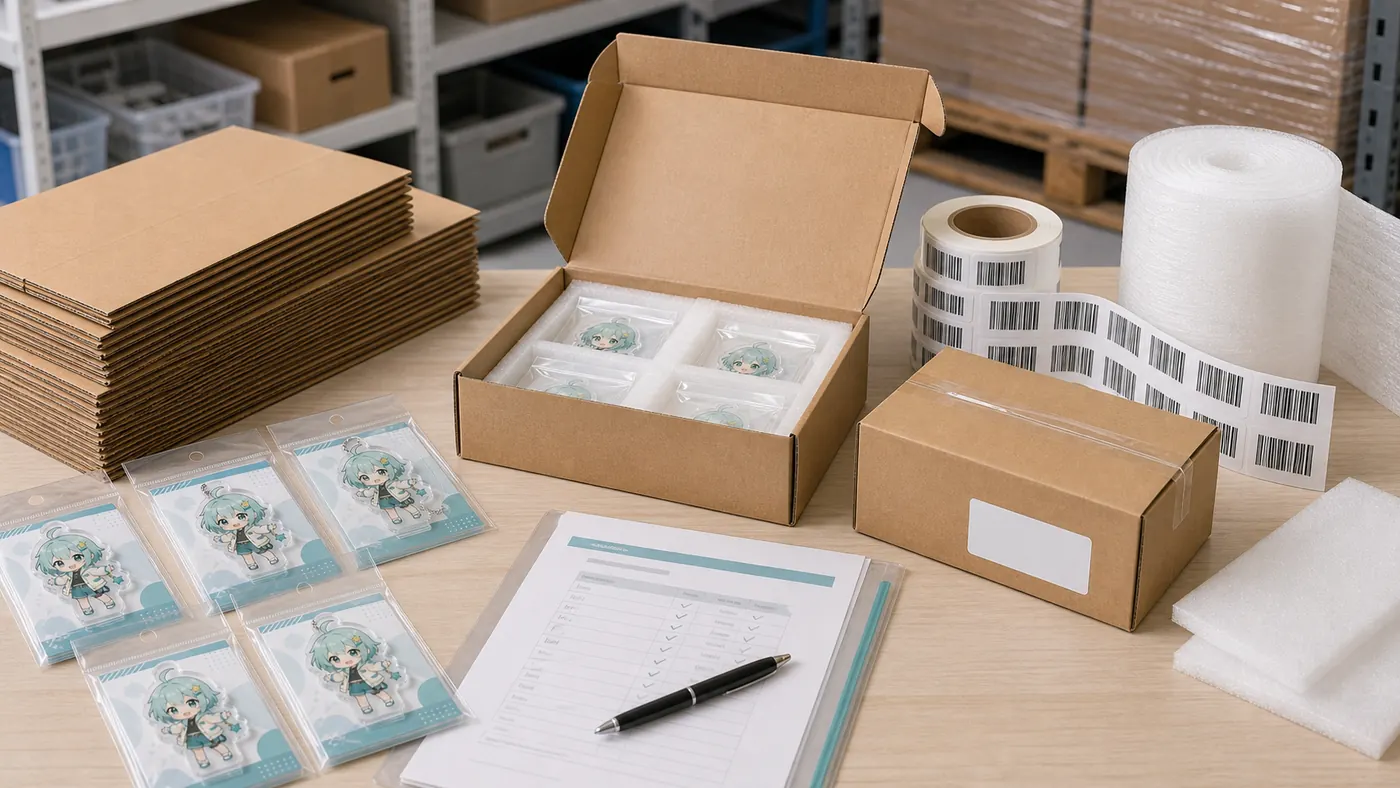
12 steps from inquiry to Japan DDP delivery
Product image, quantity, SKU count, destination and sales format are shared.
Size, thickness, print surface, hardware, backing card and bag are organized.
Rubbing, breakage, chipping, dust, visibility and in-carton movement are checked.
Protective film, PE bag, EPE, dividers and carton method are selected.
Materials, inspection scope, photo records and DDP terms are reflected.
Bag size, protection material, carton packing and opening ease are checked.
Packaging sample, color reference and carton sample are kept as production standards.
SKU sheet, work instruction, inspection standard and carton count sheet are prepared.
SKUs are separated, individually packed, cushioned and carton packed.
Scratches, sealing, JAN, carton count and carton label are reconciled.
Carton number, carton list, required documents and destination are checked.
DDP terms are confirmed for warehouses, stores or event venues in Japan.
Materials that speed up quotation
Product data, size, thickness, print surface, hardware, backing card and bag specification.
SKU list, quantity, JAN/EAN/UPC data, carton quantity and destination.
Desired packaging, inspection standard, required documents and DDP terms.
If details are not ready yet
Product images are enough to start. We can organize packaging samples, inspection items, document checks and DDP conditions before mass production, avoiding both over-packaging and insufficient protection.
Acrylic goods scratch-prevention packaging OEM FAQ
When should scratch-prevention packaging be decided?
At quotation stage, we confirm product size, thickness, print surface, hardware, backing card, bag specification and shipping method. At sample stage, protective film, PE bag, cushioning and carton design are checked.
Can the protective film thickness or material be specified?
Yes, it can be specified. We do not publish a fixed universal thickness guarantee; film choice is confirmed by product surface, print method, removability, adhesive residue risk and cost.
Are EPE foam or bubble film always required?
It depends on thickness, fragility, transport distance and how the goods move inside cartons. Thin sheets, exposed edges and wide printed surfaces often need individual bags plus cushioning.
How do you reduce multi-SKU mix-ups or shortages?
SKU sheets, color cards, tray separation, JAN/EAN/UPC data, carton labels and carton count sheets are reconciled under one rule set. Photo records or quantity sheets can be discussed when needed.
Can we check packaging samples before mass production?
Yes. Bag size, backing card, protective film, cushioning and carton packing can be checked by sample before mass production, including opening risk, visibility, sealing and in-carton movement.
Can breakage or chipping during transport be fully guaranteed?
No public page should describe this as a complete guarantee. Risk is reduced through packaging design, carton specification and pre-shipment checks based on product shape and transport conditions.
Can JAN labels and carton labels be handled together?
Yes. Based on supplied JAN/EAN/UPC data, SKU sheets, destinations and carton quantity rules, individual labels, carton labels, carton numbers and carton lists can be reconciled.
Can documents such as RoHS, REACH or food-contact checks be provided?
It depends on material, target market, usage and required test items. We avoid unsupported certification claims and confirm document availability by project.
Can you support Japan DDP delivery after packaging?
Yes. Individual packing, inner cartons, outer cartons, carton labels, pre-shipment confirmation, required documents and Japan warehouse DDP terms can be organized by project.
Can small lots use scratch-prevention packaging?
Yes. Unit cost depends on quantity, SKU count, packaging material, manual work scope and inspection scope. Please share product images and desired packaging first.
With packaging specs and SKU sheets, we can review the scratch-prevention plan faster
Send product images, quantity, SKU count, desired packaging and destination. We will organize surface protection, cushioning, cartons, inspection and DDP delivery in a public-safe and detailed way.
Related pages to check
Decision framework: Acrylic Scratch-Prevention Packaging
Use this acrylic scratch-prevention packaging to decide and document protective film policy, face separators and sleeve fit, hardware isolation, bag and backing support, inner-box movement control, and transport and opening inspection. The result should be an approval record that procurement, artwork, production, QC and packaging teams can apply to the same SKU.
Search intent boundary: This page owns the informational and risk-reduction intent for acrylic scratch prevention packaging. Commercial product terms remain on the related product pages, while this guide answers the pre-production decision.
What to lock before approval
A reliable decision has three parts: a written criterion, a representative finished sample and a repeatable verification method. Screenshots or verbal approvals are not enough when the decision affects material, fit, color, assembly or pack-out. The six controls below should appear in the same quotation, sample record and inspection instruction.
| Decision | What the buyer must define | Acceptable approval evidence |
|---|---|---|
| Protective Film Policy | Define protective film policy by SKU before quotation and do not replace it with a vague good-quality instruction. | Keep an approved dimensioned specification or controlled reference that production and QC can identify during bulk release. |
| Face Separators and Sleeve Fit | Define face separators and sleeve fit by SKU before quotation and do not replace it with a vague good-quality instruction. | Keep an approved artwork proof and component record that production and QC can identify during bulk release. |
| Hardware Isolation | Define hardware isolation by SKU before quotation and do not replace it with a vague good-quality instruction. | Keep an approved representative physical sample that production and QC can identify during bulk release. |
| Bag and Backing Support | Define bag and backing support by SKU before quotation and do not replace it with a vague good-quality instruction. | Keep an approved sellable pack or use-condition check that production and QC can identify during bulk release. |
| Inner-Box Movement Control | Define inner-box movement control by SKU before quotation and do not replace it with a vague good-quality instruction. | Keep an approved inspection photo and measured result that production and QC can identify during bulk release. |
| Transport and Opening Inspection | Define transport and opening inspection by SKU before quotation and do not replace it with a vague good-quality instruction. | Keep an approved SKU-linked bulk report and carton trace that production and QC can identify during bulk release. |
Failure risks to close
- Protective Film Policy is not controlled: suppliers can interpret the same request differently and the quotation is not comparable.
- Face Separators and Sleeve Fit is not controlled: the physical sample can pass while the wrong revision enters bulk production.
- Hardware Isolation is not controlled: packing or use conditions reveal a failure that a loose visual sample did not show.
- Bag and Backing Support is not controlled: the buyer cannot separate an isolated defect from a repeated batch or SKU problem.
Quote inputs
- project name and target market for Acrylic Scratch-Prevention Packaging
- editable artwork and the latest revision code
- finished dimensions and quantity for every design
- protective film policy
- face separators and sleeve fit
- hardware isolation
- individual packaging, label and barcode requirements
- inspection evidence and acceptance criteria
- delivery destination and required arrival date
Sample-to-bulk control
Approve a finished sample that represents the intended artwork, construction and sellable package. Record the sample date, revision, dimensions, material or component codes, visual limits and function checks. If a later change affects artwork, material, hardware, assembly or packaging, identify the impacted SKUs and obtain a new approval instead of relying on the earlier sample.
For bulk inspection, use the same viewing conditions, measurement points and pass/fail language used during approval. The report should identify the purchase order, SKU, batch, sampled quantity and result. Photographs are useful evidence only when they show the relevant scale, lighting, label or test condition and can be traced to the inspected lot.
When comparing quotations, separate confirmed specifications from assumptions. Ask each supplier to identify exclusions, proposed substitutes, sampling scope, packaging labor and delivery basis. A lower figure is not equivalent when it omits a component, uses a different inspection level or assumes that several designs can share one uncontrolled pack. Close those differences before price approval so the purchase decision remains auditable.