Acrylic Keychain Packaging
For e-commerce operators, IP owners, and merchandise planners, we organize acrylic keychain scratch-prevention packaging, shipping protection, multi-SKU control, inspection, and Japan DDP delivery planning.
The acrylic body, metal hardware, protective film, individual bag, EPE cushion, carton label, and shipment documents are managed as one specification set so unboxing quality and warehouse receiving can be checked together.
Packaging is designed as part of the acrylic keychain specification
Scratch prevention is not just placing the item in a bag. The acrylic body, metal hardware, backing card, JAN label, and carton condition need to be checked before mass production.
Protective film
Transparent surfaces, printed surfaces, double-sided print, and peel-off appearance are reviewed with samples.
Individual packaging
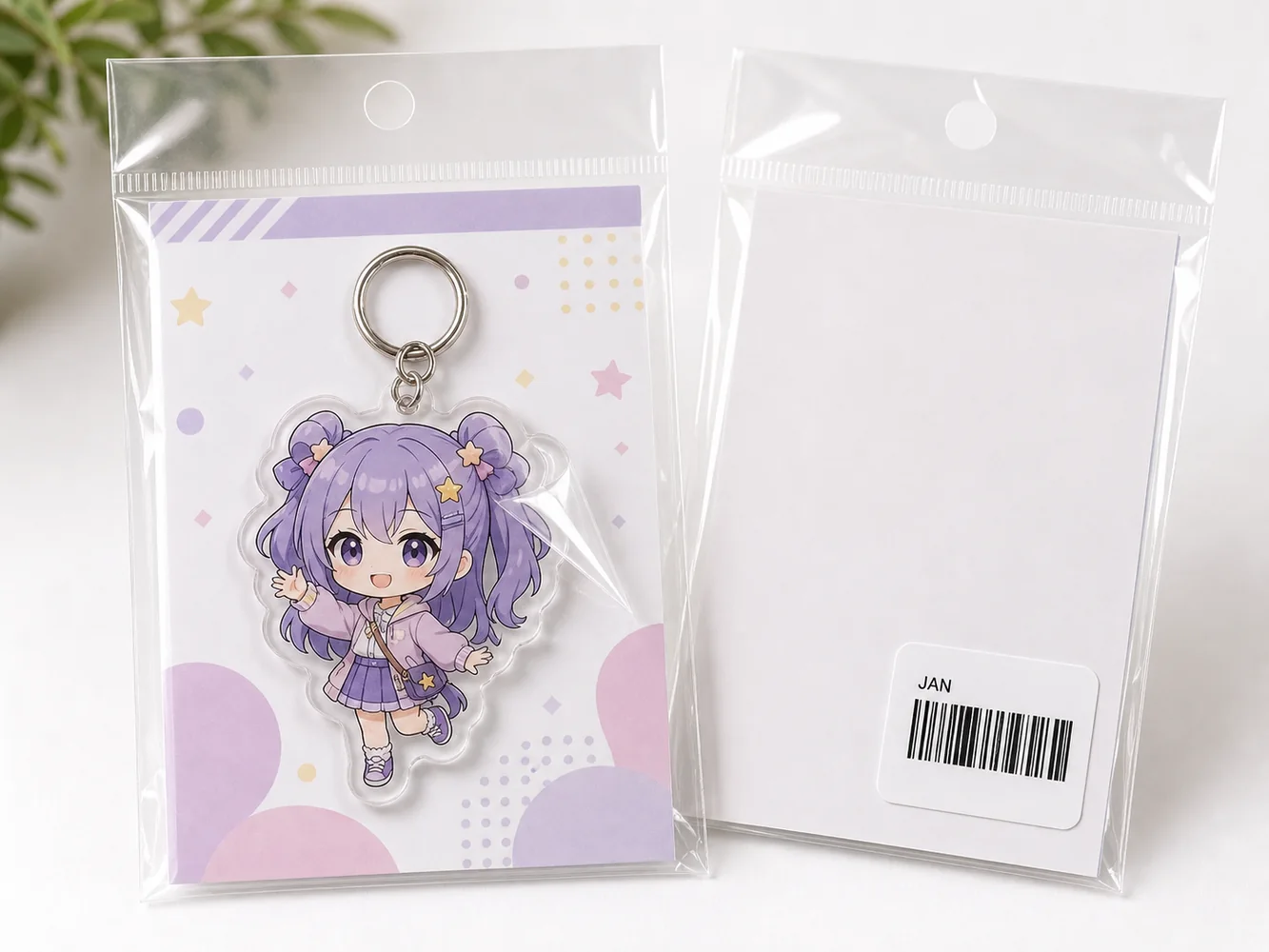
OPP/PE bag, backing card, header, JAN position, and hardware direction are designed as one unit.
Shipping packing
Cushioning, dividers, carton marks, pallet fixing, and DDP documents are aligned with delivery conditions.
This page explains the packaging logic in a public-safe level of detail. Final film thickness, cushion dimensions, carton specification, inspection method, and document set are decided after reviewing design, quantity, sales channel, and destination conditions.
What EC, IP, and planning teams need to confirm before mass production
Methods and inspection depth are project-specific confirmation items. Packaging cost and protection level are adjusted according to selling price, SKU count, delivery route, and destination.
| Issue | Likely cause | Project-specific countermeasure |
|---|---|---|
| Acrylic parts rub during transit | Hardware moves inside the bag or there is too much carton space | Review protective film, bag size, EPE, dividers, and hardware direction with samples |
| Scratches or dust are visible at unboxing | Dust before packing, rubbing inside the bag, or uneven work steps | Set pre-packing cleaning, appearance checks, photo records, and shipment checklists |
| SKU or backing card mismatch | Acrylic body, backing card, JAN, and carton label are not mapped together | Create SKU sheets, packing instructions, separated work units, and final shipment matching |
| Breakage risk during overseas shipping | Carton strength, stacking, empty space, or pallet fixing is not suitable | Review cushioning, carton, void filling, carton marks, and pallet fixing per delivery condition |
Scratch prevention is planned in three layers
Surface protection.Protective film, application side, peel-off appearance, and print impact are checked.
Individual protection.OPP or PE bag, hardware direction, backing card fit, and movement inside the bag are reviewed.
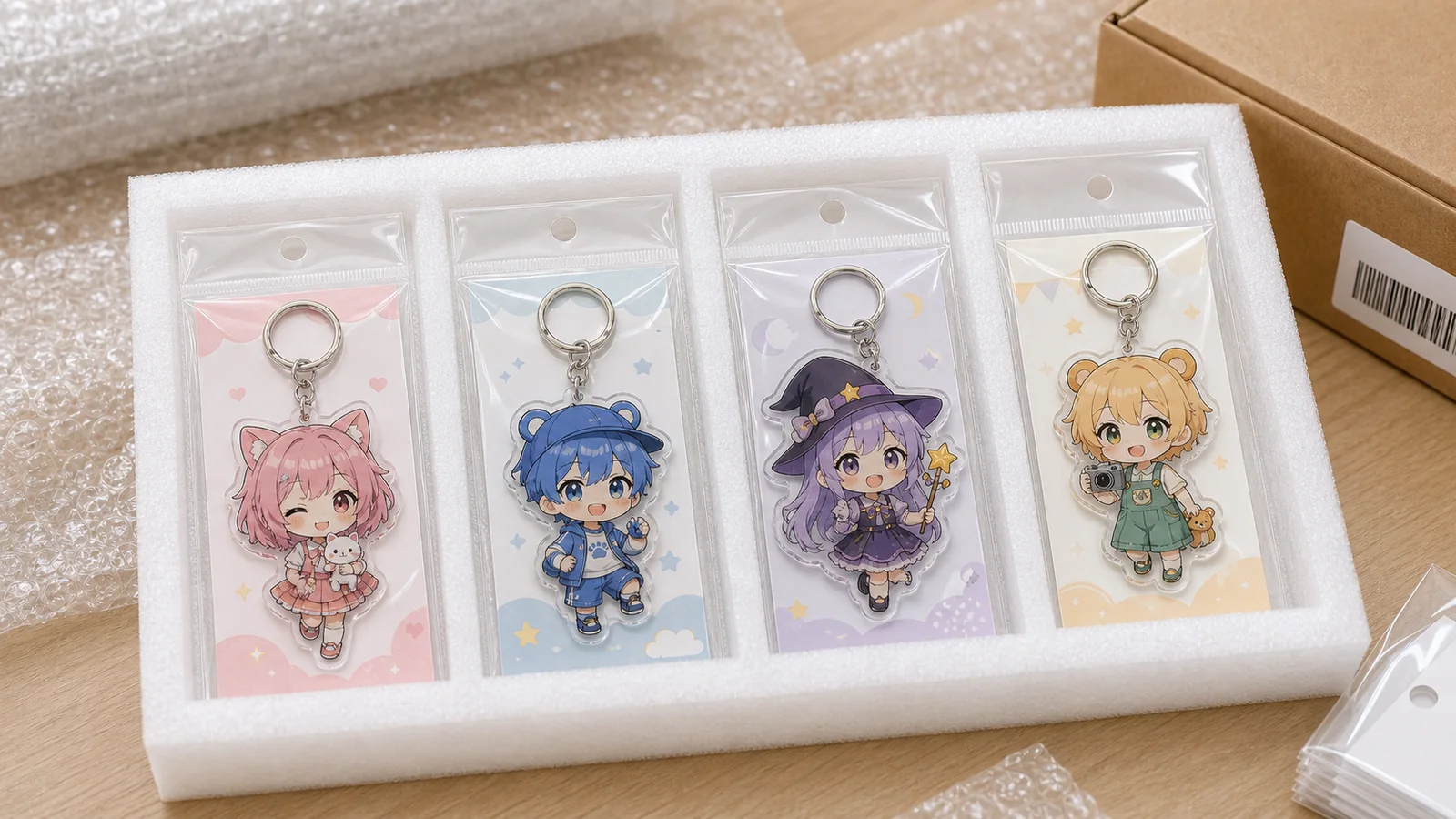
Carton protection.EPE, bubble wrap, dividers, kraft paper, and carton void space are checked.
Protect metal hardware, edges, and clear surfaces separately
Metal hardware is useful but can rub the acrylic body during handling or transit. The sample stage should check how the hardware is placed, how much the product moves inside the bag, and whether a divider or tray is needed.
Protection from China factory to Japan delivery
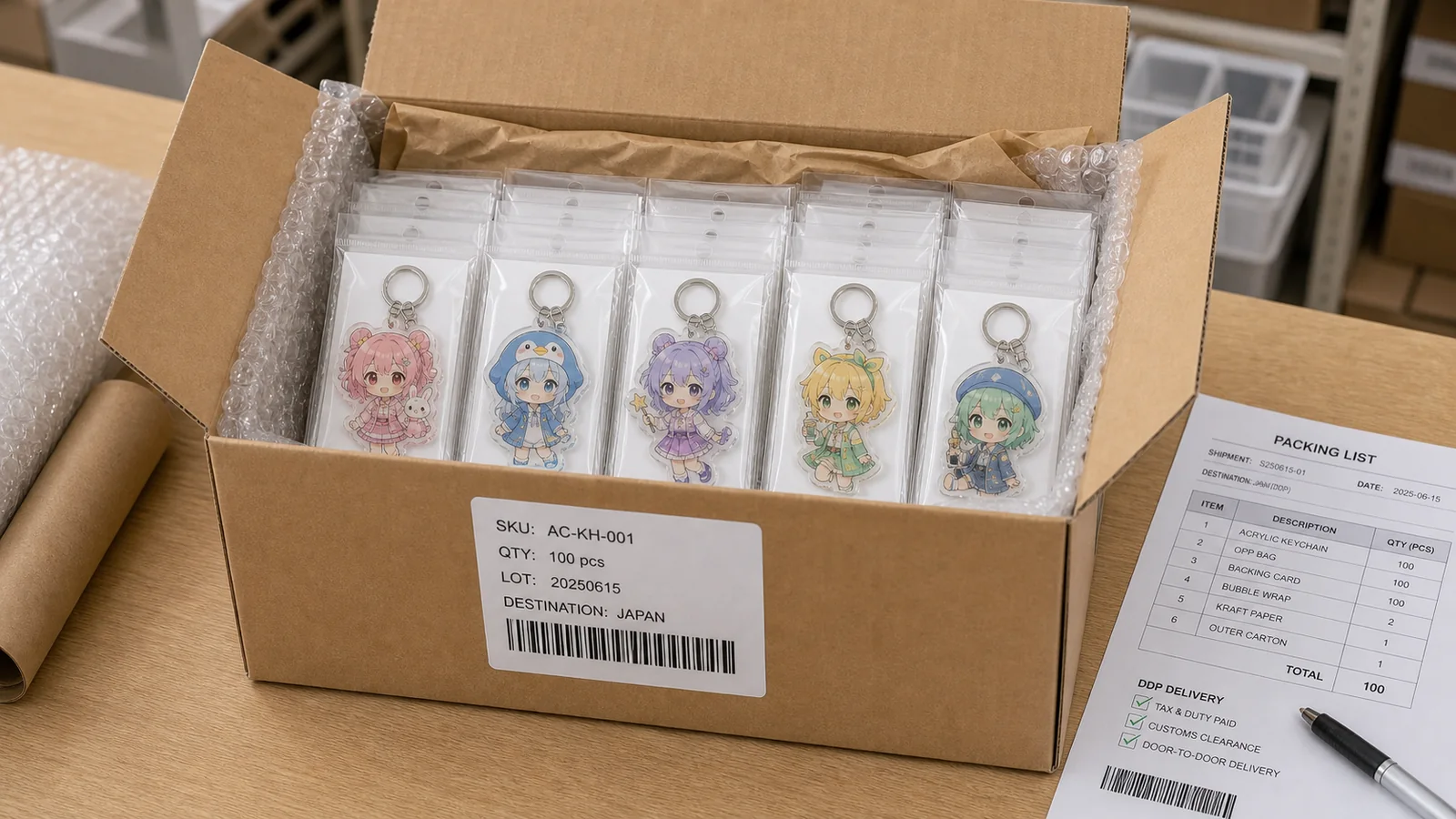
For DDP delivery, product packaging is only one part of the work. Carton label, packing size, weight, destination, and shipping documents also need to match.
Carton
Void space, stacking, dividers, carton labels, and handling marks are checked.
Documents
Invoice, packing list, SKU quantity, and destination information are aligned before shipment.
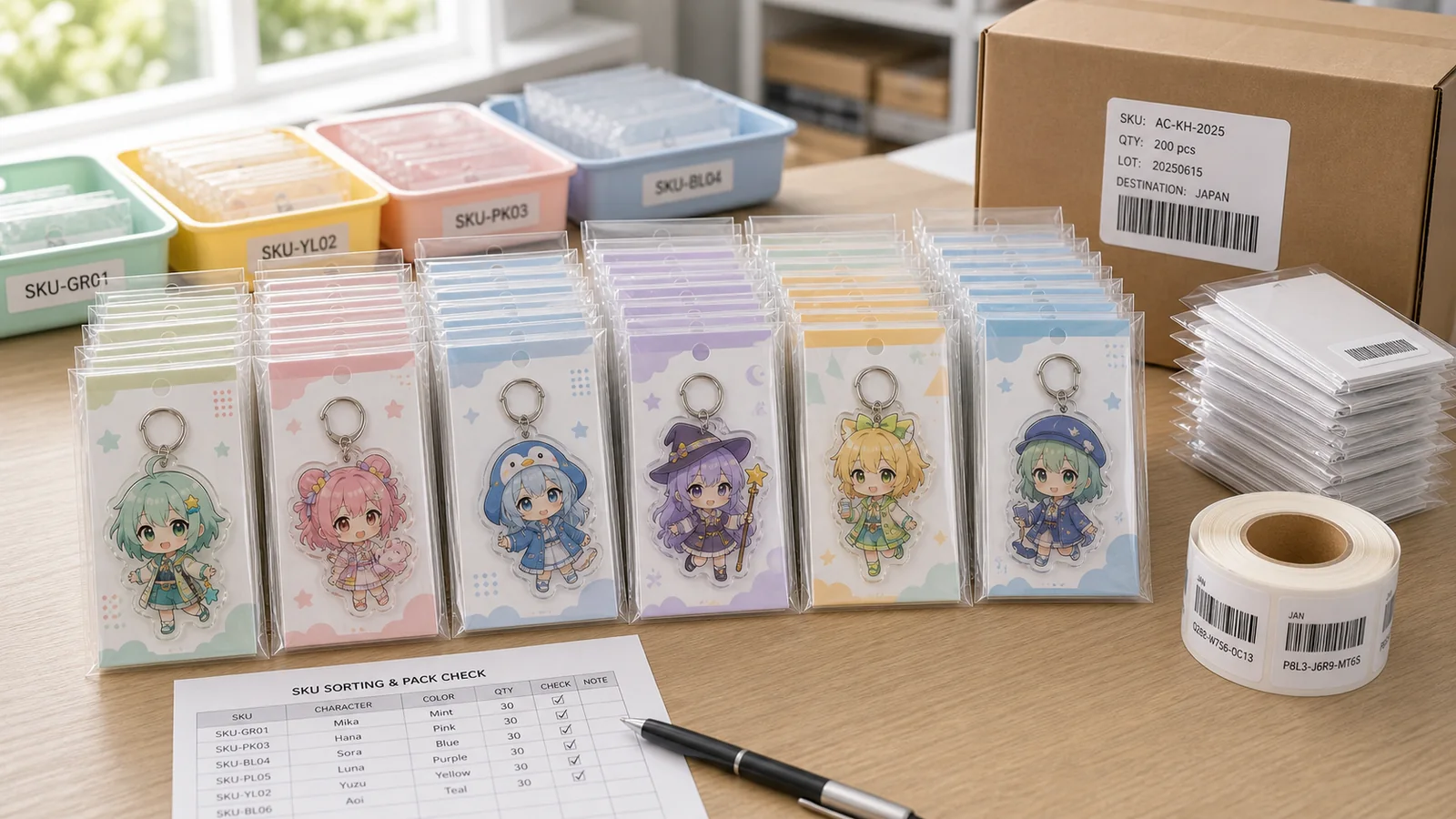
Multi-SKU sorting and final matching flow
SKU code, character name, backing card file, JAN, quantity, and carton allocation are managed in one sheet.
Acrylic bodies, backing cards, bags, and hardware are separated by SKU before packing.
After packing, quantity, JAN, carton label, and destination are matched and recorded for shipment.
Acrylic keychain packaging patterns we can review
| Category | Examples | Packaging focus |
|---|---|---|
| Standard acrylic keychain | Character shape, charm, logo shape | Hardware direction, clear surface rubbing, movement inside the bag |
| Double-sided print | Front/back designs, transparent expression | Rubbing on both sides and contact with printed surfaces |
| Irregular cut shape | Complex silhouette, thin protrusions, cut-out shapes | Edge chipping, EPE cut-out feasibility, divider needs |
| Acrylic plus metal parts | Clasp, ball chain, plate accessory | Metal-to-acrylic contact, bag fixation, anti-oxidation review |
| Random or blind goods | Lottery goods, trading goods, online exclusives | Mix-ratio sheet, SKU table, carton allocation, JAN control |
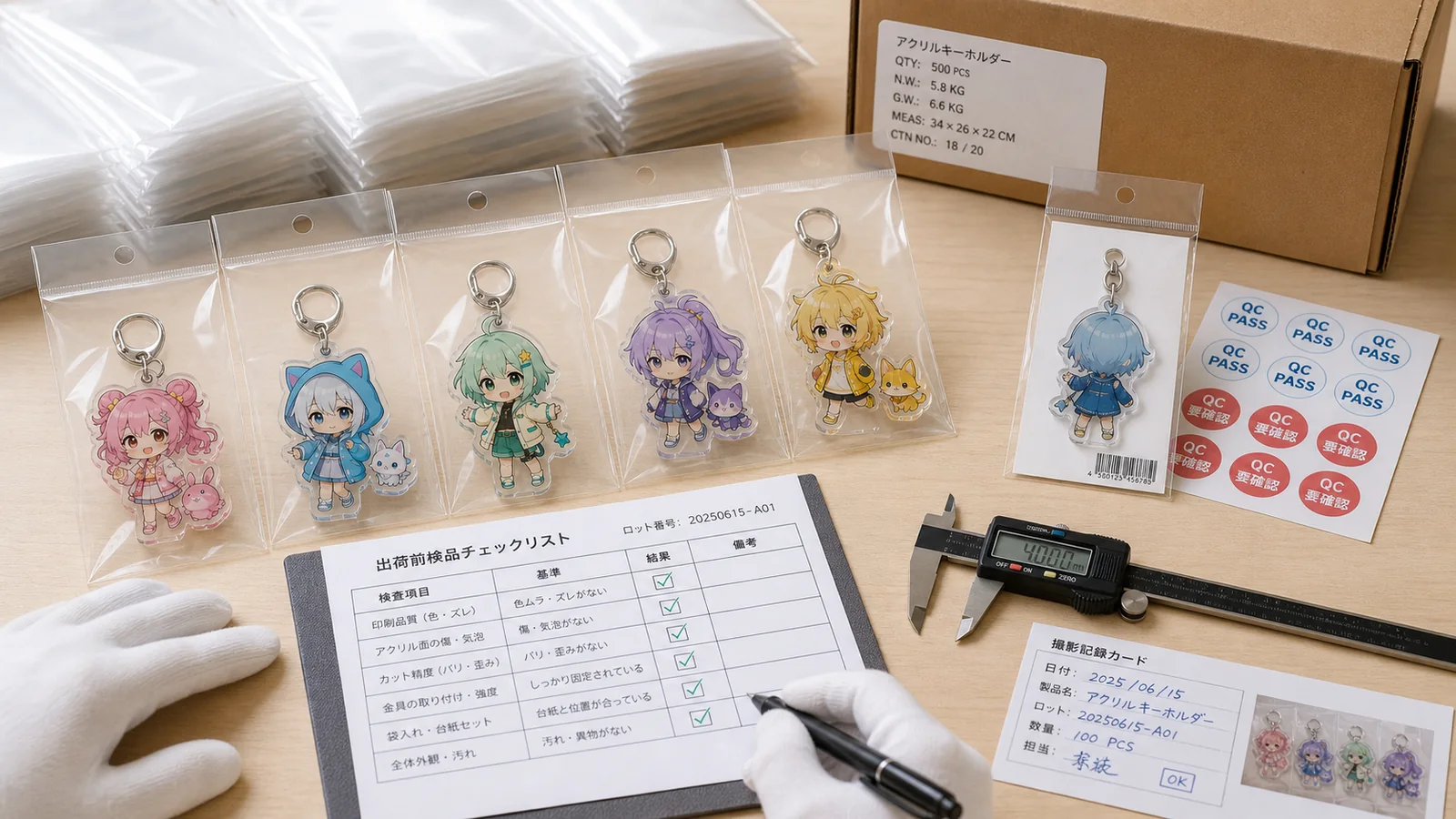
Inspection records separate appearance, packaging, and shipment data
The required inspection depth depends on sales channel, quantity, price range, and destination. Appearance, backing card, JAN, carton label, and quantity consistency should all be reviewed.
Appearance
Scratches, dust, bubbles, color unevenness, print alignment, and protective film condition.
Packaging
Bag, seal, backing card, JAN, hardware direction, and SKU quantity.
Workflow from specification review to Japan delivery
Design, size, thickness, hardware, SKU, and packaging conditions.
Film, OPP, EPE, backing card, and carton are organized per project.
Appearance, hardware, movement inside the bag, and backing-card fit.
SKU sheet, packing instruction, inspection items, and carton label.
Appearance, packaging, quantity, JAN, and labels are checked.
Shipment documents, destination, delivery terms, and customs conditions.
Warehouse, EC logistics center, event venue, or split destination.
Packaging and inspection notes are kept for the next production run.
Frequently Asked Questions
Which projects need scratch-prevention packaging for acrylic keychains?
It is useful for e-commerce sales, event merchandise, IP goods, random packs, and multi-character series where unboxing appearance and SKU accuracy matter.
Are protective film and individual bags always required?
They depend on the use case, target price, sales channel, and shipping route. For transparent acrylic, double-sided print, or metal hardware, film, OPP bags, and cushioning should be reviewed together.
Can metal hardware scratch the acrylic part?
Yes, rings or clasps may rub the acrylic body during packing or shipping. Hardware direction, bag fit, and backing-card placement should be checked at sample stage.
How do you reduce multi-SKU mix-ups?
SKU sheets, backing card files, JAN numbers, quantities, and carton labels are connected before packing. The control method is adjusted according to SKU count and delivery destinations.
How is breakage during overseas shipping addressed?
Individual packaging can be combined with EPE, bubble wrap, dividers, reinforced cartons, and pallet fixing according to the project. Carton strength and stacking method are also reviewed.
Can inspection reports be provided?
If needed, photo records and checklists for appearance, packaging, quantity, SKU matching, and carton labels can be prepared. The submission format is agreed per project.
What is checked for DDP delivery?
Destination, carton size, weight, SKU quantity, invoice, packing list, labels, duties, and delivery feasibility are reviewed before shipment.
Can packaging be discussed for small runs?
Yes. The practical packaging method depends on quantity, SKU count, backing card use, and bag requirements.
Can REACH or RoHS documents be arranged?
Required standards and submission destinations are reviewed first. Material information or third-party testing feasibility can be checked without making unsupported blanket certification claims.
What information is needed for quotation?
Design files, size, thickness, hardware, quantity, SKU count, packaging style, JAN needs, destination, and schedule help us quote faster.
Let us organize your acrylic keychain packaging specification
If you have design files, rough artwork, SKU count, backing card ideas, and destination conditions, we can review scratch-prevention packaging, shipping protection, and inspection items together.
Related pages
Decision framework: Acrylic Keychain Packaging
Use this acrylic keychain packaging to decide and document bag and backing-card dimensions, protective film removal rule, hardware isolation, SKU label and barcode position, sealed-pack scratch check, and inner-box movement control. The result should be an approval record that procurement, artwork, production, QC and packaging teams can apply to the same SKU.
Search intent boundary: This page owns the informational and risk-reduction intent for acrylic keychain packaging. Commercial product terms remain on the related product pages, while this guide answers the pre-production decision.
What to lock before approval
A reliable decision has three parts: a written criterion, a representative finished sample and a repeatable verification method. Screenshots or verbal approvals are not enough when the decision affects material, fit, color, assembly or pack-out. The six controls below should appear in the same quotation, sample record and inspection instruction.
| Decision | What the buyer must define | Acceptable approval evidence |
|---|---|---|
| Bag and Backing-Card Dimensions | Define bag and backing-card dimensions by SKU before quotation and do not replace it with a vague good-quality instruction. | Keep an approved dimensioned specification or controlled reference that production and QC can identify during bulk release. |
| Protective Film Removal Rule | Define protective film removal rule by SKU before quotation and do not replace it with a vague good-quality instruction. | Keep an approved artwork proof and component record that production and QC can identify during bulk release. |
| Hardware Isolation | Define hardware isolation by SKU before quotation and do not replace it with a vague good-quality instruction. | Keep an approved representative physical sample that production and QC can identify during bulk release. |
| SKU Label and Barcode Position | Define SKU label and barcode position by SKU before quotation and do not replace it with a vague good-quality instruction. | Keep an approved sellable pack or use-condition check that production and QC can identify during bulk release. |
| Sealed-Pack Scratch Check | Define sealed-pack scratch check by SKU before quotation and do not replace it with a vague good-quality instruction. | Keep an approved inspection photo and measured result that production and QC can identify during bulk release. |
| Inner-Box Movement Control | Define inner-box movement control by SKU before quotation and do not replace it with a vague good-quality instruction. | Keep an approved SKU-linked bulk report and carton trace that production and QC can identify during bulk release. |
Failure risks to close
- Bag and Backing-Card Dimensions is not controlled: suppliers can interpret the same request differently and the quotation is not comparable.
- Protective Film Removal Rule is not controlled: the physical sample can pass while the wrong revision enters bulk production.
- Hardware Isolation is not controlled: packing or use conditions reveal a failure that a loose visual sample did not show.
- SKU Label and Barcode Position is not controlled: the buyer cannot separate an isolated defect from a repeated batch or SKU problem.
Quote inputs
- project name and target market for Acrylic Keychain Packaging
- editable artwork and the latest revision code
- finished dimensions and quantity for every design
- bag and backing-card dimensions
- protective film removal rule
- hardware isolation
- individual packaging, label and barcode requirements
- inspection evidence and acceptance criteria
- delivery destination and required arrival date
Sample-to-bulk control
Approve a finished sample that represents the intended artwork, construction and sellable package. Record the sample date, revision, dimensions, material or component codes, visual limits and function checks. If a later change affects artwork, material, hardware, assembly or packaging, identify the impacted SKUs and obtain a new approval instead of relying on the earlier sample.
For bulk inspection, use the same viewing conditions, measurement points and pass/fail language used during approval. The report should identify the purchase order, SKU, batch, sampled quantity and result. Photographs are useful evidence only when they show the relevant scale, lighting, label or test condition and can be traced to the inspected lot.
When comparing quotations, separate confirmed specifications from assumptions. Ask each supplier to identify exclusions, proposed substitutes, sampling scope, packaging labor and delivery basis. A lower figure is not equivalent when it omits a component, uses a different inspection level or assumes that several designs can share one uncontrolled pack. Close those differences before price approval so the purchase decision remains auditable.