
ACRYLIC MATERIAL & THICKNESS GUIDE
Acrylic Thickness Guide
Choose acrylic material and thickness by use case for original IP acrylic goods.

Thickness affects appearance, durability, and cost
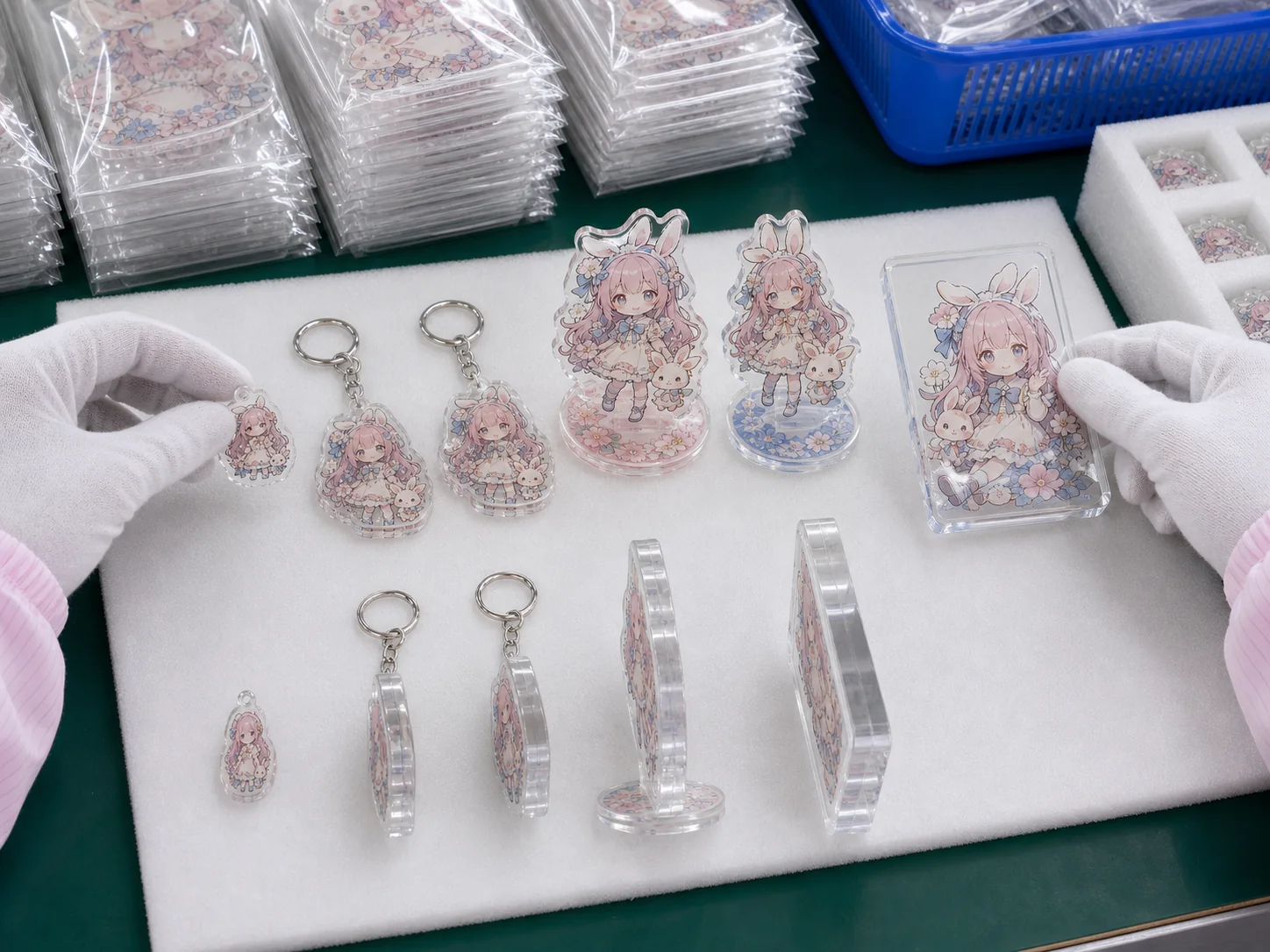
In acrylic goods OEM, changing the thickness can change the product impression, strength, weight, shipping cost, and unit price. Even with the same original IP artwork, a thin charm and a thicker display plate can feel like very different products.
Common choices are around 2 mm, 3 mm, and 5 mm, but the best thickness depends on the product category, size, sales method, and packaging conditions.

Recommended thickness by use case
| Around 2 mm | Suitable for small charms, lightweight novelty items, and products where cost control is important. |
|---|---|
| Around 3 mm | Often used for acrylic keychains, standard acrylic stands, and official merchandise. |
| Around 5 mm | Suitable for plates that should show thickness, display use, or products that need a more stable feel. |
| Special materials | For hologram, glitter, aurora, and similar materials, confirm both material availability and matching thickness before sampling. |
How to choose by product category
Acrylic stands
- Stability when displayed upright
- Fit with the base slot
- Main body size
Acrylic keychains
- Easy to carry
- Strength around the hole
- Balance with the metal fitting
Charms and plates
- Lightweight feel or premium thickness
- Appearance of the clear edge
- Crack risk during packing
What to check before mass production
When deciding thickness, check not only the unit price but also the risk of damage during transportation, compatibility with OPP bags and backing cards, and outer carton weight. A thicker board can make the product feel more premium, while also increasing weight and cost.
If multiple SKUs are produced together, using the same thickness can simplify management. If the product categories are different, it may be more natural to assign a different thickness for each use case.
Production-to-delivery workflow
Frequently Asked Questions
What thickness is common for acrylic stands?
Around 3 mm is often used, but the final choice should be adjusted according to the stand size and base-slot design.
Is thicker acrylic always stronger?
Thickness affects strength, but shape, hole position, and packaging method also matter. Thickness alone cannot prevent every type of breakage.
Can special materials be selected by thickness?
Available options depend on material inventory and lot conditions. We confirm the requested material and thickness together before sampling.
Related Products and Pages
Discuss Acrylic Goods OEM for Your Original IP Project
Share your artwork files, target size, quantity, SKU count, packaging requirements, and delivery destination so we can organize the specifications and prepare a quotation.
Decision framework: Acrylic Thickness Guide
Use this acrylic thickness guide to decide and document product load and use case, nominal sheet thickness, tab and slot compatibility, edge and weight expectation, finished sample measurement, and pack and shipping weight. The result should be an approval record that procurement, artwork, production, QC and packaging teams can apply to the same SKU.
Search intent boundary: This page owns the informational and risk-reduction intent for acrylic thickness guide. Commercial product terms remain on the related product pages, while this guide answers the pre-production decision.
What to lock before approval
A reliable decision has three parts: a written criterion, a representative finished sample and a repeatable verification method. Screenshots or verbal approvals are not enough when the decision affects material, fit, color, assembly or pack-out. The six controls below should appear in the same quotation, sample record and inspection instruction.
| Decision | What the buyer must define | Acceptable approval evidence |
|---|---|---|
| Product Load and Use Case | Define product load and use case by SKU before quotation and do not replace it with a vague good-quality instruction. | Keep an approved dimensioned specification or controlled reference that production and QC can identify during bulk release. |
| Nominal Sheet Thickness | Define nominal sheet thickness by SKU before quotation and do not replace it with a vague good-quality instruction. | Keep an approved artwork proof and component record that production and QC can identify during bulk release. |
| Tab and Slot Compatibility | Define tab and slot compatibility by SKU before quotation and do not replace it with a vague good-quality instruction. | Keep an approved representative physical sample that production and QC can identify during bulk release. |
| Edge and Weight Expectation | Define edge and weight expectation by SKU before quotation and do not replace it with a vague good-quality instruction. | Keep an approved sellable pack or use-condition check that production and QC can identify during bulk release. |
| Finished Sample Measurement | Define finished sample measurement by SKU before quotation and do not replace it with a vague good-quality instruction. | Keep an approved inspection photo and measured result that production and QC can identify during bulk release. |
| Pack and Shipping Weight | Define pack and shipping weight by SKU before quotation and do not replace it with a vague good-quality instruction. | Keep an approved SKU-linked bulk report and carton trace that production and QC can identify during bulk release. |
Failure risks to close
- Product Load and Use Case is not controlled: suppliers can interpret the same request differently and the quotation is not comparable.
- Nominal Sheet Thickness is not controlled: the physical sample can pass while the wrong revision enters bulk production.
- Tab and Slot Compatibility is not controlled: packing or use conditions reveal a failure that a loose visual sample did not show.
- Edge and Weight Expectation is not controlled: the buyer cannot separate an isolated defect from a repeated batch or SKU problem.
Quote inputs
- project name and target market for Acrylic Thickness Guide
- editable artwork and the latest revision code
- finished dimensions and quantity for every design
- product load and use case
- nominal sheet thickness
- tab and slot compatibility
- individual packaging, label and barcode requirements
- inspection evidence and acceptance criteria
- delivery destination and required arrival date
Sample-to-bulk control
Approve a finished sample that represents the intended artwork, construction and sellable package. Record the sample date, revision, dimensions, material or component codes, visual limits and function checks. If a later change affects artwork, material, hardware, assembly or packaging, identify the impacted SKUs and obtain a new approval instead of relying on the earlier sample.
For bulk inspection, use the same viewing conditions, measurement points and pass/fail language used during approval. The report should identify the purchase order, SKU, batch, sampled quantity and result. Photographs are useful evidence only when they show the relevant scale, lighting, label or test condition and can be traced to the inspected lot.
When comparing quotations, separate confirmed specifications from assumptions. Ask each supplier to identify exclusions, proposed substitutes, sampling scope, packaging labor and delivery basis. A lower figure is not equivalent when it omits a component, uses a different inspection level or assumes that several designs can share one uncontrolled pack. Close those differences before price approval so the purchase decision remains auditable.