Acrylic Goods Manufacturing Cost Guide
1. Reasons why the unit price changes in acrylic goods OEM
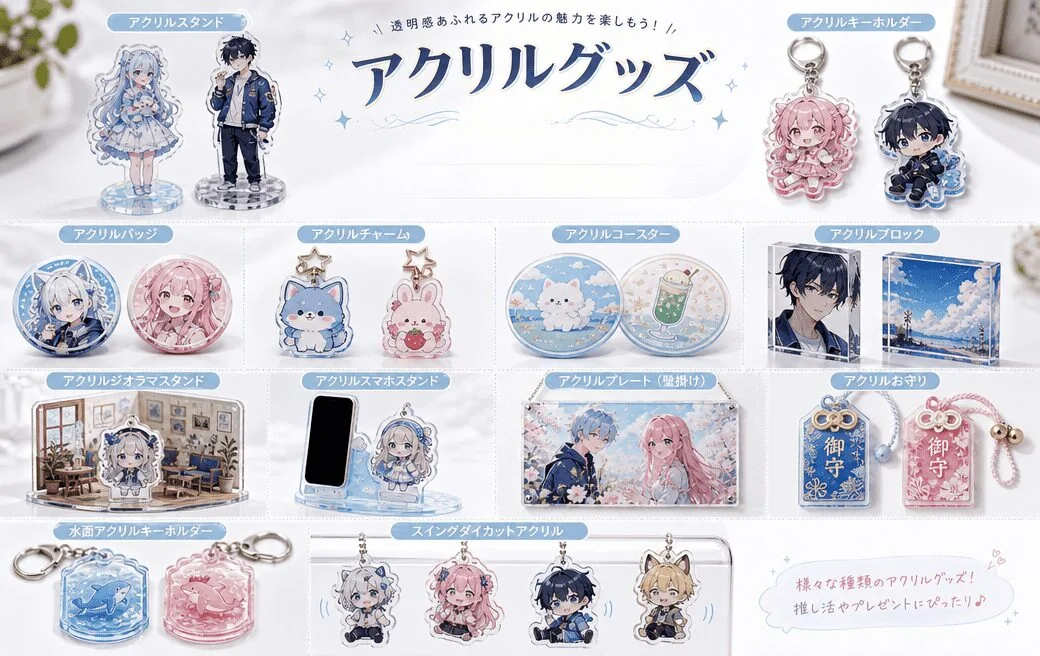
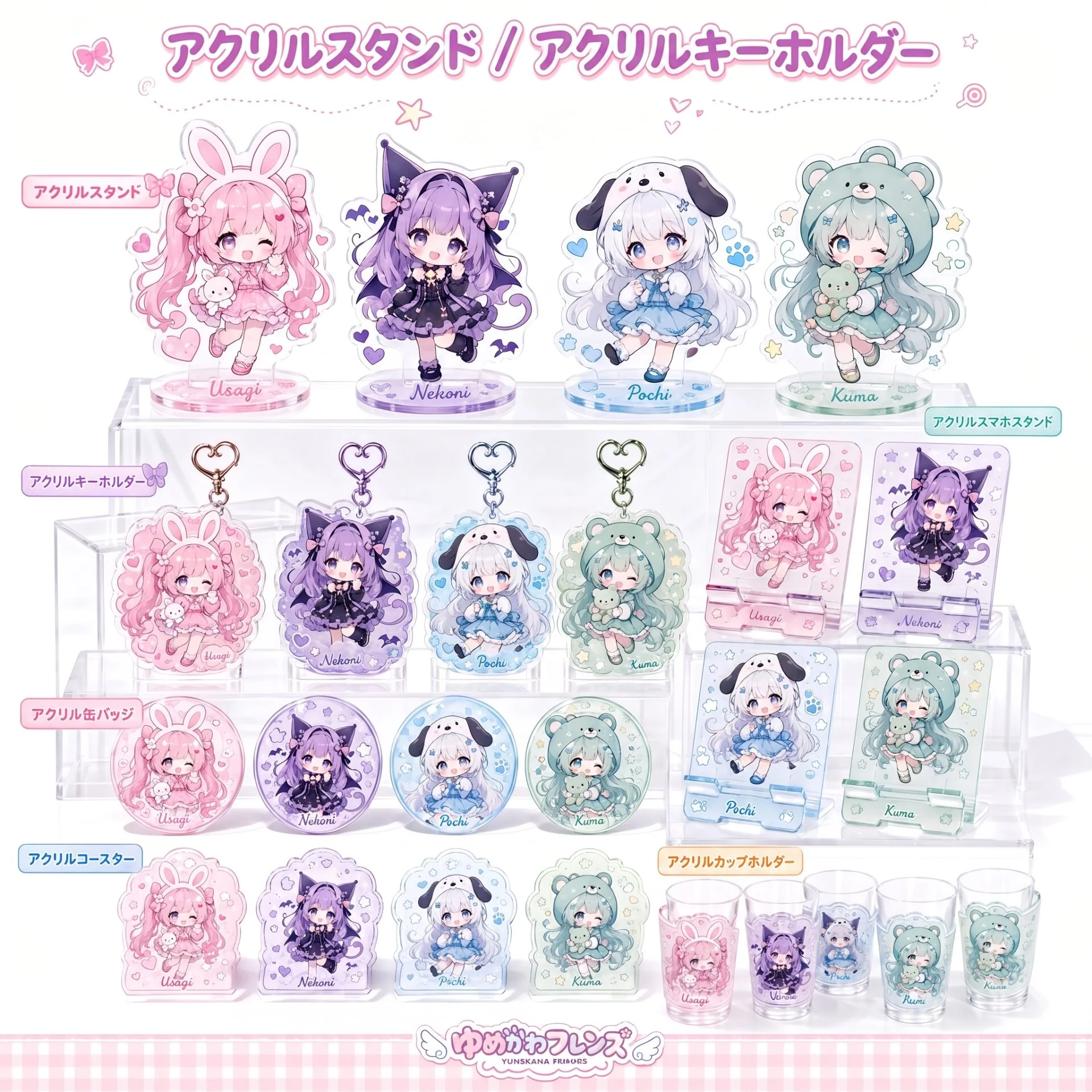
Acrylic stands, acrylic key chains, and acrylic magnets are standard categories often used for anime goods, oshi-katsu goods, lottery prizes, and event merchandise. It is relatively easy to mass produce and is suitable for developing multiple characters.
On the other hand, even for the same acrylic goods, the unit price varies greatly depending on the size, thickness, printing method, cut shape, pedestal, metal fittings, packaging, and number of SKUs.
In order to lower the unit price, it is important not to simply reduce the specifications, but to create a design that is easy to mass produce while maintaining the appearance of a product for sale.
In this article, we will explain the factors that affect the unit price and design points for reducing costs when mass producing OEM acrylic goods in a Chinese factory.
2. Differences between Acstar, Ackey, and Magnet
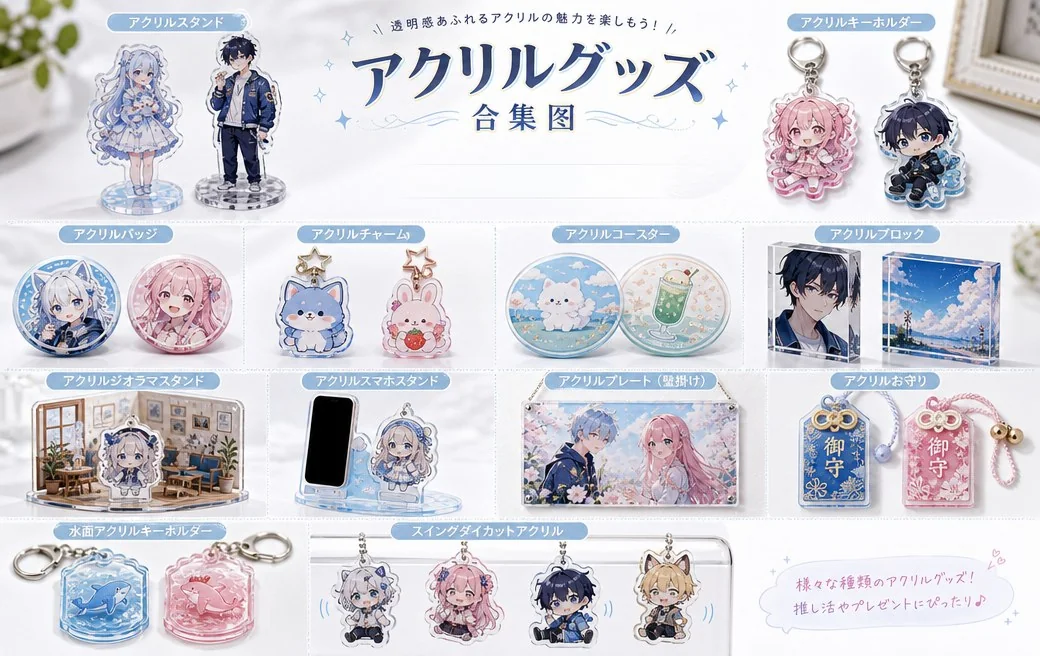
The design of acrylic goods changes depending on the purpose.
| Product category | Main uses | Specification points |
|---|---|---|
| acrylic stand | Over-the-counter sales, promotions, lottery prizes | Pedestal, insertion accuracy, size feeling |
| acrylic keychain | Random products, event sales, novelties | Metal fittings, double-sided printing, mount, packaging |
| acrylic magnet | Retail miscellaneous goods, regional limited products, prizes | Magnetic force, thickness, shape, mount |
| diorama acrylic | High price products, limited products | Multiple parts, backgrounds, and assembly |
First, decide which product category will be your main focus and which categories will be combined in the same project.
3. Main specifications that affect unit price
The following items have a major influence on the estimate for acrylic goods.
- size
- Thickness
- Cut line complexity
- Single-sided printing / double-sided printing
- Presence of white version
- special acrylic
- Lamé, hologram, aurora processing
- Shape of pedestal
- Type of metal fittings
- Mount, OPP packaging
- Number of SKUs
- Total quantity
If you want to lower the unit price, it is important to check these one by one and distinguish between necessary specifications and specifications that can be cut.
4. Design points for size, thickness, and shape
For acrylic goods, size and thickness are directly linked to unit price. The larger the size, the higher the material cost, and the more complex the cut line, the longer the processing time will be.
Design points:
- Same size range for the same series
- The pedestal and background parts will be shared.
- Avoid overly complex cut lines
- Reduce small parts and thin protrusions
- Do not increase the thickness more than necessary
- Make it easy to pack
In the case of Acstar, it is tempting to increase the size to emphasize appearance, but you also need to consider the stability of the pedestal, the risk of damage during transportation, and the packaging size.
5. How to choose printing, special processing, pedestals, and metal fittings
Printing specifications
Single-sided printing makes it easier to reduce unit costs, and double-sided printing makes it easier to increase product value. Choose according to how the character looks and the selling price.
Check items:
- Single-sided printing / double-sided printing
- White version range
- color, density
- Detail reproduction
- Printing deviation tolerance range
Special processing
Lamé, hologram, aurora, colored acrylic, etc. are effective for differentiation, but if they are included in all SKUs, the unit price will increase.
The recommended method is to use special processing only for limited edition products and top prizes, and to mass produce SKUs with common specifications.
Pedestal/metal fittings
The pedestal for acrylic stand and the metal fittings for Ackey affect the impression of quality.
Check items:
- Pedestal insertion accuracy
- Thickness and shape of the pedestal
- Nasukan, ball chain, crab crab
- Metal color
- Installation position
- Damage prevention during transportation
6. How to reduce costs through multi-SKU mass production
For anime goods and oshi-katsu goods, multiple characters are often created at the same time. In this case, the higher the number of SKUs, the higher the management cost.
How to keep costs down:
- use common size
- use a common pedestal
- Use a common mount
- Use common packaging
- Unify metal fittings
- Limit special processing to some SKUs
- Create a SKU table with images
- Determine the quantity for each pattern early
In particular, common pedestals and common mounts are effective in both cost and progress management. It also makes it easier to create a unified look, making it easier to develop a series of products.
7. Concept of packaging, mounts, and JAN stickers
For acrylic goods, not only the product itself but also the packaging is important. Packaging specifications differ for in-store sales, event sales, lottery prizes, and e-commerce sales.
Check items:
- OPP bag
- Mount included
- JAN seal
- blind packaging
- set assembly
- hanging hole
- Caution display
- Quantity per carton
While the mount increases the product value, it also incurs printing and enclosing costs. We design according to the product rank, such as using simple mounts for low-priced products and highly designed mounts for limited edition products.
8. Information to prepare before quotation
To speed up your estimate process, it will be helpful to have the following information ready:
- Product category
- design data
- Desired size
- acrylic thickness
- Printing surface
- Presence of pedestal and metal fittings
- Number of SKUs
- Quantity by SKU
- Packaging specifications
- Desired delivery date
- Delivery destination
Even if the design is not finalized yet, if you know the reference image, desired size, quantity, and purpose of sale, you can organize the approximate specifications.
9. Frequently asked questions
QIs it possible to make Akusuta and Aki with the same project?
yes. You can use the same design assets and change the size, hardware, pedestal, and packaging.
QWhat is the most effective way to lower unit prices?
It is effective to standardize the size, thickness, pedestal, packaging, and metal fittings, and group the quantities by SKU.
QCan I use special acrylic?
Consultation is possible depending on the content of the case. Lamé, holograms, colored acrylic, etc. can be used for limited edition products or some SKUs to help differentiate them.
QCan you handle blind packaging?
It is possible. We will organize the quantity by design, mix rate, mount, JAN sticker, and BOX management in advance.
QIs it possible to deliver DDP to Japan?
It's possible. After confirming the delivery destination, quantity, carton size, and desired delivery date, you can consider a quote based on DDP conditions.
10. Related product page
Please contact us first to arrange mass production specifications.
If you send us information on the product category, quantity, number of SKUs, desired delivery date, and delivery destination, we will organize and guide you through the specifications, inspection, packaging, and delivery conditions that are easy to mass produce.
Click here for free estimate and specification consultationDecision framework: Acrylic Goods Manufacturing Cost Guide
Use this acrylic goods manufacturing cost guide to decide and document quantity and SKU mix, sheet yield and finished size, print and special finish, hardware and assembly labor, individual packaging method, and freight and delivery schedule. The result should be an approval record that procurement, artwork, production, QC and packaging teams can apply to the same SKU.
Search intent boundary: This page owns the informational and risk-reduction intent for acrylic goods manufacturing cost. Commercial product terms remain on the related product pages, while this guide answers the pre-production decision.
What to lock before approval
A reliable decision has three parts: a written criterion, a representative finished sample and a repeatable verification method. Screenshots or verbal approvals are not enough when the decision affects material, fit, color, assembly or pack-out. The six controls below should appear in the same quotation, sample record and inspection instruction.
| Decision | What the buyer must define | Acceptable approval evidence |
|---|---|---|
| Quantity and SKU Mix | Define quantity and SKU mix by SKU before quotation and do not replace it with a vague good-quality instruction. | Keep an approved dimensioned specification or controlled reference that production and QC can identify during bulk release. |
| Sheet Yield and Finished Size | Define sheet yield and finished size by SKU before quotation and do not replace it with a vague good-quality instruction. | Keep an approved artwork proof and component record that production and QC can identify during bulk release. |
| Print and Special Finish | Define print and special finish by SKU before quotation and do not replace it with a vague good-quality instruction. | Keep an approved representative physical sample that production and QC can identify during bulk release. |
| Hardware and Assembly Labor | Define hardware and assembly labor by SKU before quotation and do not replace it with a vague good-quality instruction. | Keep an approved sellable pack or use-condition check that production and QC can identify during bulk release. |
| Individual Packaging Method | Define individual packaging method by SKU before quotation and do not replace it with a vague good-quality instruction. | Keep an approved inspection photo and measured result that production and QC can identify during bulk release. |
| Freight and Delivery Schedule | Define freight and delivery schedule by SKU before quotation and do not replace it with a vague good-quality instruction. | Keep an approved SKU-linked bulk report and carton trace that production and QC can identify during bulk release. |
Failure risks to close
- Quantity and SKU Mix is not controlled: suppliers can interpret the same request differently and the quotation is not comparable.
- Sheet Yield and Finished Size is not controlled: the physical sample can pass while the wrong revision enters bulk production.
- Print and Special Finish is not controlled: packing or use conditions reveal a failure that a loose visual sample did not show.
- Hardware and Assembly Labor is not controlled: the buyer cannot separate an isolated defect from a repeated batch or SKU problem.
Quote inputs
- project name and target market for Acrylic Goods Manufacturing Cost Guide
- editable artwork and the latest revision code
- finished dimensions and quantity for every design
- quantity and SKU mix
- sheet yield and finished size
- print and special finish
- individual packaging, label and barcode requirements
- inspection evidence and acceptance criteria
- delivery destination and required arrival date
Sample-to-bulk control
Approve a finished sample that represents the intended artwork, construction and sellable package. Record the sample date, revision, dimensions, material or component codes, visual limits and function checks. If a later change affects artwork, material, hardware, assembly or packaging, identify the impacted SKUs and obtain a new approval instead of relying on the earlier sample.
For bulk inspection, use the same viewing conditions, measurement points and pass/fail language used during approval. The report should identify the purchase order, SKU, batch, sampled quantity and result. Photographs are useful evidence only when they show the relevant scale, lighting, label or test condition and can be traced to the inspected lot.
When comparing quotations, separate confirmed specifications from assumptions. Ask each supplier to identify exclusions, proposed substitutes, sampling scope, packaging labor and delivery basis. A lower figure is not equivalent when it omits a component, uses a different inspection level or assumes that several designs can share one uncontrolled pack. Close those differences before price approval so the purchase decision remains auditable.