IP Collaboration Acrylic Goods OEM
Licensed IP Acrylic Merchandise
For anime, game, and character IP collaboration projects, procurement teams need to manage more than the acrylic item itself. Approval files, SKU sheets, package labeling, QC criteria, and channel-specific delivery conditions should be aligned before mass production.
Images are original local preview assets using fictional cute anime IP. No real IP, brands, certification marks, or watermarks are used.
SHORT ANSWER
For IP collaboration acrylic goods, lock approval and SKU control before treating the project as a simple product order.
When acrylic standees, keychains, charms, panels, and bonus items are produced together, common risks are approval rollback, mixed SKUs, packaging mismatch, and delivery unit errors rather than the acrylic material alone.
- Confirm the approval route for each licensor and sales channel
- Manage SKU sheets and packaging specifications in the same version
- Prepare quantity, packaging, and delivery units before quotation
PROJECT FIT
IP collaboration projects this acrylic goods OEM page is built for
This page is for projects with multiple products, SKUs, and sales channels, not only a single generic acrylic item.
Events and pop-up retail
Plan SKU quantity, venue delivery, backing cards, OPP bags, and carton labels before short-term sales begin.
Anime and game IP campaigns
Track artwork version, color checks, white ink, and cut line approval so revision rounds do not disrupt production.
EC, kuji, and retail programs
Separate JAN labels, backing cards, blind packaging, inner-box quantity, and set-building rules by sales channel.
RISK CONTROL
Mass production risks to clarify before acrylic goods manufacturing
IP collaboration projects cannot be judged only by a cute product mockup. Approval, SKU, packaging, and QC gaps should be reviewed before production starts.
| Area | Common issue | What to define in advance | Priority |
|---|---|---|---|
| Approval and version control | Samples or production proceed from outdated artwork files | Latest file number, approver, and revision history linked to the SKU sheet | High |
| SKU and assortment | Character quantity or random assortment ratios are mixed | SKU code, unit count, set rules, and reserve quantity logic | High |
| Packaging and labels | JAN labels, backing cards, warning text, or carton labels do not fit the sales channel | Packaging specifications and label placement for each channel | Medium |
| Quality criteria | Scratch, color difference, cut edge, or base fitting standards remain unclear | Acceptable range and QC checkpoints confirmed at sample approval | Medium |
APPROVAL WORKFLOW
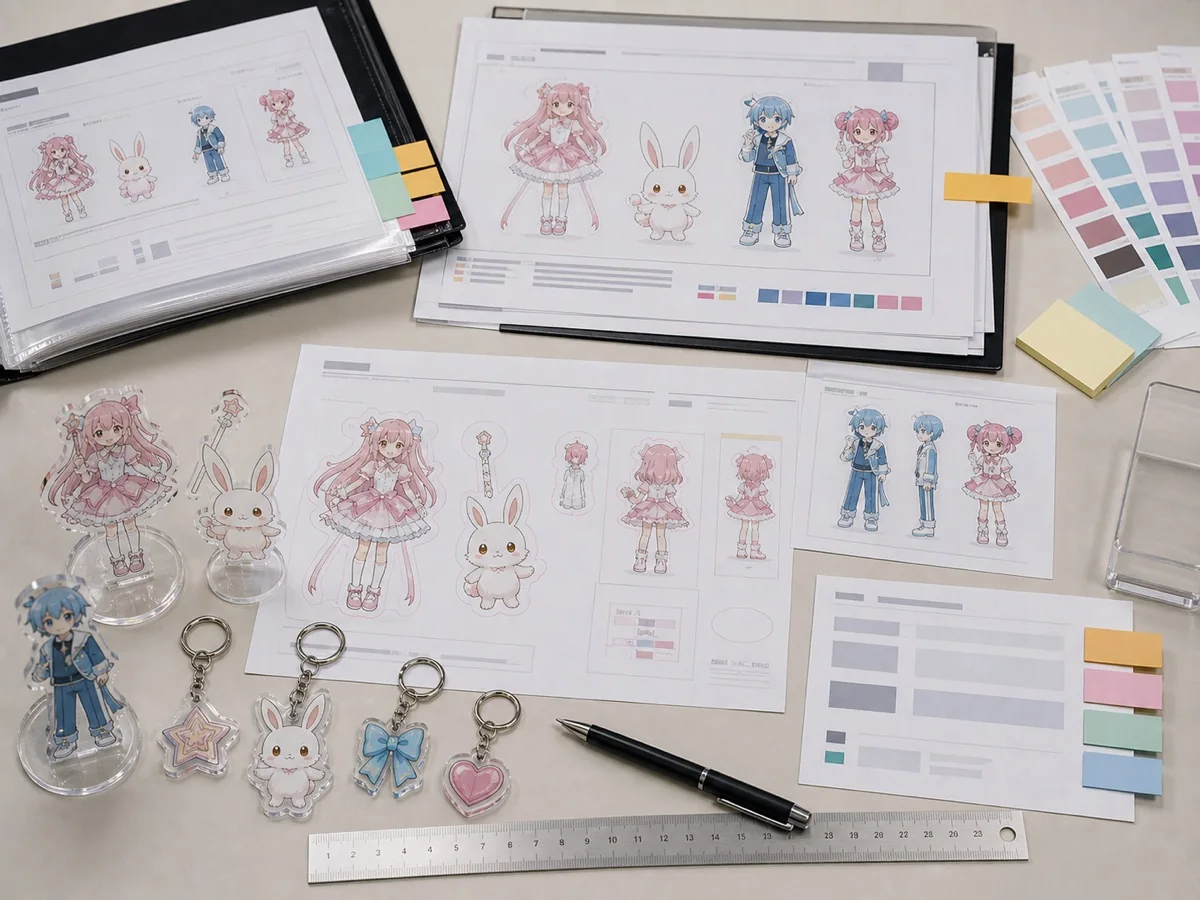
Manage artwork, licensor review, and sample approval in one workflow
When a project needs several approval rounds, data review and sample review should be recorded separately. Visual approval should be checked together with white ink, cut lines, acrylic thickness, fittings, bases, and packaging.
- Confirm project conditionsProduct types, sales channels, planned quantity, and approval stakeholders.
- Review artwork dataWhite ink, cut lines, color, SKU differences, and restricted expressions.
- Check physical samplesColor, transparency, metal fittings, bases, and packaging with real samples.
- Lock before mass productionSKU sheet, packaging specification, QC criteria, and delivery unit.
SKU CONTROL
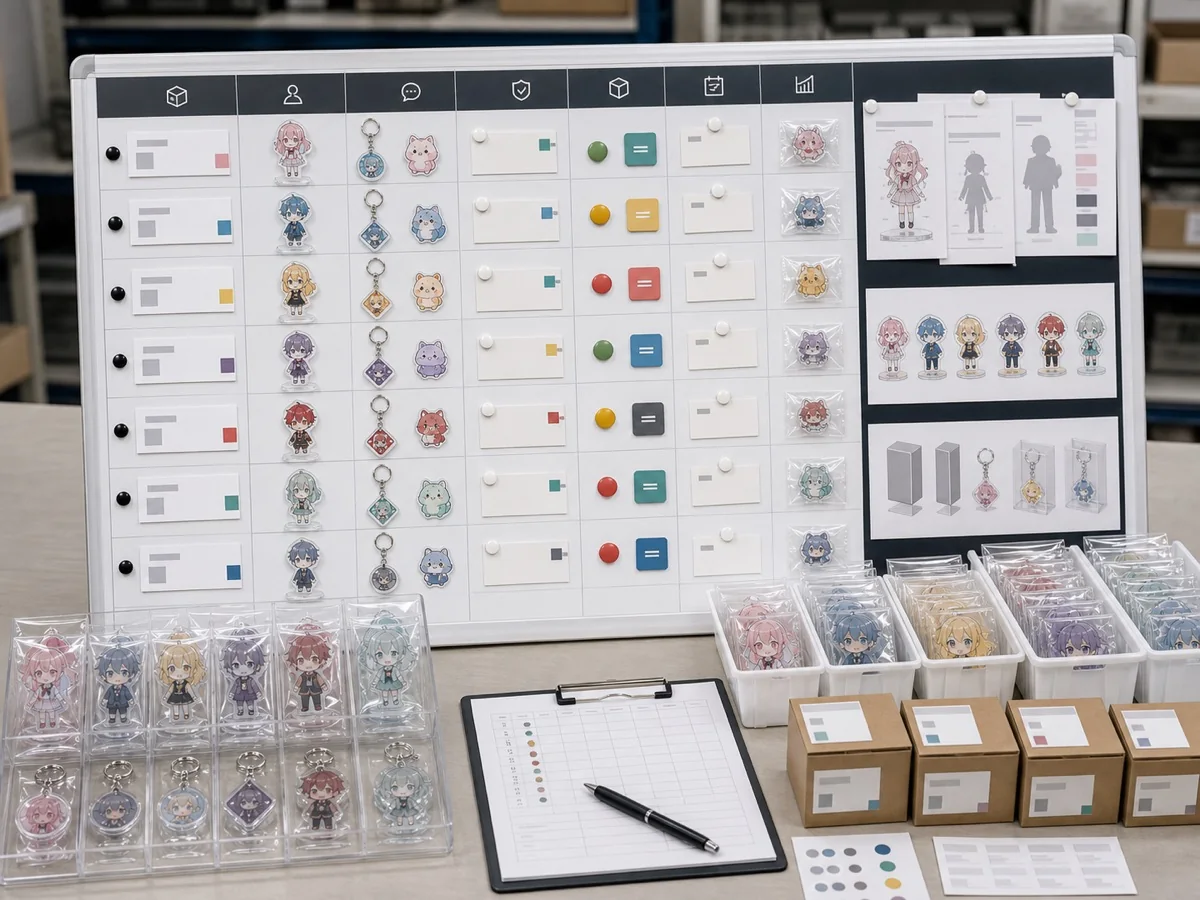
The SKU sheet connects product specs, approval status, and packaging rules
For IP collaboration acrylic goods, the SKU sheet should not be only a quantity list. It should connect approval status, package requirements, and delivery units in one controlled document.
| Control item | What to check | Quotation impact |
|---|---|---|
| SKU count | Differences by character, prize rank, and sales set | Affects file count, QC, and sorting work |
| Random assortment | Mix ratio, inner bag, carton, and set conditions | Affects packaging labor and sorting method |
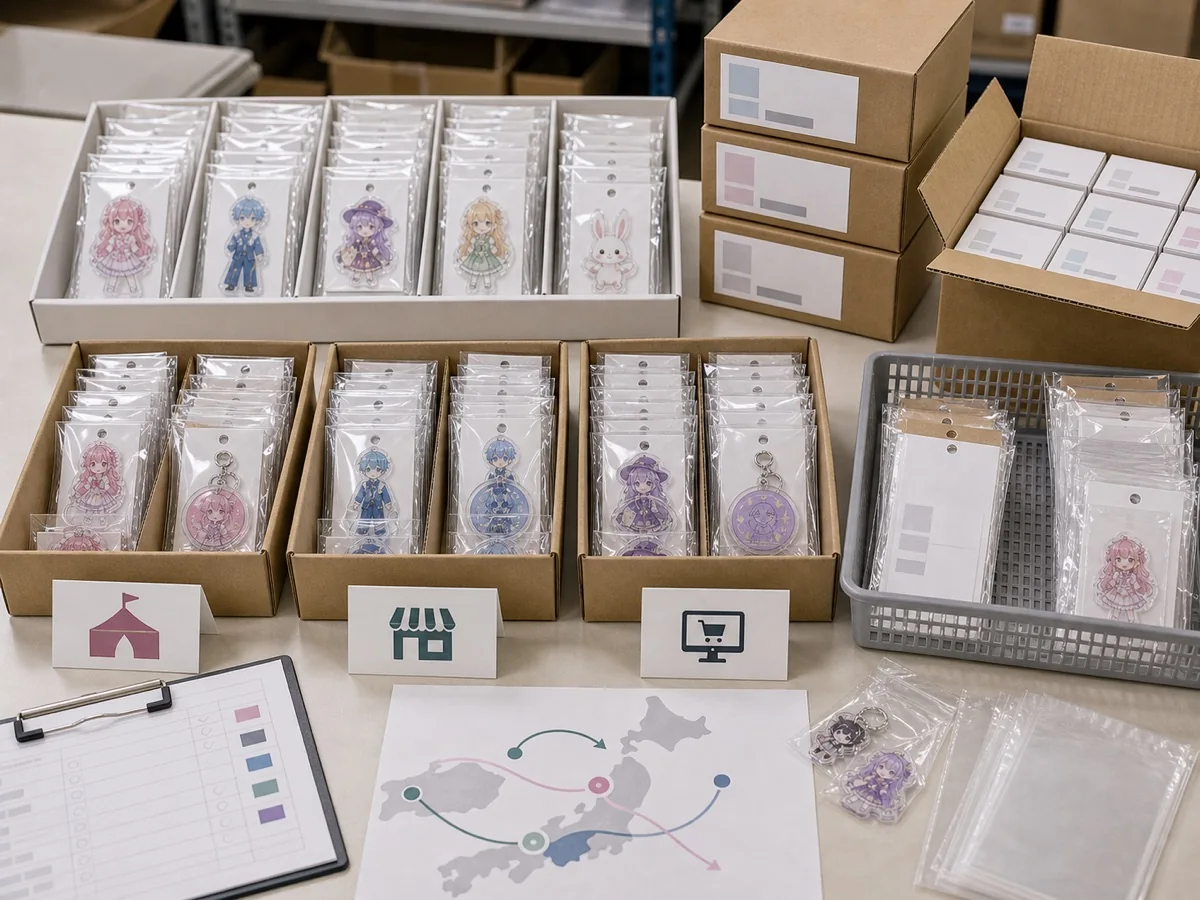
| Channel-specific specs | Retail, EC, event, and kuji prize differences | Affects labels, backing cards, and packing units |
PRODUCT LINEUP
Build an IP collaboration lineup from multiple acrylic goods formats
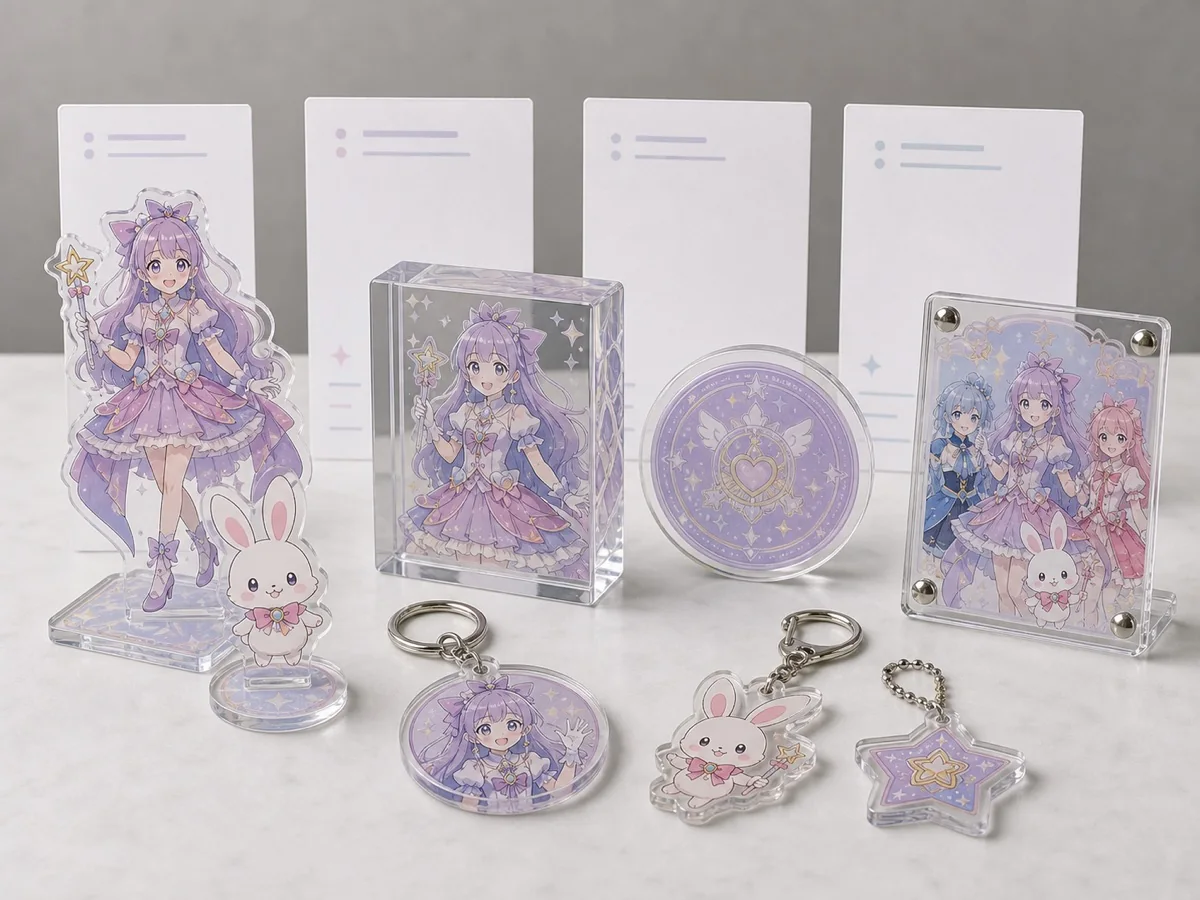
The right acrylic goods format changes by sales goal. Standees, keychains, charms, acrylic blocks, coasters, and mini panels should be planned as a project lineup rather than isolated items.
| Product type | Suitable use | Checkpoints |
|---|---|---|
| Acrylic standees | Retail, events, and bonus sets | Base fitting, thickness, and individual packaging |
| Acrylic keychains | Random sales and kuji prizes | Metal fitting, hole position, inner bag, and mix ratio |
| Acrylic blocks and panels | Commemorative goods and limited sales | Weight, protective packaging, and shipping damage prevention |
PACKAGING
Review backing cards, JAN labels, and carton labels by sales channel
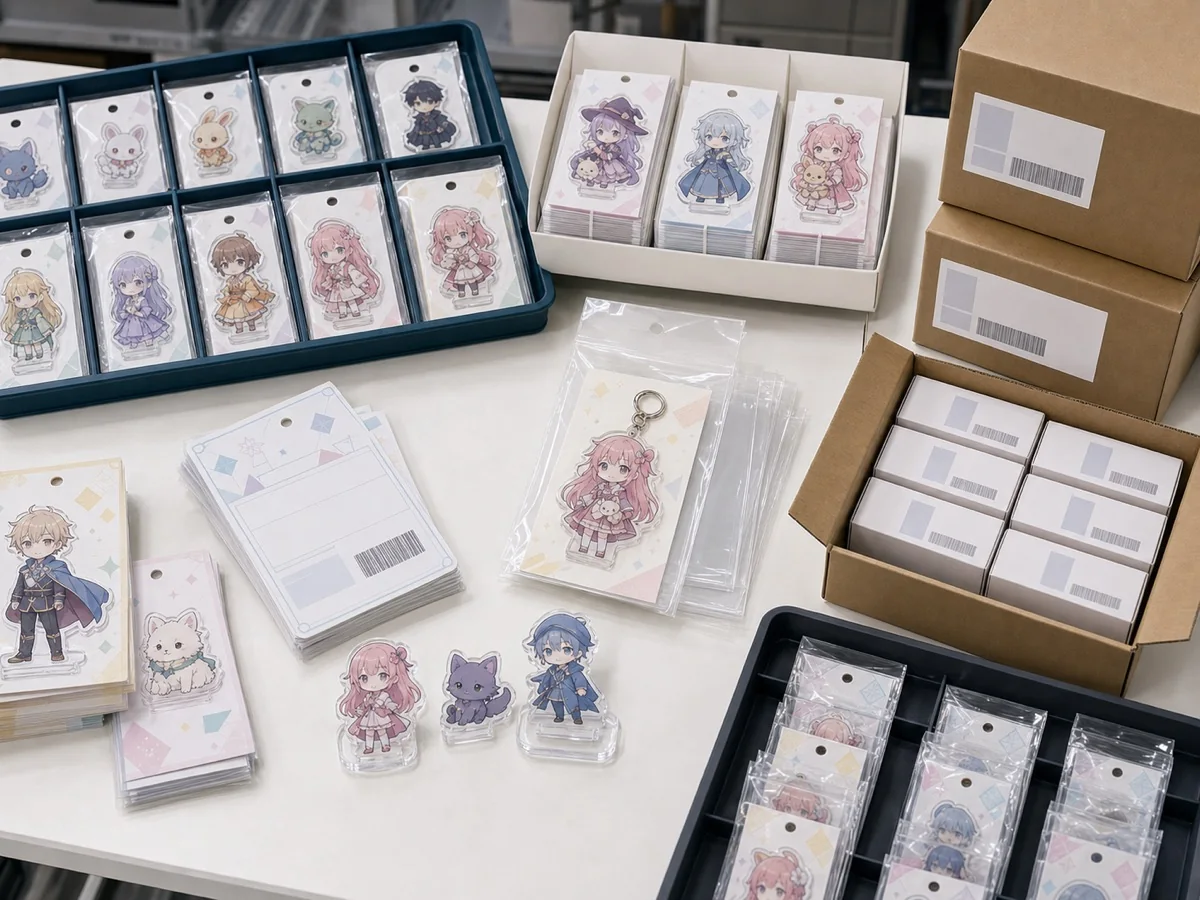
Packaging specifications change according to the sales channel and set content. JAN labels and caution text should be checked with the backing card back side, inner bag, carton label, and SKU sheet so they do not interfere with the character artwork.
- Backing card size and back-side label position
- OPP bag, header bag, and individual inner bag
- JAN label, SKU label, and carton label
- Packing unit for retail, EC, and event delivery
QUALITY CHECK
QC should cover both IP artwork expression and sellable packaging condition
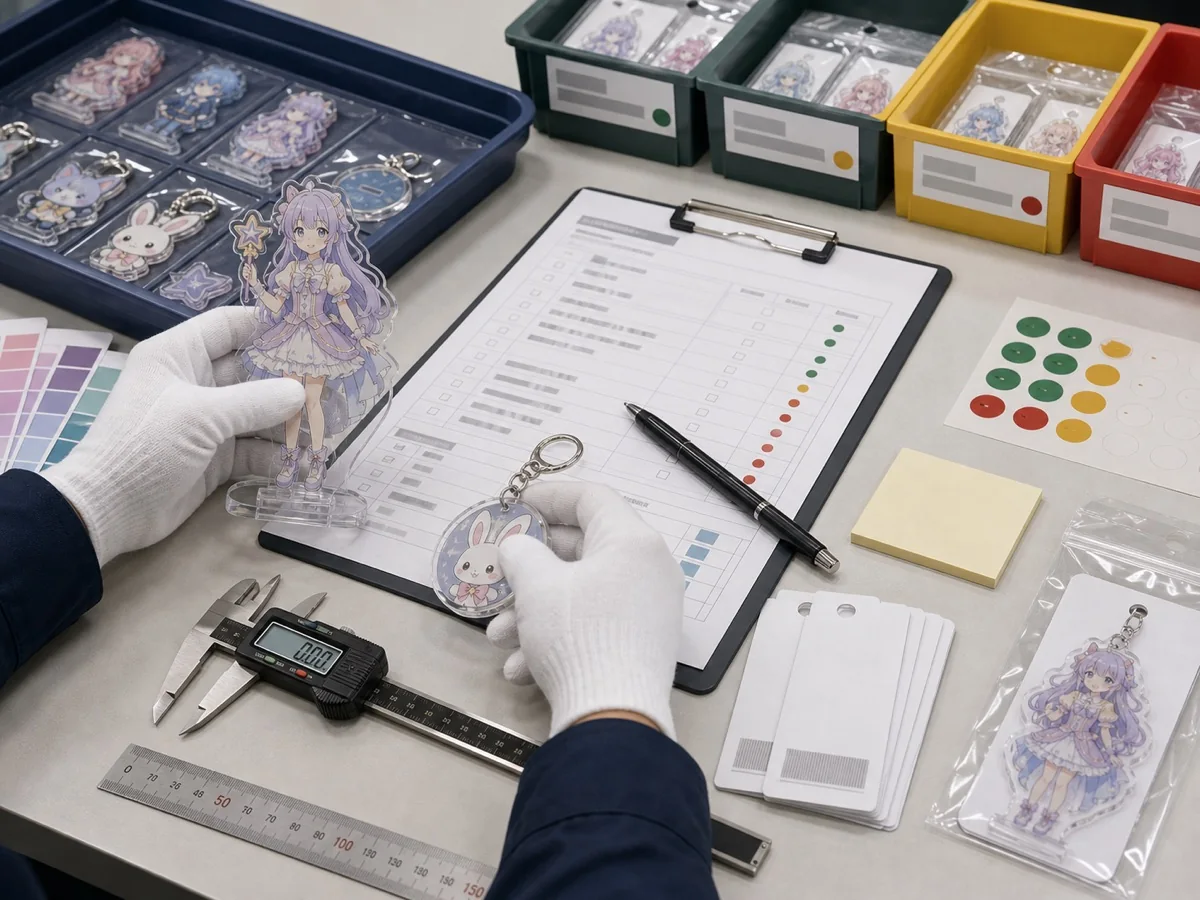
Acrylic transparency, print alignment, cut edges, scratches, fittings, base parts, packaging direction, and SKU mixing should be reviewed according to the project. The practical step is to define the agreed inspection scope before mass production.
| QC view | Check items | Reference materials |
|---|---|---|
| Appearance | Scratches, dirt, print shift, and white ink appearance | Approved sample and QC criteria |
| Assembly | Base fitting, metal fitting attachment, and thickness variation | Specification sheet and sample photos |
| Packaging | SKU mix, backing card direction, label position, and count per unit | SKU sheet and packaging instruction |
QUOTE MATERIALS
Documents to prepare before requesting an acrylic goods OEM quote
Final conditions depend on each project. For the first consultation, the materials below make specification review easier.
- Product lineup, planned quantity, SKU count, and sales channel
- Artwork files, approval version, color reference, white ink, and cut lines
- Packaging specifications, JAN labels, backing cards, and carton labels
- Preferred delivery format, inner box, carton, and shipment unit
FAQ
FAQ for IP collaboration acrylic goods OEM procurement
These answers are for pre-quote review. Actual conditions depend on artwork files, SKU count, packaging, and delivery format.
What should we share first for an IP collaboration acrylic goods project?
Planned quantity, sales channel, product lineup, approval route, packaging requirements, target delivery window, and any material or expression restrictions help the specification review and quotation move forward.
Can SKU additions be reviewed during the approval process?
SKU additions can affect plate count, packaging, backing cards, QC, and carton breakdown. When SKUs change, the SKU sheet and approval status should be updated before production conditions are confirmed again.
Can JAN labels and backing card packaging be discussed?
JAN labels, backing cards, OPP bags, inner boxes, and carton labels can be reviewed depending on project requirements. Final specifications should match the sales channel and supplied artwork files.
Can random assortment or kuji prize breakdowns be managed?
Mix ratio, inner bags, carton units, reserve quantity, and SKU identification methods should be organized first. Then the project conditions can be reviewed against that structure.
Is the delivery lead time fixed?
A fixed lead time is not stated here. Product specifications, sample review, approval rounds, quantity, packaging, and shipping conditions all affect the schedule, so timing should be checked for each project.
RELATED LINKS
Related acrylic goods OEM pages to check next
This page should connect with the main acrylic goods entry, artwork data, packaging, and channel-specific OEM pages.
NEXT STEP
Prepare an IP collaboration acrylic goods specification sheet for production review.
When product lineup, approval status, SKU sheet, packaging conditions, and delivery units are ready, we can help organize the points that need to be checked before quotation.
Project controls for Licensed IP Acrylic Merchandise
Licensed IP Acrylic Merchandise programs are planned for licensed IP owners and collaboration project managers. Before mass production, align licensed asset and rights scope, artwork revision and approval owner, character SKU matrix, copyright and legal lines, physical sample evidence, and channel-specific allocation in one project matrix so artwork, sellable units and delivery cartons use the same approved SKU data.
Search intent boundary: This page owns the buyer and use-case intent for licensed IP acrylic merchandise. Product engineering remains on the dedicated stand, keychain and acrylic product pages, preventing the pages from competing for broad product terms.
What to lock before approval
Treat the program as a controlled release, not as a group of unrelated artwork files. The commercial quote, approval list, packaging data and destination split should reference the same project and SKU codes. The six controls below should appear in the same quotation, sample record and inspection instruction.
| Decision | What the buyer must define | Acceptable approval evidence |
|---|---|---|
| Licensed Asset and Rights Scope | Define licensed asset and rights scope by SKU before quotation and do not replace it with a vague good-quality instruction. | Keep an approved dimensioned specification or controlled reference that production and QC can identify during bulk release. |
| Artwork Revision and Approval Owner | Define artwork revision and approval owner by SKU before quotation and do not replace it with a vague good-quality instruction. | Keep an approved artwork proof and component record that production and QC can identify during bulk release. |
| Character SKU Matrix | Define character SKU matrix by SKU before quotation and do not replace it with a vague good-quality instruction. | Keep an approved representative physical sample that production and QC can identify during bulk release. |
| Copyright and Legal Lines | Define copyright and legal lines by SKU before quotation and do not replace it with a vague good-quality instruction. | Keep an approved sellable pack or use-condition check that production and QC can identify during bulk release. |
| Physical Sample Evidence | Define physical sample evidence by SKU before quotation and do not replace it with a vague good-quality instruction. | Keep an approved inspection photo and measured result that production and QC can identify during bulk release. |
| Channel-Specific Allocation | Define channel-specific allocation by SKU before quotation and do not replace it with a vague good-quality instruction. | Keep an approved SKU-linked bulk report and carton trace that production and QC can identify during bulk release. |
Failure risks to close
- Licensed Asset and Rights Scope is not controlled: suppliers can interpret the same request differently and the quotation is not comparable.
- Artwork Revision and Approval Owner is not controlled: the physical sample can pass while the wrong revision enters bulk production.
- Character SKU Matrix is not controlled: packing or use conditions reveal a failure that a loose visual sample did not show.
- Copyright and Legal Lines is not controlled: the buyer cannot separate an isolated defect from a repeated batch or SKU problem.
Quote inputs
- project name and target market for Licensed IP Acrylic Merchandise
- editable artwork and the latest revision code
- finished dimensions and quantity for every design
- licensed asset and rights scope
- artwork revision and approval owner
- character SKU matrix
- individual packaging, label and barcode requirements
- inspection evidence and acceptance criteria
- delivery destination and required arrival date
Sample-to-bulk control
Approve a finished sample that represents the intended artwork, construction and sellable package. Record the sample date, revision, dimensions, material or component codes, visual limits and function checks. If a later change affects artwork, material, hardware, assembly or packaging, identify the impacted SKUs and obtain a new approval instead of relying on the earlier sample.
For bulk inspection, use the same viewing conditions, measurement points and pass/fail language used during approval. The report should identify the purchase order, SKU, batch, sampled quantity and result. Photographs are useful evidence only when they show the relevant scale, lighting, label or test condition and can be traced to the inspected lot.
When comparing quotations, separate confirmed specifications from assumptions. Ask each supplier to identify exclusions, proposed substitutes, sampling scope, packaging labor and delivery basis. A lower figure is not equivalent when it omits a component, uses a different inspection level or assumes that several designs can share one uncontrolled pack. Close those differences before price approval so the purchase decision remains auditable.