
B2B OEM / RETAIL ACRYLIC GOODS
Retail Acrylic Merchandise Packaging
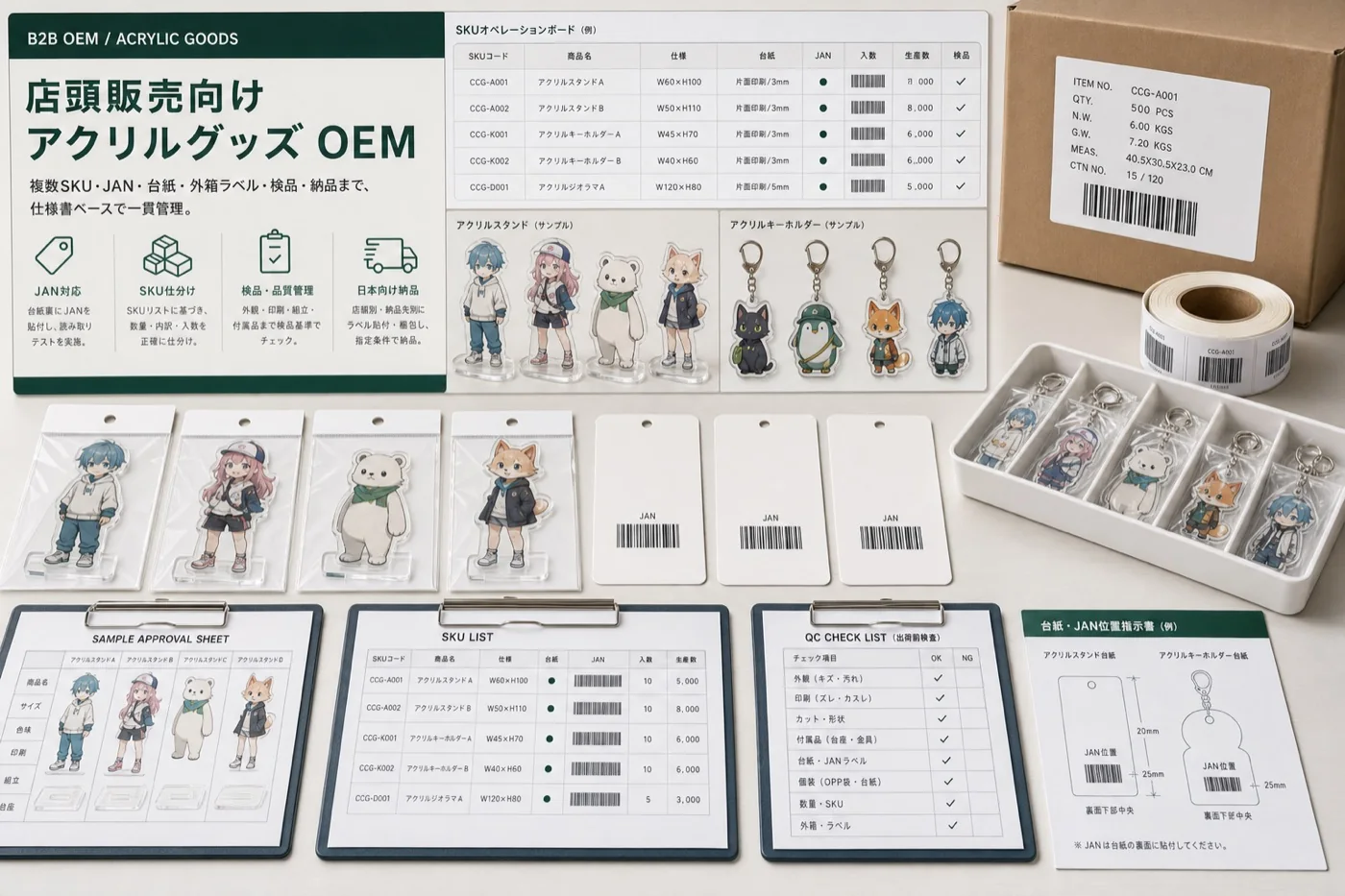
Retail acrylic goods OEM is plannedfor B2B procurement buyers.It covers backing cards, JAN labels,SKU sorting, inspection criteria,carton labels, and delivery termsbefore mass production.
FIRST CHECK
What to confirm first for retail acrylic goods OEM
For products sold in stores, specification gaps before launch can become store-side handling problems. Before mass production, we separate product specifications from the management details needed for retail display.
The first items to lock are the SKU list, backing-card specification, JAN label position, packaging format, inspection criteria, carton markings, and delivery destination requirements. If a quote is based only on acrylic size and printing method, backing cards, barcodes, store-by-store sorting, and carton labels may be added later, creating sample revisions or pre-delivery rework.
SKU OPERATIONS BOARD
Manage SKU, JAN, backing-card packaging, and delivery terms from the specification sheet
We align the required fields before quotation so planning, sales, quality control, and warehouse teams can work from the same information.
Specification check
Confirm product size, material, printing, fittings, quantity, and SKU count.Sample
Confirm sample conditions including backing card, JAN, OPP bag, and fittings.Backing card / JAN
Organize display position, label placement, back-side layout, and caution text.SKU sorting
Confirm design-by-design, quantity, store allocation, and assortment ratio.Japan delivery
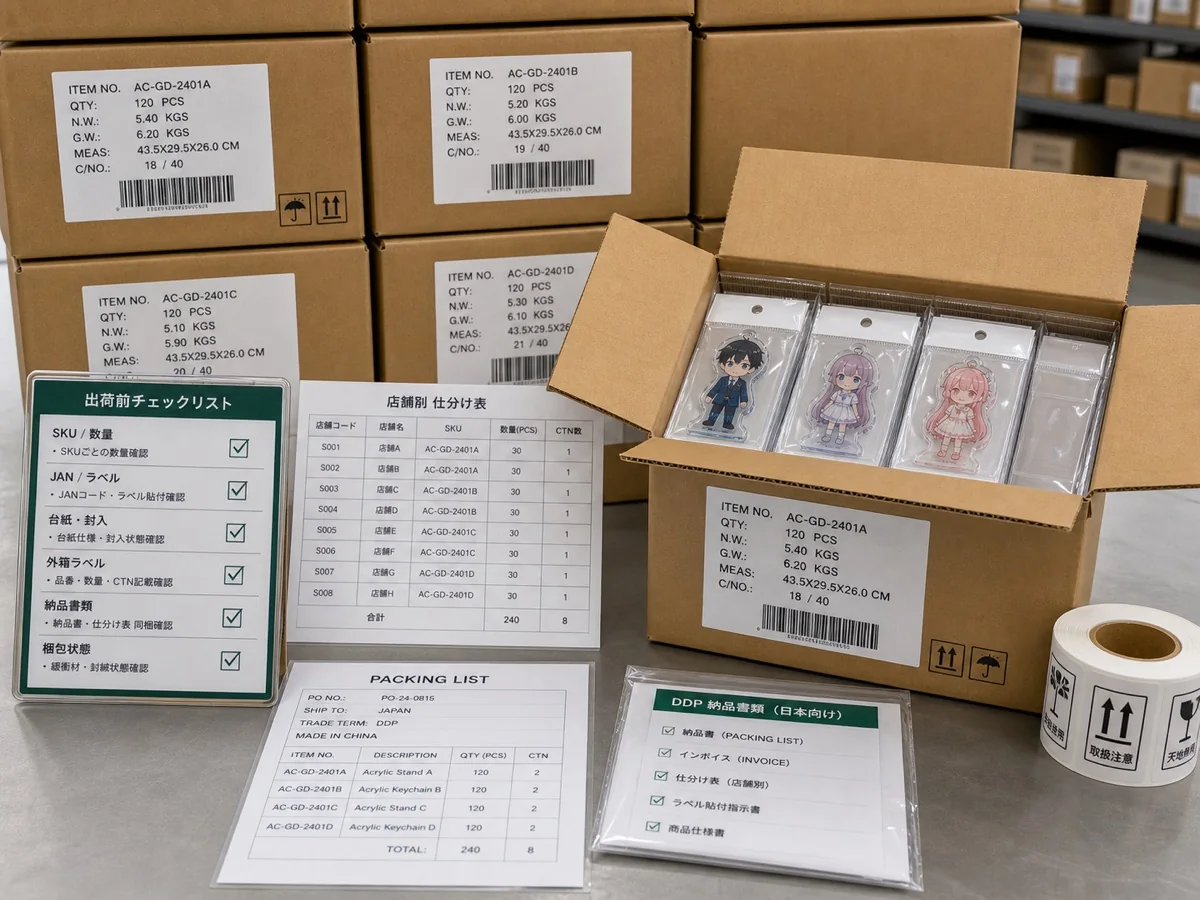
Confirm carton labels, packing method, delivery destination, and delivery format.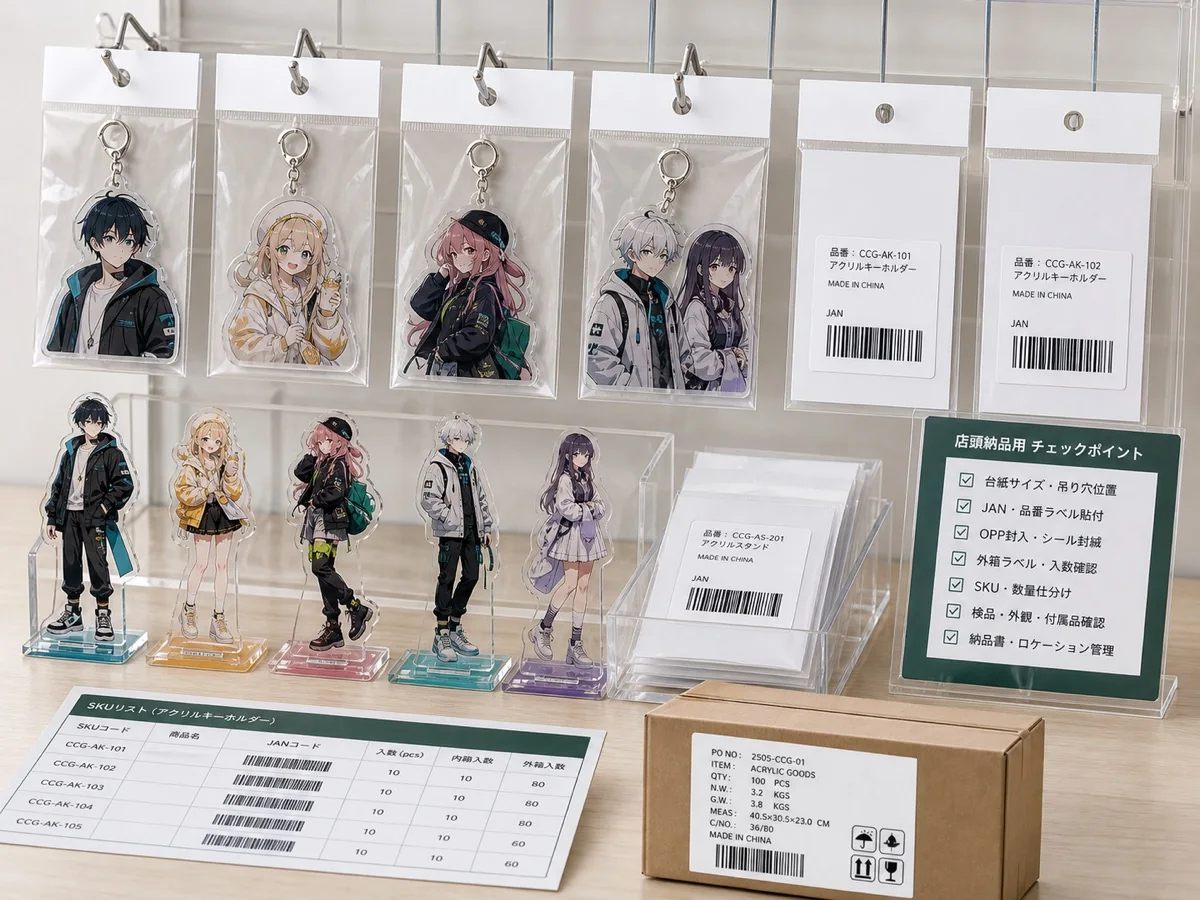
RETAIL READINESS
Check the product and packaging as a retail-ready set
Even if the acrylic item looks good by itself, mismatched backing-card size, hanging position, JAN label placement, OPP excess, or fitting direction can create store handling problems.
Display look
Check the character artwork, transparent area, fittings, and perceived quality after the item is placed on the backing card.
Store handling
Plan hang holes, JAN position, ease of opening, and shelf placement.
After delivery
Set conditions for store-by-store sorting, carton markings, and damage-reduction packing before production.
RISK LIST
Common missed checks in retail sales projects
Rather than promising one-size-fits-all lead times or absolute quality, we identify project-specific risks early and reflect them in samples and mass-production conditions.
| JAN label mismatch | Confirm back-side label position, size, direction, and consistency with the JAN list. The label should not interfere with the product front. |
|---|---|
| SKU mix-up | Map sorting by design, quantity, store, and assortment into the SKU sheet and cross-check it with carton labels. |
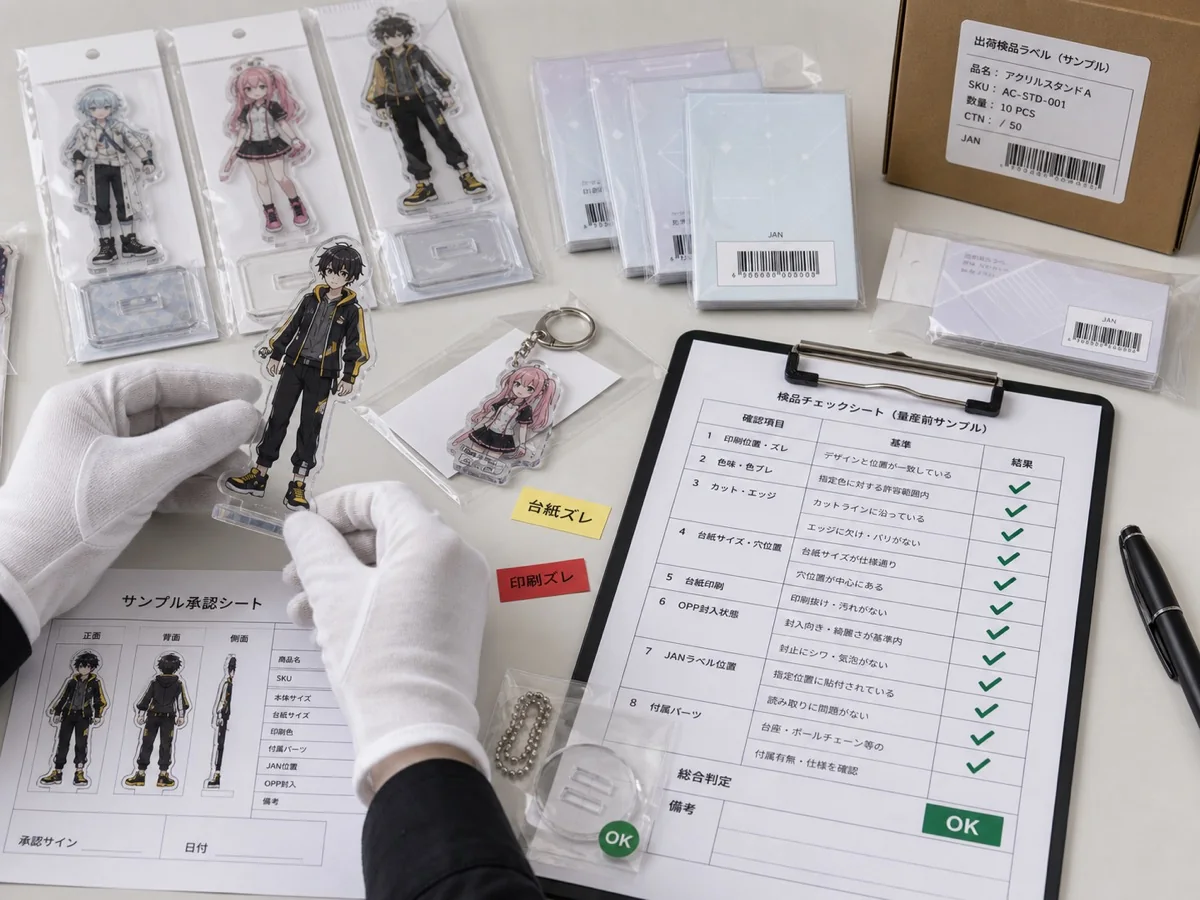
| Backing-card mismatch | Check backing-card size, hang hole, OPP bag dimensions, caution text, and front/back appearance during sampling. |
| Inspection standard gap | Align the inspection scope for scratches, print shift, edges, fittings, OPP insertion, and backing-card condition before shipment. |
| Insufficient carton labels | Organize product name, SKU, quantity, case pack, store information, and delivery requirements on carton labels or shipping documents. |
PRODUCT AND PROCESS
Plan acrylic stand and keychain specifications from the retail rollout
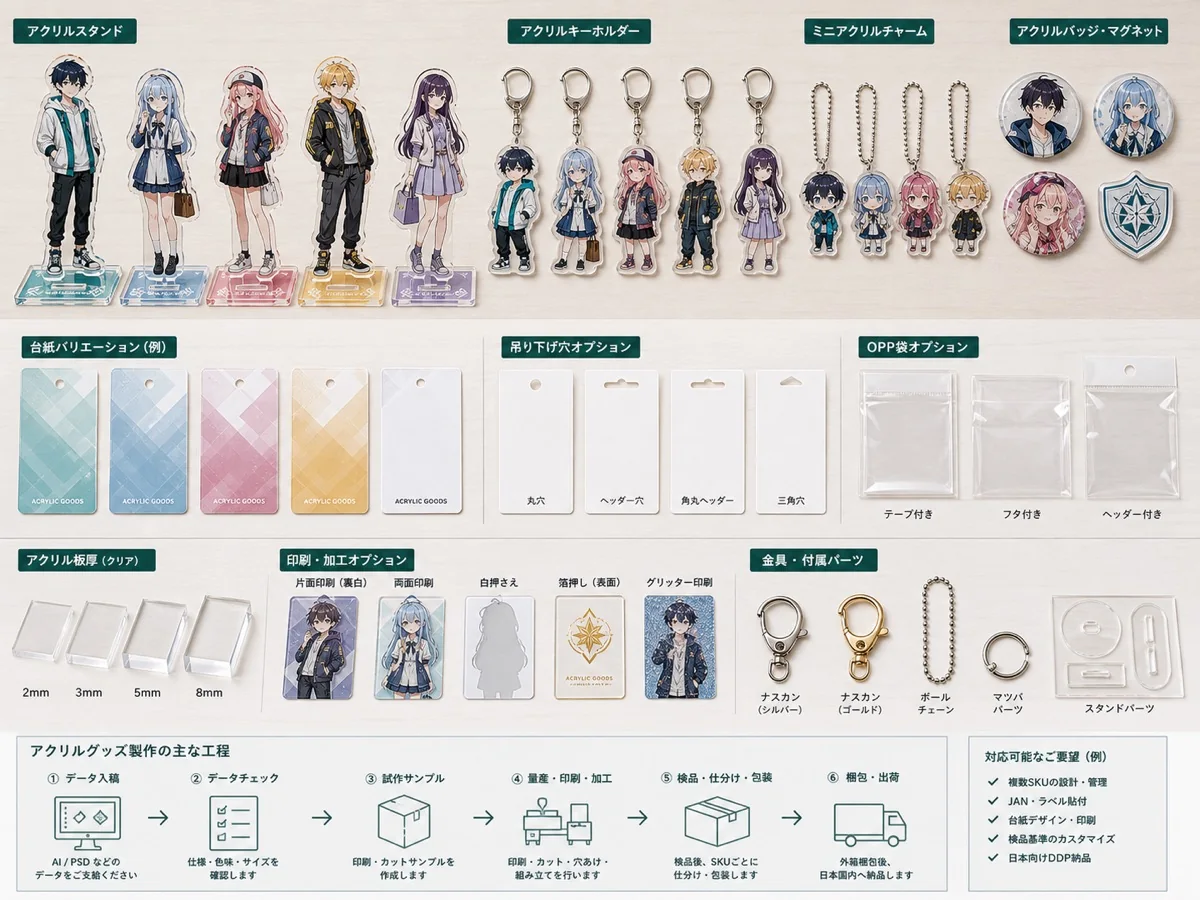
Acrylic stands, acrylic keychains, mini charms, and acrylic magnets each require different checks for size, thickness, printing, fittings, backing cards, OPP, JAN labels, and carton labels.
| Product body | Clear acrylic, colored acrylic, thickness, shape, laser cutting, hole position, and fitting requirements. |
|---|---|
| Printing | Single-side printing, double-side printing, white ink area, transparent area, color check, and fine-line reproduction. |
| Packaging | OPP bags, backing cards, silver bags, set packaging, random packaging, and JAN label application. |
| Operations | SKU list, assortment ratio, carton quantity, store allocation, and delivery destination requirements. |
BACKING CARD / JAN
Fix backing-card and JAN details before mass production, not after design
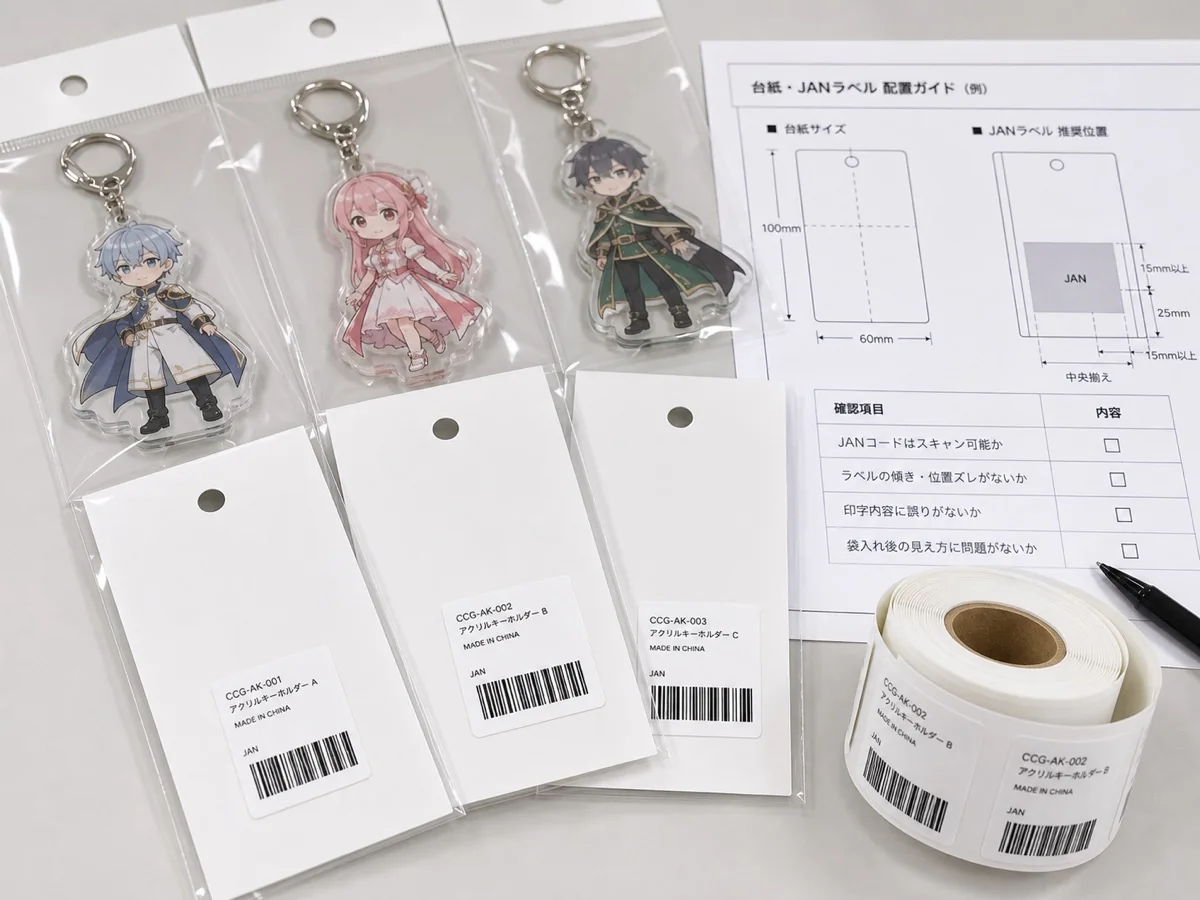
JAN label placement affects retail appearance, checkout scanning, backing-card layout, OPP bag margin, and product size. Confirm it with a backing-card sample, not only with product images.
- Check consistency among JAN list, product name, SKU code, and quantity
- Confirm backing-card size, hang hole, OPP bag margin, and fitting position
- Align label placement, caution text, and carton labeling
- Confirm identification method for random packaging or set sales
Actual JAN code ownership and retailer-specific formats are checked according to the buyer's operating requirements.
SKU SORTING
Organize multiple SKUs, assortments, and store allocation before quotation
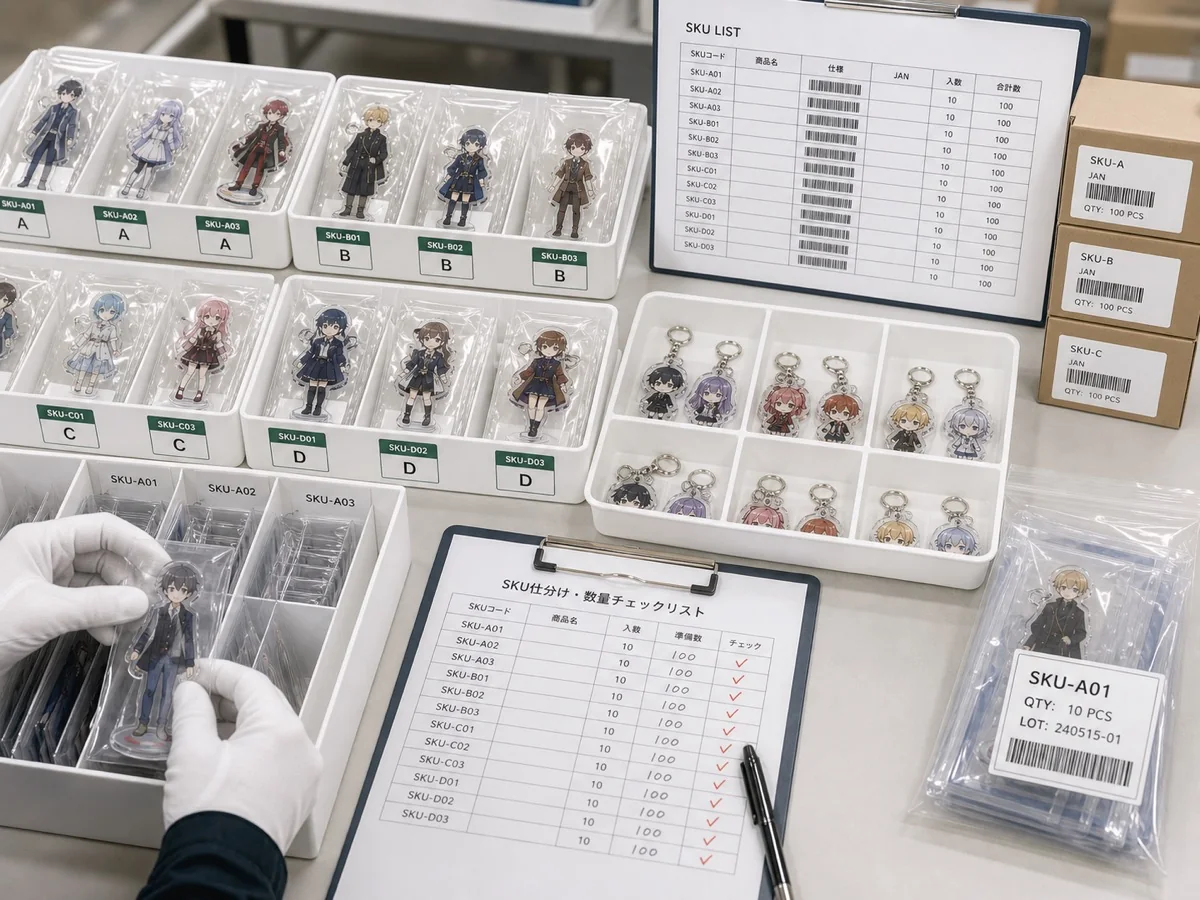
Retail projects rarely end with one design. A SKU sheet covering characters, expressions, color variations, sets, random packaging, and store allocation reduces confusion in later steps.
| SKU list | Organize SKU code, product name, size, material, printing, backing card, JAN, quantity, and case pack. |
|---|---|
| Assortment terms | Confirm normal sales, random sales, set sales, and store-by-store allocation conditions. |
| Work instructions | Specify sorting unit, inner bag, carton quantity, label display, and inspection matching method. |
QC AND DELIVERY
Confirm inspection, carton labels, and delivery terms before mass production
Inspection planning covers not only the acrylic product, but also backing cards, OPP, JAN, cartons, and store-by-store sorting.
QUOTE MATERIALS
Materials to prepare before quotation
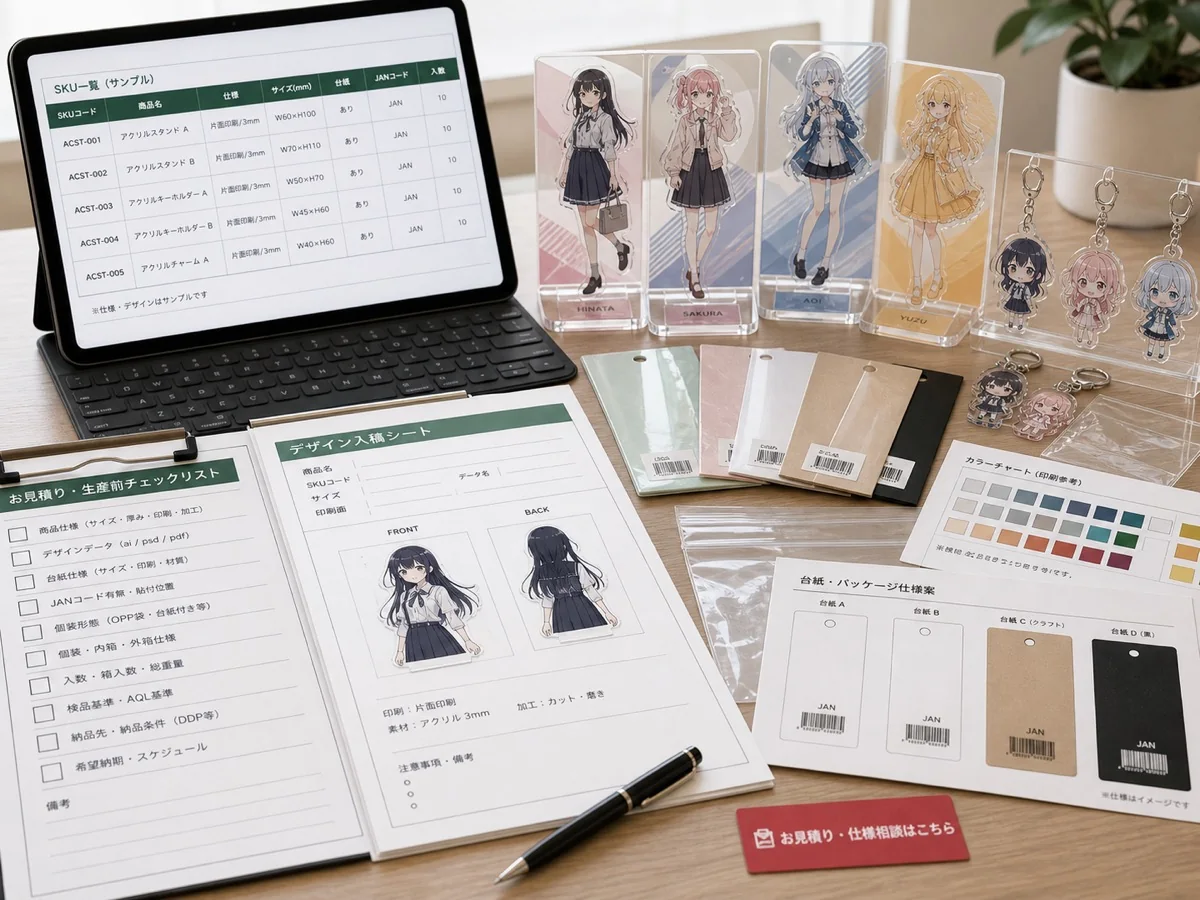
An accurate quote needs information on packaging, labels, SKUs, and delivery terms as well as the acrylic product itself. Unfixed items can be organized as candidate conditions.
Materials to share
SKU code, size, material, printing, and quantityCheck
AI, PSD, PDF, color reference, white ink layer, and cut lineCheck
Backing-card data, JAN list, label position, and caution textCheck
Delivery destination, store quantity, carton markings, and requested delivery timingCheck
What we check
Feasibility of shape, thickness, printing, fittings, and packagingProposal
Trial conditions including backing card, JAN, OPP, and inspection scopeProposal
SKU sorting, quantity matching, carton labels, and shipment checksProposal
Japan warehouse delivery, store-by-store delivery, and DDP term checksProposal
FAQ
FAQ about retail acrylic goods OEM manufacturing
These are common pre-quote questions from B2B procurement teams.
What should we confirm first for retail acrylic goods OEM?
Start with product size, quantity, SKU count, backing card, JAN label, packaging, inspection criteria, carton labels, and delivery destination terms. If the quote covers only the product body, packaging and sorting conditions are often added later.
Can you help with JAN label placement?
We can check the JAN list, placement position, back-side backing-card display, and consistency with carton labels. Actual code registration and assigned formats are handled according to the buyer's operating requirements.
Can you support multiple SKUs and random packaging?
We organize characters, designs, assortment ratios, store allocations, and random packaging in a SKU sheet, then check them against quantities, backing cards, JAN labels, and carton labels.
When should backing-card design and OPP bag size be decided?
It is safer to set candidate conditions before quotation or sampling because backing-card size, hang hole, OPP margin, front appearance, and JAN position affect each other.
What does inspection cover?
Depending on project conditions, inspection may cover print shift, color, edges, scratches, fittings, backing card, OPP insertion, JAN label position, quantity, SKU mixing, and carton labels.
Can we discuss DDP delivery to Japan or store-by-store delivery?
After confirming destination, store quantity, carton quantity, label display, and requested delivery timing, we organize the delivery method according to project conditions.
RELATED PAGES
Related acrylic goods OEM pages
You can consult us even if SKU lists, backing cards, JAN labels, or delivery terms are not finalized
We help organize not only product visuals, but also the management items needed before retail display. Start by sharing SKU count, planned quantity, sales format, and desired delivery destination.
Project controls for Retail Acrylic Merchandise Packaging
Retail Acrylic Merchandise Packaging programs are planned for retail merchandise teams requiring shelf-ready packaging. Before mass production, align hanging or shelf display method, backing card and JAN barcode, OPP bag fit and seal, warnings and legal copy, SKU pack-out verification, and store-ready carton allocation in one project matrix so artwork, sellable units and delivery cartons use the same approved SKU data.
Search intent boundary: This page owns the buyer and use-case intent for retail acrylic merchandise packaging. Product engineering remains on the dedicated stand, keychain and acrylic product pages, preventing the pages from competing for broad product terms.
What to lock before approval
Treat the program as a controlled release, not as a group of unrelated artwork files. The commercial quote, approval list, packaging data and destination split should reference the same project and SKU codes. The six controls below should appear in the same quotation, sample record and inspection instruction.
| Decision | What the buyer must define | Acceptable approval evidence |
|---|---|---|
| Hanging or Shelf Display Method | Define hanging or shelf display method by SKU before quotation and do not replace it with a vague good-quality instruction. | Keep an approved dimensioned specification or controlled reference that production and QC can identify during bulk release. |
| Backing Card and JAN Barcode | Define backing card and JAN barcode by SKU before quotation and do not replace it with a vague good-quality instruction. | Keep an approved artwork proof and component record that production and QC can identify during bulk release. |
| OPP Bag Fit and Seal | Define OPP bag fit and seal by SKU before quotation and do not replace it with a vague good-quality instruction. | Keep an approved representative physical sample that production and QC can identify during bulk release. |
| Warnings and Legal Copy | Define warnings and legal copy by SKU before quotation and do not replace it with a vague good-quality instruction. | Keep an approved sellable pack or use-condition check that production and QC can identify during bulk release. |
| SKU Pack-Out Verification | Define SKU pack-out verification by SKU before quotation and do not replace it with a vague good-quality instruction. | Keep an approved inspection photo and measured result that production and QC can identify during bulk release. |
| Store-Ready Carton Allocation | Define store-ready carton allocation by SKU before quotation and do not replace it with a vague good-quality instruction. | Keep an approved SKU-linked bulk report and carton trace that production and QC can identify during bulk release. |
Failure risks to close
- Hanging or Shelf Display Method is not controlled: suppliers can interpret the same request differently and the quotation is not comparable.
- Backing Card and JAN Barcode is not controlled: the physical sample can pass while the wrong revision enters bulk production.
- OPP Bag Fit and Seal is not controlled: packing or use conditions reveal a failure that a loose visual sample did not show.
- Warnings and Legal Copy is not controlled: the buyer cannot separate an isolated defect from a repeated batch or SKU problem.
Quote inputs
- project name and target market for Retail Acrylic Merchandise Packaging
- editable artwork and the latest revision code
- finished dimensions and quantity for every design
- hanging or shelf display method
- backing card and JAN barcode
- OPP bag fit and seal
- individual packaging, label and barcode requirements
- inspection evidence and acceptance criteria
- delivery destination and required arrival date
Sample-to-bulk control
Approve a finished sample that represents the intended artwork, construction and sellable package. Record the sample date, revision, dimensions, material or component codes, visual limits and function checks. If a later change affects artwork, material, hardware, assembly or packaging, identify the impacted SKUs and obtain a new approval instead of relying on the earlier sample.
For bulk inspection, use the same viewing conditions, measurement points and pass/fail language used during approval. The report should identify the purchase order, SKU, batch, sampled quantity and result. Photographs are useful evidence only when they show the relevant scale, lighting, label or test condition and can be traced to the inspected lot.
When comparing quotations, separate confirmed specifications from assumptions. Ask each supplier to identify exclusions, proposed substitutes, sampling scope, packaging labor and delivery basis. A lower figure is not equivalent when it omits a component, uses a different inspection level or assumes that several designs can share one uncontrolled pack. Close those differences before price approval so the purchase decision remains auditable.