Anime Acrylic Merchandise Manufacturer
For anime studios, production committees, and licensees, we organize acrylic stands, keychains, acrylic badges, layered dioramas, and event merchandise sets from specification review to mass production, inspection, packaging, and delivery to Japan.
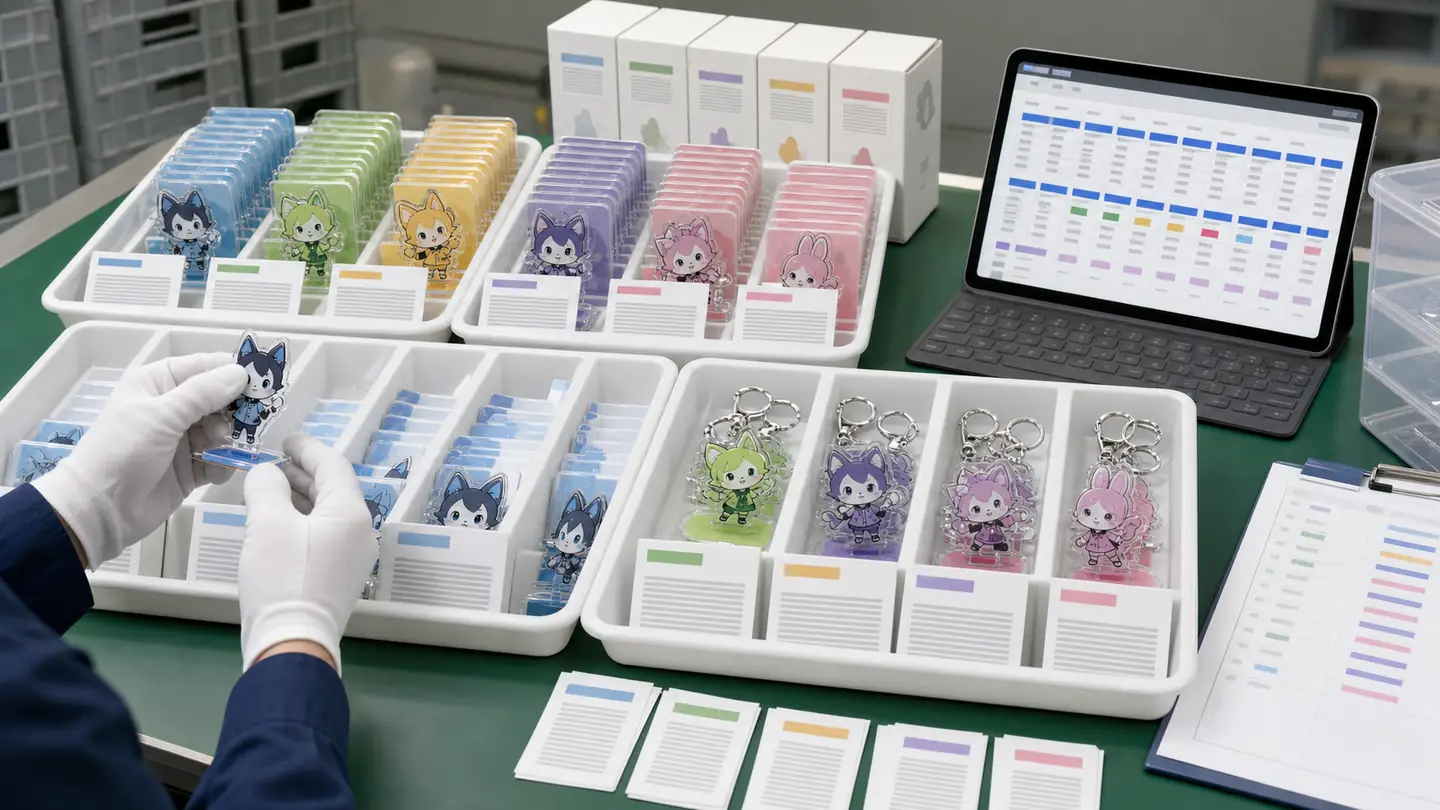
Unreleased character data, multi-SKU control, white ink and color differences, backing cards, JAN/SKU placement, blind-box packing, and warehouse delivery requirements are made visible before mass production starts.
What should be confirmed first when producing official anime goods in China?
The first checks are not only product type. Sales timing, SKU count, copyright notice, packaging format, and delivery destination should be fixed early. If they remain vague, sampling may move forward while mass production, inspection, and warehouse receiving still face rework.
Sales Timing
Work backward from broadcast, theatrical release, events, EC preorders, or retail launch, and separate checkpoints for samples, approvals, mass production, and shipping.
SKU Count
Manage character, expression, backing-card, bonus, and blind-box ratio differences in one SKU sheet.
Rights Notice
Confirm copyright marks, approval rules, unreleased-data access scope, and whether data may be reused for repeat orders.
Delivery Terms
Prepare warehouse or venue delivery, split shipment, carton labels, JAN codes, and packing lists before production.
Four problems anime merchandise teams often meet before production
These are not fixed guarantees. They are risk items to check at the start of each project. The right control method depends on quantity, approval workflow, packaging, and delivery terms.
| Common issue | Typical cause | Pre-production control |
|---|---|---|
| The event date leaves very little time | Artwork approval, samples, backing cards, JAN labels, and logistics are handled separately | Split the schedule into sample approval, mass-production approval, packaging approval, and shipping confirmation deadlines |
| Character SKUs get mixed | The acrylic item, backing card, JAN, carton label, and shipment list are not linked clearly | Create a character-level SKU sheet and packing instruction, then define checks before and after packing |
| Color or white ink differs between sample and production | Transparent acrylic, white ink, back printing, and protective film appearance were not confirmed | Record white-ink area, color tolerance, front/back print method, and film requirements during sampling |
| Sharing unreleased IP data feels risky | Data recipients, storage period, work scope, and reuse conditions are unclear | Confirm NDA, access scope, storage/deletion policy, and repeat-order data handling by project |
Main acrylic product formats for official anime goods
Even with the same character artwork, each product needs its own thickness, white ink, cutline, hardware, packaging, and JAN placement. For mass production, it is safer to separate the specification sheet by product category.
Acrylic Stands
Standing artwork, bases, background parts, and diorama structures. Fit, protective film, and backing-card size matter.
Acrylic Keychains
Custom cut shapes, hole position, clasps, ball chains, double-sided printing, and OPP packing should be checked.
Acrylic Badges
Safety pins, magnets, clips, exhibition use, event badges, and attachment to clothing are confirmed by scenario.
Layered and Set Items
Dioramas, bonus sets, blind-box programs, box sales, and retail-display quantity control are planned in advance.
For unreleased character data, define the work scope first
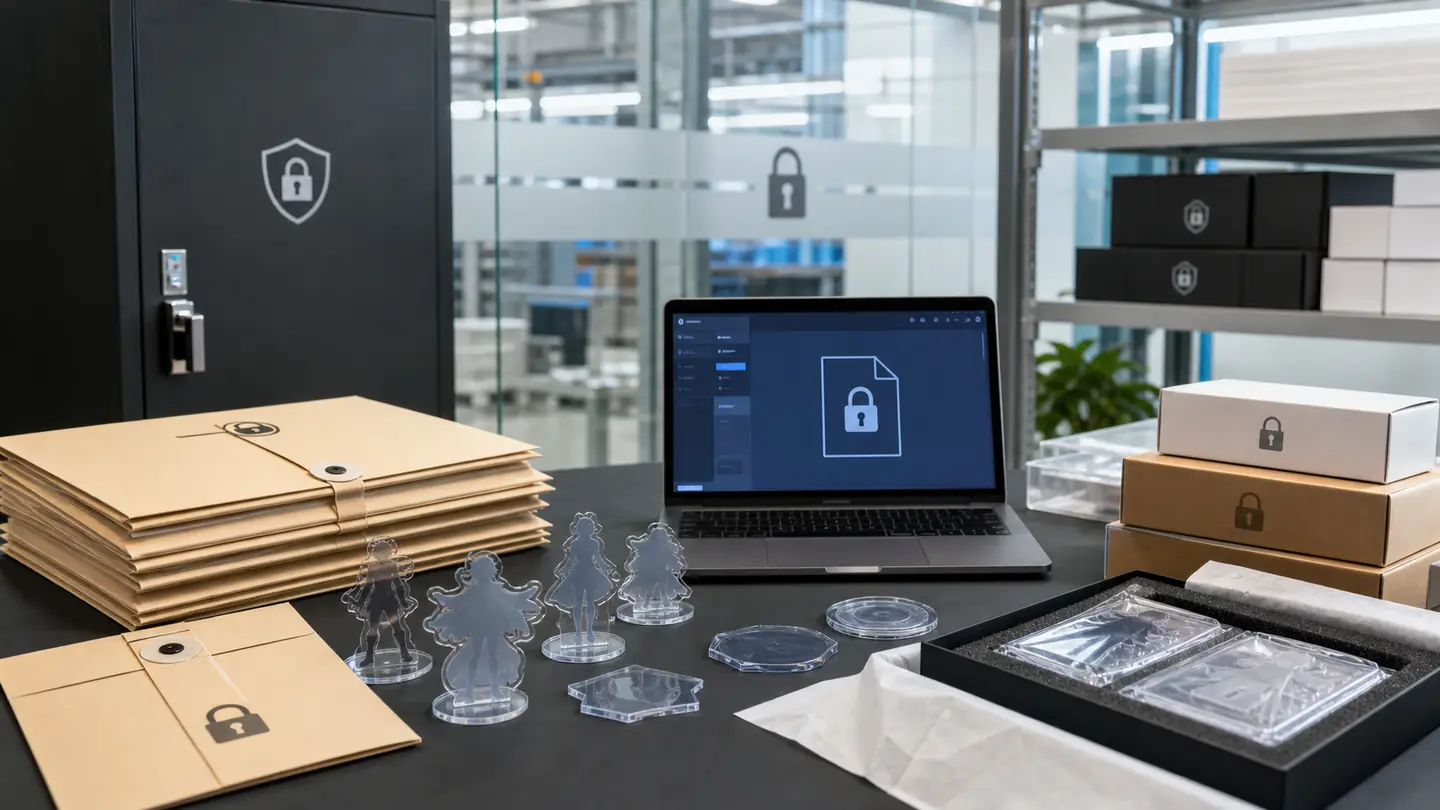
Official anime goods may include unreleased visuals, approval-stage designs, copyright notices, and launch timing. We confirm NDA requirements, data recipients, work scope, storage period, deletion requests, and repeat-order handling for each project.
Before artwork transfer. Confirm file format, rights notices, approval rules, and the range of unreleased information.
During production. Keep the responsible team, work process, sample-sharing scope, and revision history clear.
After delivery. Decide whether data should be retained for repeat orders, deleted, or re-confirmed before additional production.
White ink, thickness, and cutlines need sample-based standards
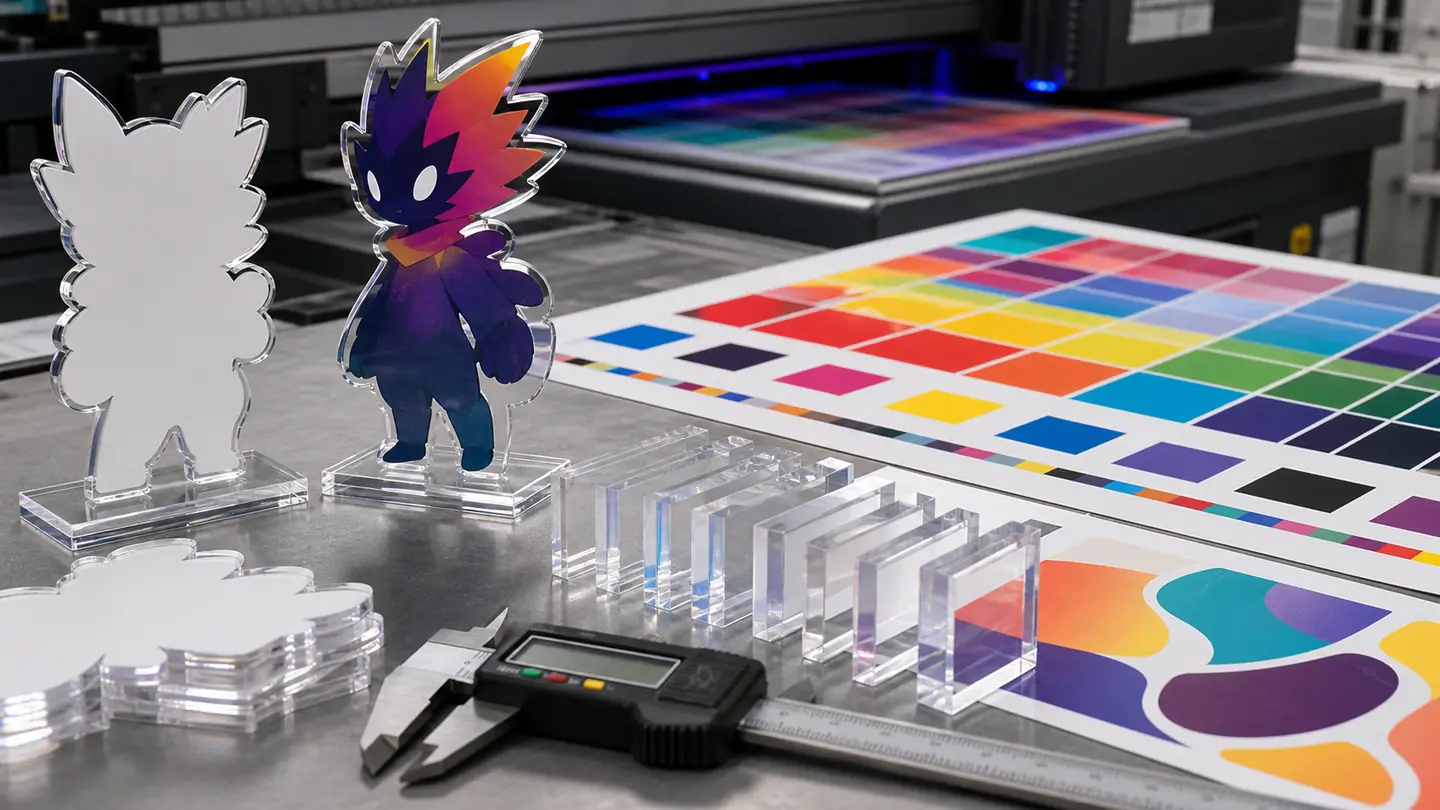
Transparent acrylic changes appearance depending on white ink, print side, background color, protective film, and thickness. Before mass production, check character outlines, fine hair and costume lines, gradients, base fit, hole position, and thin protruding parts.
| Check item | What to confirm |
|---|---|
| White ink | Transparent areas, stronger-color areas, and how the artwork looks from the back side |
| Color tolerance | How approval samples and early production pieces will be compared |
| Cutline | Fine hair, costume tips, base slots, hole position, and edge-chipping risk |
| Thickness | Candidate thicknesses, standing stability, shipping cost, and packing impact |
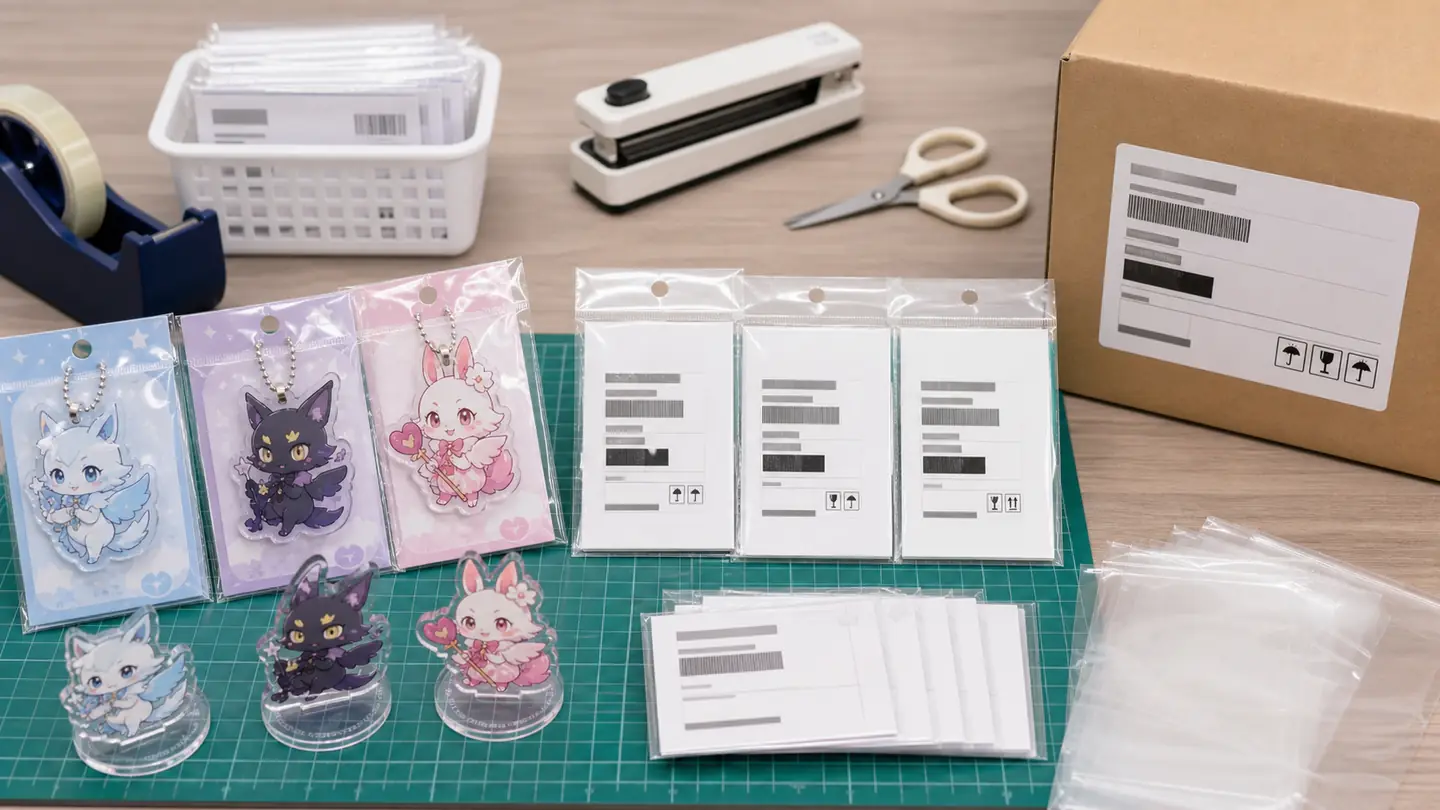
Backing cards, JAN codes, and SKUs must work for both retail and warehouse receiving
Official anime goods need clear front-facing character presentation while keeping JAN/SKU data readable for warehouse receiving, retail display, and EC fulfillment. JAN registration is normally managed by the brand or seller; the factory can place, print, apply, and check supplied data.
Use the backing-card front for visual appeal, and the back for JAN, notices, SKU, and rights text.
Select OPP bags, header bags, blister packs, set bags, or box sales by sales channel.
For blind boxes, check assortment ratio, box-unit quantity, carton labels, and shipment lists together.
Specification items to organize before quotation
Accurate quotation requires more than the acrylic part itself. Packaging, inspection, and logistics should be included in one specification sheet.
| Item | What to confirm | Why it matters |
|---|---|---|
| Product type | Acrylic stand, keychain, badge, layered diorama, or set product | Hardware, backing card, JAN, and carton quantity vary by product |
| Size and thickness | Main part size, base size, thickness candidate, and hole position | Stability, shipping cost, and backing-card size are affected |
| Print spec | Single/double sided, white ink, front/back printing, protective film | Transparency and color strength must be confirmed with samples |
| SKU control | Character, expression, outfit, backing card, bonus, and assortment ratio | Without a SKU sheet and packing instruction, mix-up risk increases |
| Packaging | OPP, backing card, header bag, box, blind bag, carton | JAN position, warning text, rights text, and retail display need review |
| Inspection | Scratches, print alignment, white ink gaps, chips, hardware, quantity, SKU matching | Inspection criteria should be defined per project, not as a blanket claim |
| Delivery | Domestic warehouse, event venue, split delivery, DDP, carton marks, documents | Destination-level quantities and carton labels are needed |
Mass-production inspection must cover more than appearance
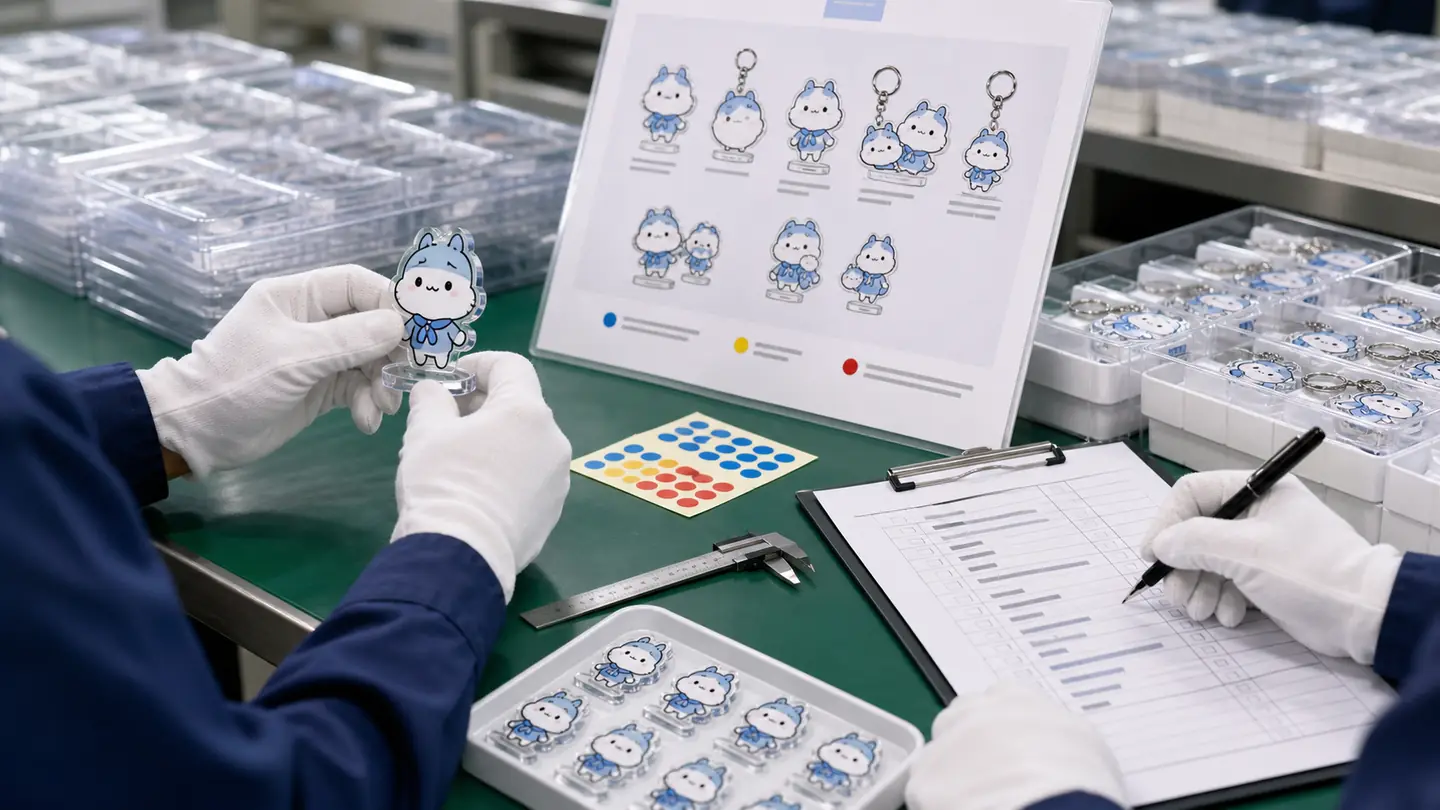
For fan-facing official goods, scratches and chips are only part of the check. Character name, backing card, JAN, set contents, and carton labels also need to match. Inspection criteria are set by order conditions across appearance, print, cutting, hardware, packing, quantity, and shipping documents.
Appearance and Processing
Check surface scratches, print shift, white-ink gaps, burrs, chips, base fit, and hardware installation.
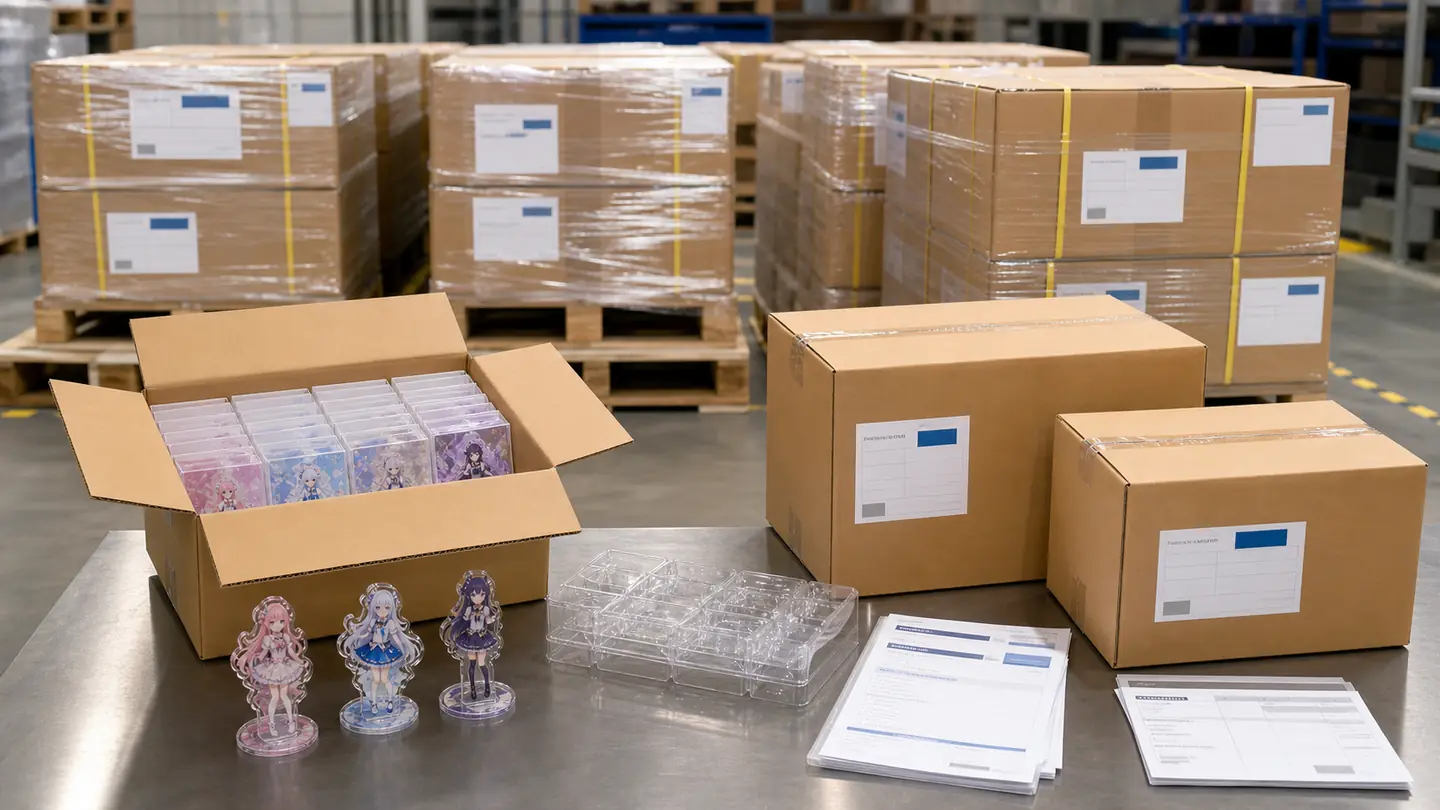
Packing and Shipping
Check SKU, backing card, JAN, quantity, carton quantity, destination labels, and shipment documents.
Delivery to Japan should be planned from carton labels and documents
When goods go to Japanese warehouses, event venues, retailers, or EC logistics centers, carton count, weight, carton marks, SKU quantities, split delivery, invoices, and packing lists should be confirmed early. DDP delivery can be discussed by project conditions.
Documents to prepare: destination address, desired delivery date, SKU quantity by destination, carton quantity, JAN/SKU sheet, warehouse labels, delivery terms, and customs or billing requirements.
How the project moves from inquiry to delivery
Instead of promising a fixed timeline, we confirm project conditions and separate approval, sampling, mass production, inspection, and shipping checkpoints.
Confirm product type, quantity, SKUs, launch timing, IP data handling, and destination.
Review AI/PDF files, white ink, cutlines, rights text, backing cards, JAN, and packing instructions.
Confirm color, white ink, thickness, hardware, backing cards, packaging, and approval comments.
Finalize SKU sheet, inspection criteria, packing instruction, carton labels, and shipping documents.
Check appearance, printing, cutting, hardware, packing, quantity, and SKU matching.
Confirm carton count, weight, shipping documents, and delivery terms by destination.
Reconfirm stored data, color difference, specification changes, and inventory conditions.
Record defect trends, packaging improvements, future SKU additions, and schedule adjustments.
Materials that speed up quotation
Artwork Files
AI/PDF/PSD files, size, cutline, white ink, backing-card data, rights text, and approval rules.
Sales and SKU Data
Product type, SKU sheet, character count, quantity, assortment ratio, JAN needs, and set structure.
Delivery Data
Destination, desired timing, split delivery, carton quantity, warehouse labels, DDP terms, and shipping documents.
Risks to check before mass production
Approval risk: If rights text, color, white ink, backing cards, JAN, warning text, and launch timing have different approvers, decide the approval order first.
SKU risk: Match the SKU sheet with actual goods so character versions, bonuses, backing cards, blind-box ratios, and carton labels do not mix.
Packaging risk: Check bag movement, scratches, bent backing cards, JAN position, hang holes, and transport pressure during sampling.
Logistics risk: Confirm destination-level quantity, carton count, weight, warehouse labels, shipping documents, and acceptable delivery dates early.
FAQ for acrylic anime goods OEM
Can anime studios or production committees contact you directly?
Yes. We can start with rights holders, animation studios, production committees, licensees, event operators, or merchandising companies. First we confirm the use case, sales schedule, SKU count, quantity, and delivery destination, then proceed with an NDA when needed.
How do you handle character artwork and unpublished IP data?
For each project, we confirm who can access the artwork, what files are required, how long data should be retained, whether deletion is required, and whether the same data may be used for repeat orders. Unreleased artwork is handled with a defined work scope and restricted access.
Can acrylic stands, keychains, and badges be managed in one project?
Yes. Even when the same character artwork is used, each item may require different thickness, cutlines, hardware, backing cards, JAN/SKU labels, and carton quantities, so we manage them as separate SKUs.
How do you confirm white ink and color reproduction?
On transparent acrylic, the white-ink layer strongly affects color and opacity. During sampling, we confirm white-ink coverage, density, front/back printing, transparency, and color tolerance before using the sample as the mass-production reference.
Can you reduce mix-ups in multi-SKU or blind-box projects?
We align the SKU sheet, backing-card numbers, packing instructions, carton labels, and shipment list. For blind-box projects, the packaging structure, assortment ratio, and carton-level quantity checks are especially important.
Can you help place JAN codes and warning text?
Supplied JAN codes and required notices can be placed on backing-card backs, OPP bag backs, carton labels, or shipment documents. We check both front-facing retail appearance and warehouse receiving readability.
Are sample and mass-production lead times fixed?
No. Timing depends on quantity, SKU count, print surfaces, hardware, packaging, inspection requirements, and logistics. We work backward from the desired delivery date and separate sampling, approval, mass production, inspection, and shipping checkpoints.
Can you support DDP delivery to Japan?
Japan DDP delivery can be discussed after confirming the destination, carton count, weight, carton labels, invoice, packing list, and delivery terms. For split delivery to warehouses or event venues, a destination-based SKU sheet helps speed up confirmation.
Can you provide RoHS, REACH, SGS, or related documents?
Document availability depends on the target material, parts, order conditions, and the recipient's requirements. We confirm this case by case instead of making unverified certification claims for every project.
What should we send before requesting a quote?
Please share artwork files, target size, acrylic thickness, product type, quantity, SKU sheet, packaging image, JAN requirements, desired delivery timing, destination, reference photos, and any legal or approval constraints.
Related product and process pages
Use these pages according to the stage of your specification review.
We can help organize the specification sheet for official anime acrylic goods
If you already have character count, product types, SKU sheet, delivery timing, packaging, JAN requirements, and destination, send them as they are. If not, we can start from the items that must be decided before production.
Information to send
Product type, reference size, quantity, SKU count, file format, backing-card/JAN needs, target timing, delivery destination, and NDA or approval requirements.