Acrylic Goods QC / IP Merchandise / Japan DDP Delivery
Acrylic Goods Quality Inspection
This guide is for IP companies, merchandise planning teams, and trading companies that mass-produce acrylic goods in China and deliver to Japan. It connects specification review, sample approval, mass production IPQC, pre-shipment inspection, JAN packaging, and DDP delivery into one practical QC standard.
Instead of saying only “inspection is in progress,” the page explains what is checked, which records remain, and which documents should be confirmed before shipment.
The Practical Answer
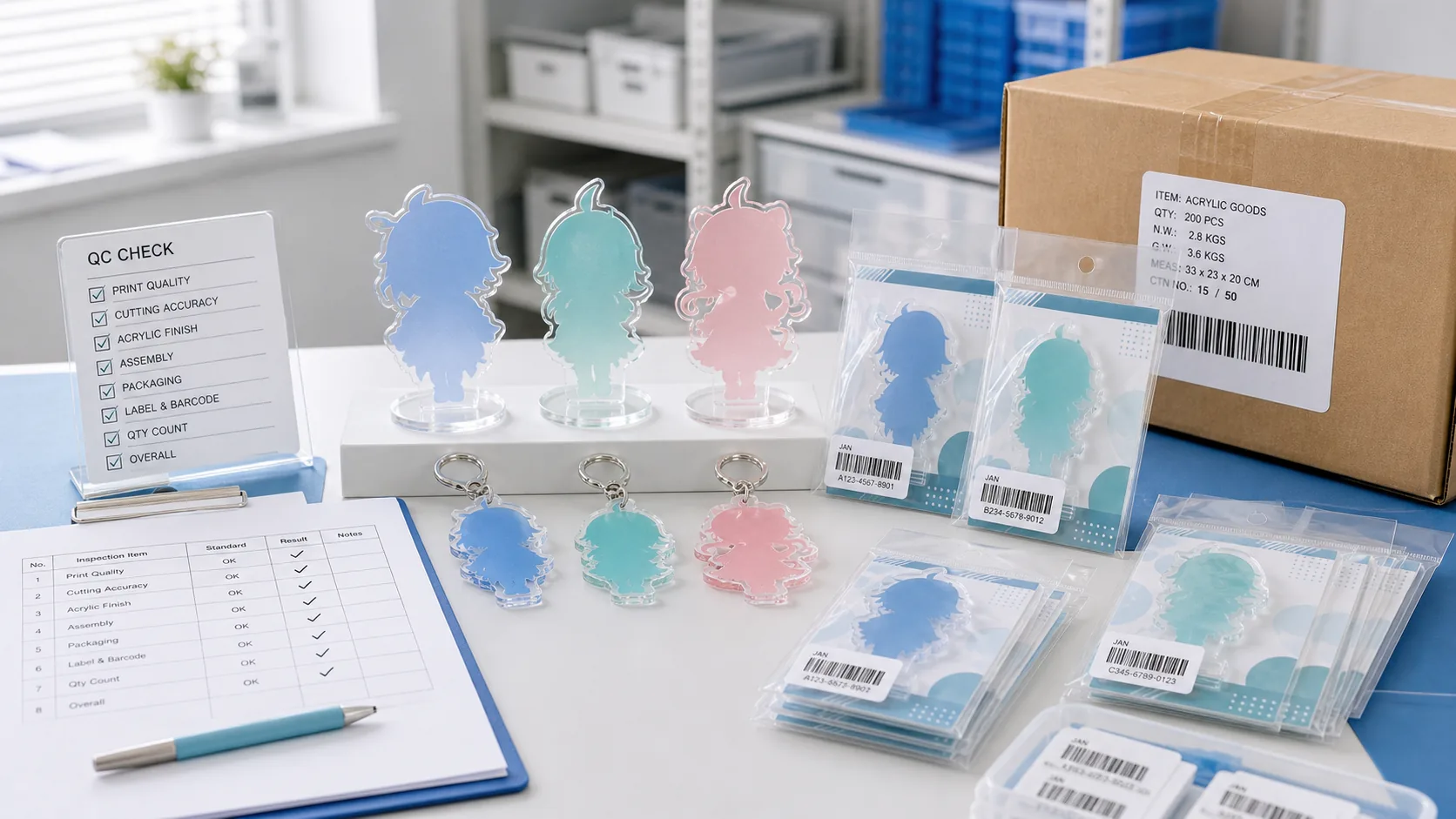
Acrylic goods QC is not only a final appearance check. Drawings, white plate, color, thickness, hole position, base fit, hardware, print surface, protective film, JAN labels, backing cards, cartons, and delivery documents should be connected before mass production starts.
Standard names on this page are treated as candidate checkpoints, not as blanket certification claims. Actual tests, certificates, and reports depend on product use, target age, destination country, and sales-channel requirements.
Projects That Need QC Criteria Early
Licensed IP merchandise
Color difference, white plate alignment, print shift, cut line, protective film, and backing-card appearance should be fixed together with sample approval notes.
Japan retail and EC delivery
JAN, SKU, carton label, carton quantity, and destination sorting become part of QC so warehouse receiving does not stop after shipment.
Multi-SKU series goods
For character, color, or blind series items, the product, backing card, JAN, packing ratio, and carton number must be checked together.
Inspection Standard Library
Inspection Criteria by Acrylic Goods Category
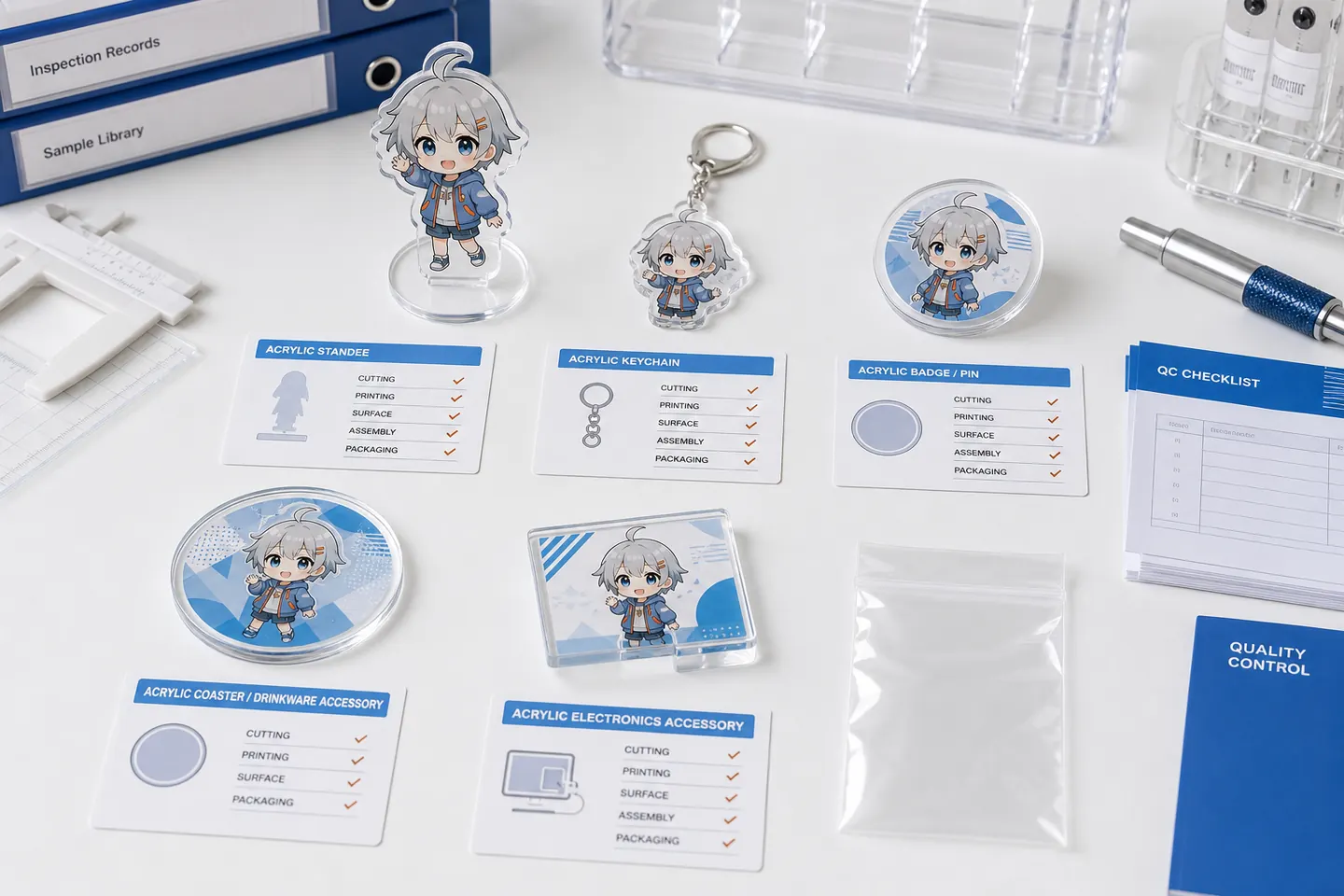
“Acrylic goods” can mean stands, keychains, badges, drinkware-related items, electronic accessories, or composite goods. Each category carries different risks, so appearance, dimensions, color, safety, packaging, and documents are defined separately.
T/CPQS, REACH, EN71, and GB 4806 are handled as candidate standards or test items to confirm project by project. Required tests and documents are finalized according to the final use and buyer requirements.
What We Confirm by Category
| Product category | Candidate standards or documents | Main inspection items | Records before shipment |
|---|---|---|---|
| Acrylic stands / keychains | T/CPQS C010-related checkpoints, internal QC criteria, buyer rules | Scratches, bubbles, chips, white plate shift, color difference, cut line, hole position, thickness, base fit, hardware attachment | Approved sample photos, dimensional checks, defect classification, SKU quantity, backing card / OPP / JAN matching |
| Badges / pins / composite badges | Badge or card-related checkpoints, metal part safety, dye and surface treatment checks | Surface scratches, print shift, pin fixing, edge finishing, bonding strength, surface treatment, color difference, SKU mix-up | Hardware checks, pull checks, surface photos, lot-based inspection sheet |
| Acrylic drinkware-related items | Food-contact material, GB 4806, REACH, and related confirmation candidates | Use case, material documents, odor, print contact surface, heat condition, migration-test need, packaging indication | Required document list, test decision notes, sample photos |
| Electronic accessories | Functional and safety checks for accessories, sales-channel requirements | Insertion, holding force, hanging load, drop, electrical safety if required, part detachment | Function checklist, durability check, abnormality photos, correction history |
| Textile / PVC / metal composite goods | Relevant textile, resin, and metal checks combined by material | pH, color fastness, friction, sewing, bonding, acrylic print durability, packing errors | Material-specific checklist, parts list, packaging confirmation |
Dimensional / Color Control
Compare Drawings, Approved Samples, and Mass-Production Goods Under One Rule
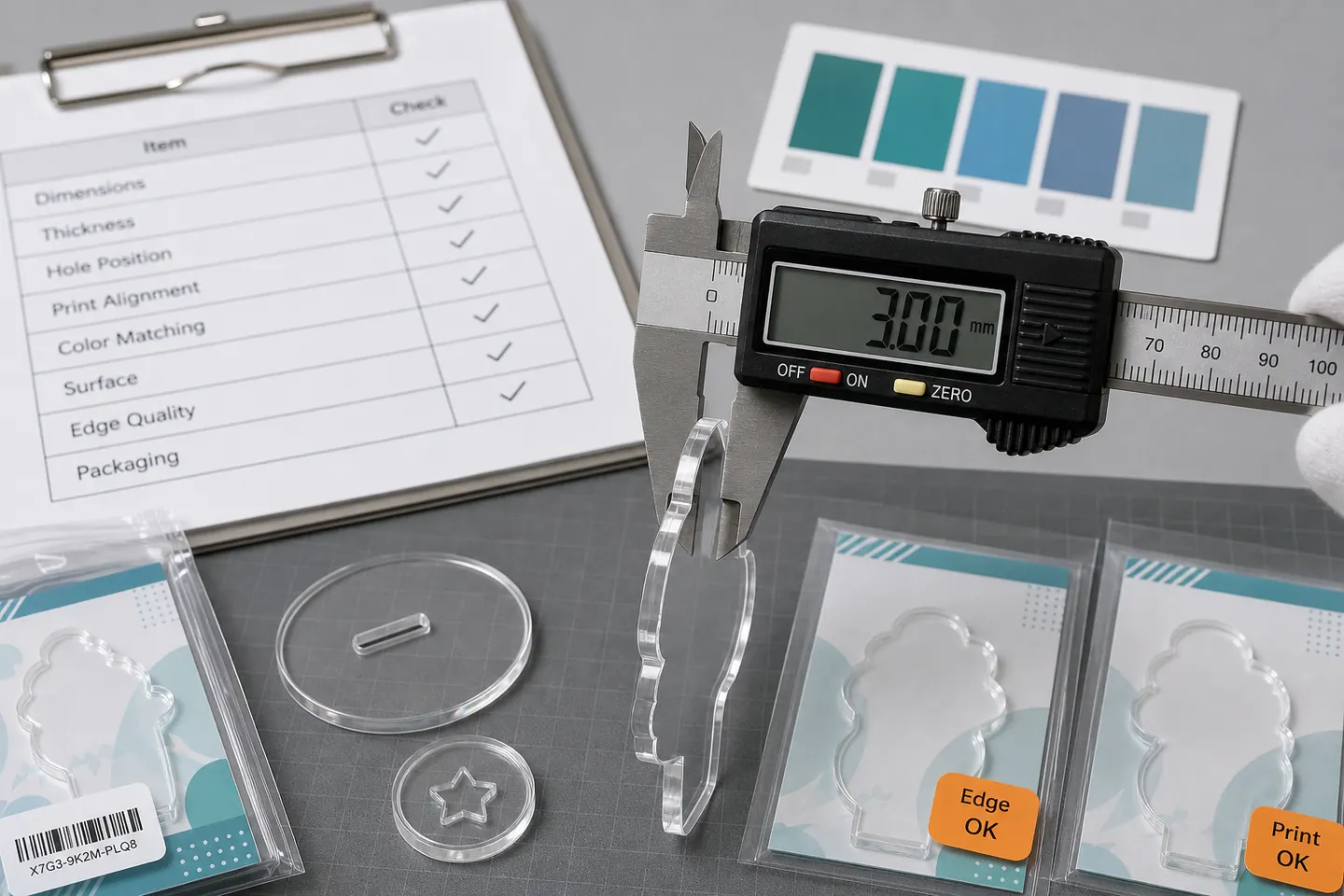
QC criteria should not be created only after mass production. Thickness, tolerance, hole diameter, white plate, print position, and base fit are confirmed during sampling, then mass-production goods are checked against the same approved range.
- Dimensions: finished size, thickness, hole position, base slot, assembled tilt.
- Appearance: scratches, white spots, bubbles, chips, burn marks, film lifting, edge finishing.
- Color: approved sample, artwork data, and mass-production goods are compared together.
- Function: base looseness, hardware rotation, bonding area, hanging strength.
QC Flow from Specification Review to Japan DDP Delivery
Specification review
Drawings, material, thickness, white plate, printing, packaging, target age, and sales-channel rules become the first QC standard draft.
Sampling
The sample is checked for appearance, dimensions, color, function, and packaging. Approved-sample photos and correction notes are recorded.
Mass-production IPQC
During production, sampling checks catch white plate shift, cracks, chips, print defects, and base-fit problems early.
Pre-shipment inspection
We separate full-check items from AQL sampling items and record defect photos, defect rate, judgment, and rework status.
Packaging and JAN
Backing cards, OPP bags, JAN labels, SKU, carton labels, and carton quantity are matched to prevent mix-ups.
DDP delivery
Shipping documents, destination sorting, protective packing, and carton marking are confirmed before Japan-side receiving.
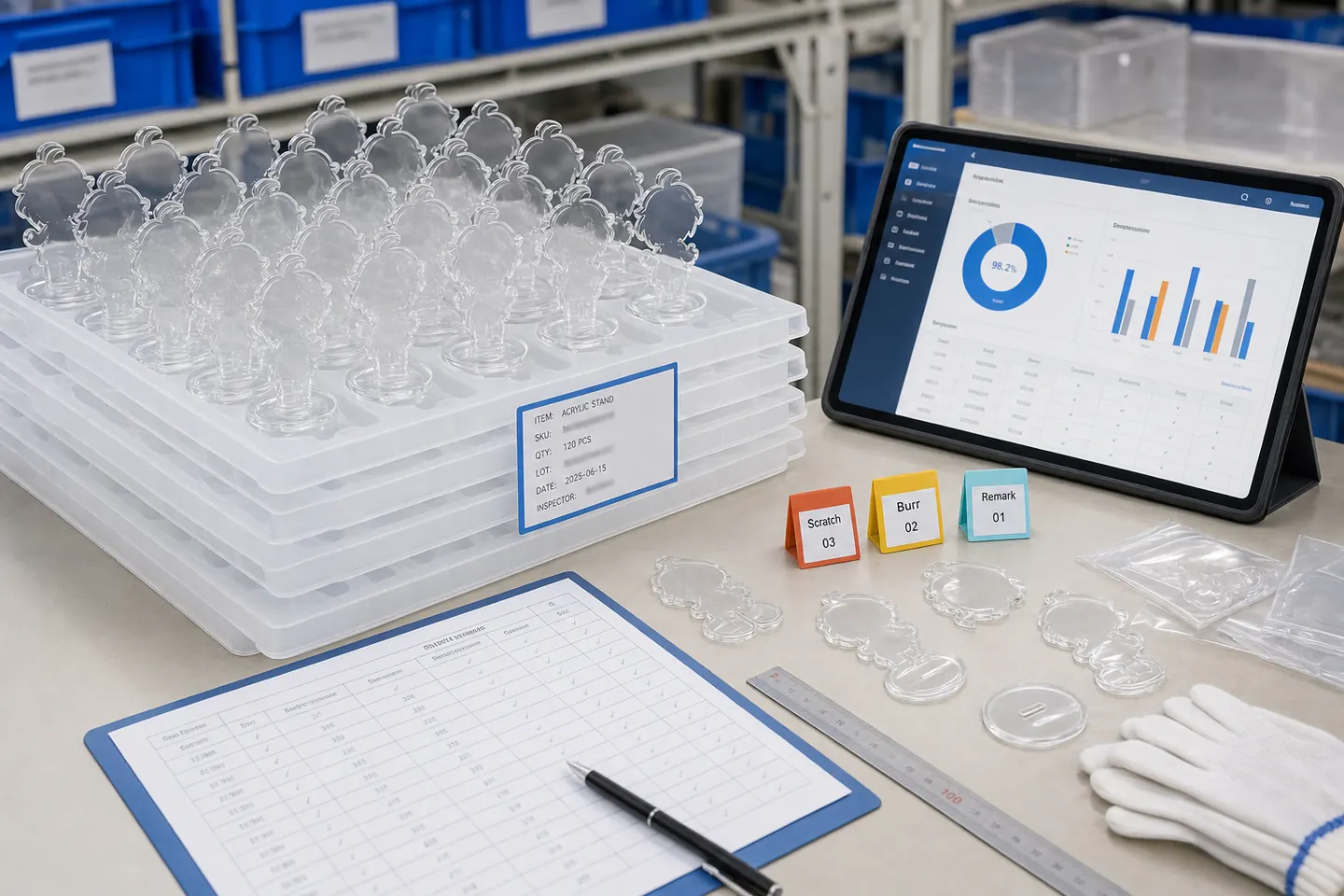
QC Dashboard
A Dashboard Makes QC Progress Easy to Understand
The worst QC status is a vague “inspection is in progress.” For mass production, the buyer should see pass status, top defects, rework count, shipment schedule, and photo records in one report.
JAN / Packaging / Carton
Packaging QC Checks Both Appearance and Logistics Data
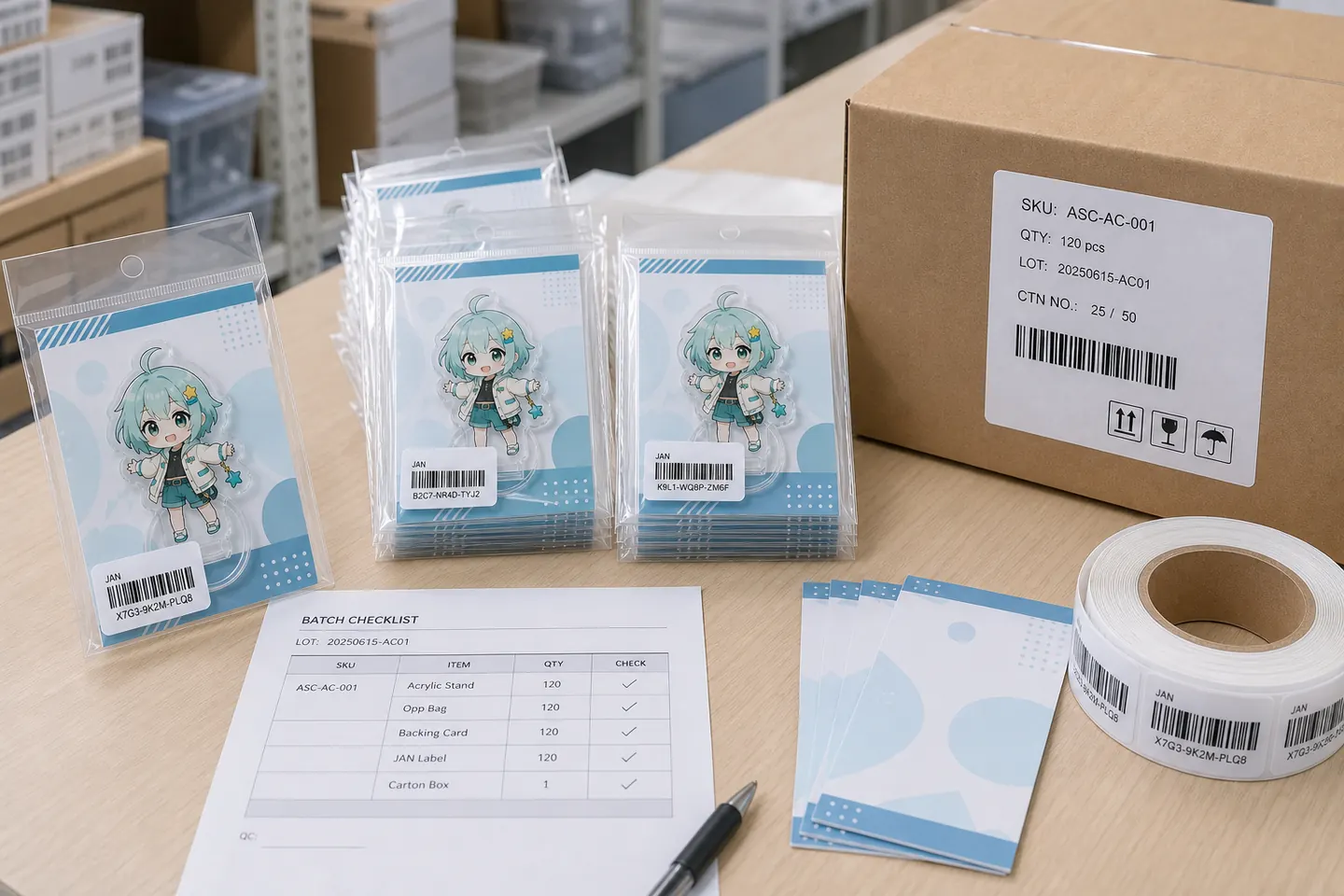
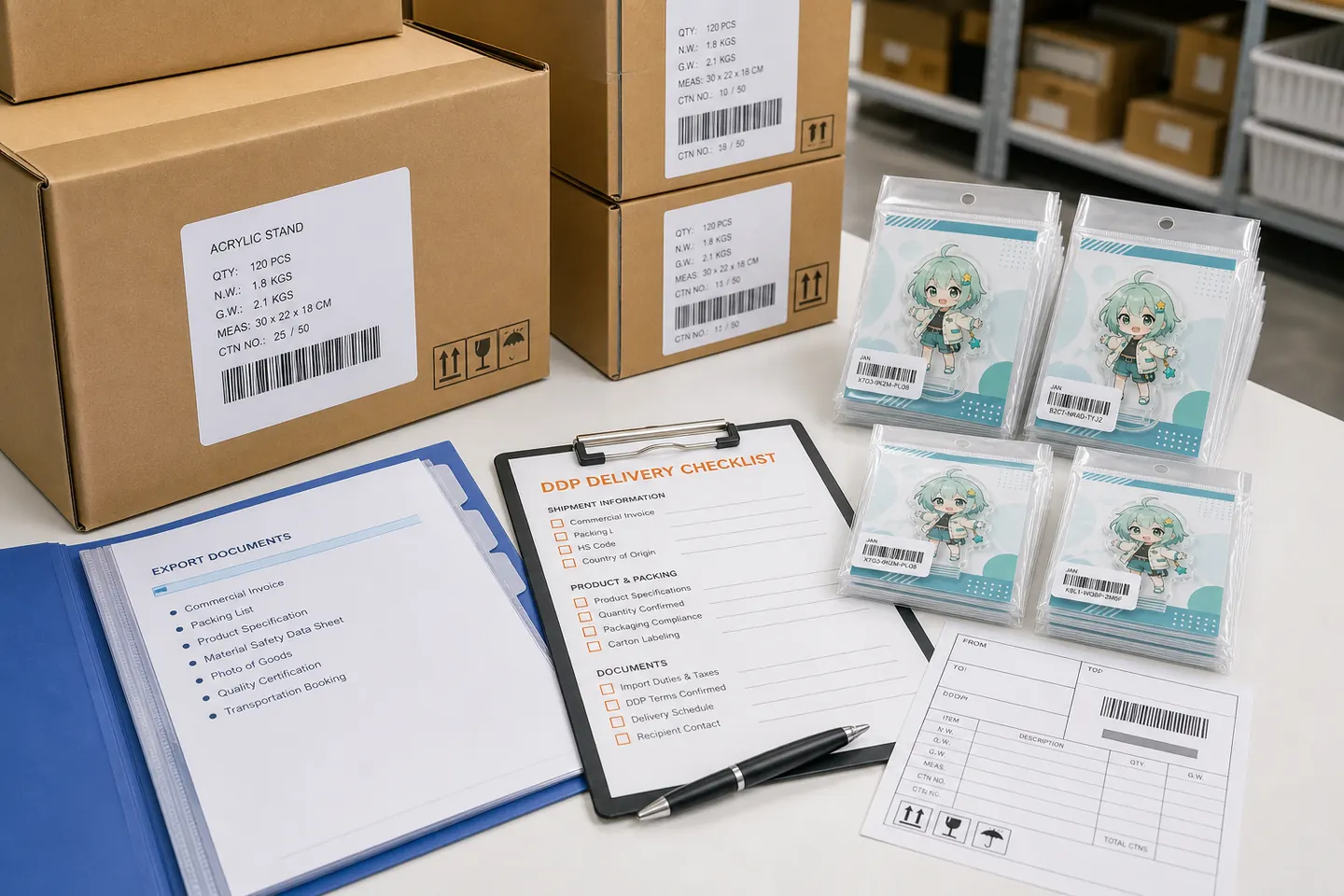
For Japan-facing delivery, beautiful products can still be rejected if JAN, SKU, carton labels, or carton quantity are wrong. Backing cards, OPP bags, JAN stickers, carton labels, lots, and destinations are checked on the same QC sheet.
- JAN and SKU match product, backing card, and carton label.
- OPP bag size, sealing, hang hole, and protective film appearance.
- Carton number, carton quantity, lot, mixed-carton status, and destination.
- Inner packing and carton strength to reduce scratches, cracks, and bending.
Factory Capability / Documents
Factory Capability Should Be Judged by Records, Not Only Big Numbers
Terms such as ISO 9001, SGS, RoHS, REACH, or food-contact material documents depend on the project. We treat them as “availability and document confirmation required,” then finalize which evidence is needed for the actual order.
Records we can prepare
QC standard sheet, approved sample record, pre-shipment inspection report, packaging specification, carton label verification, and candidate test list.
Additional DDP checks
Destination sorting, customs-related documents, carton number, lot, protective packing, shipment photos, and delivery schedule.
48h Quality Standard Comparison
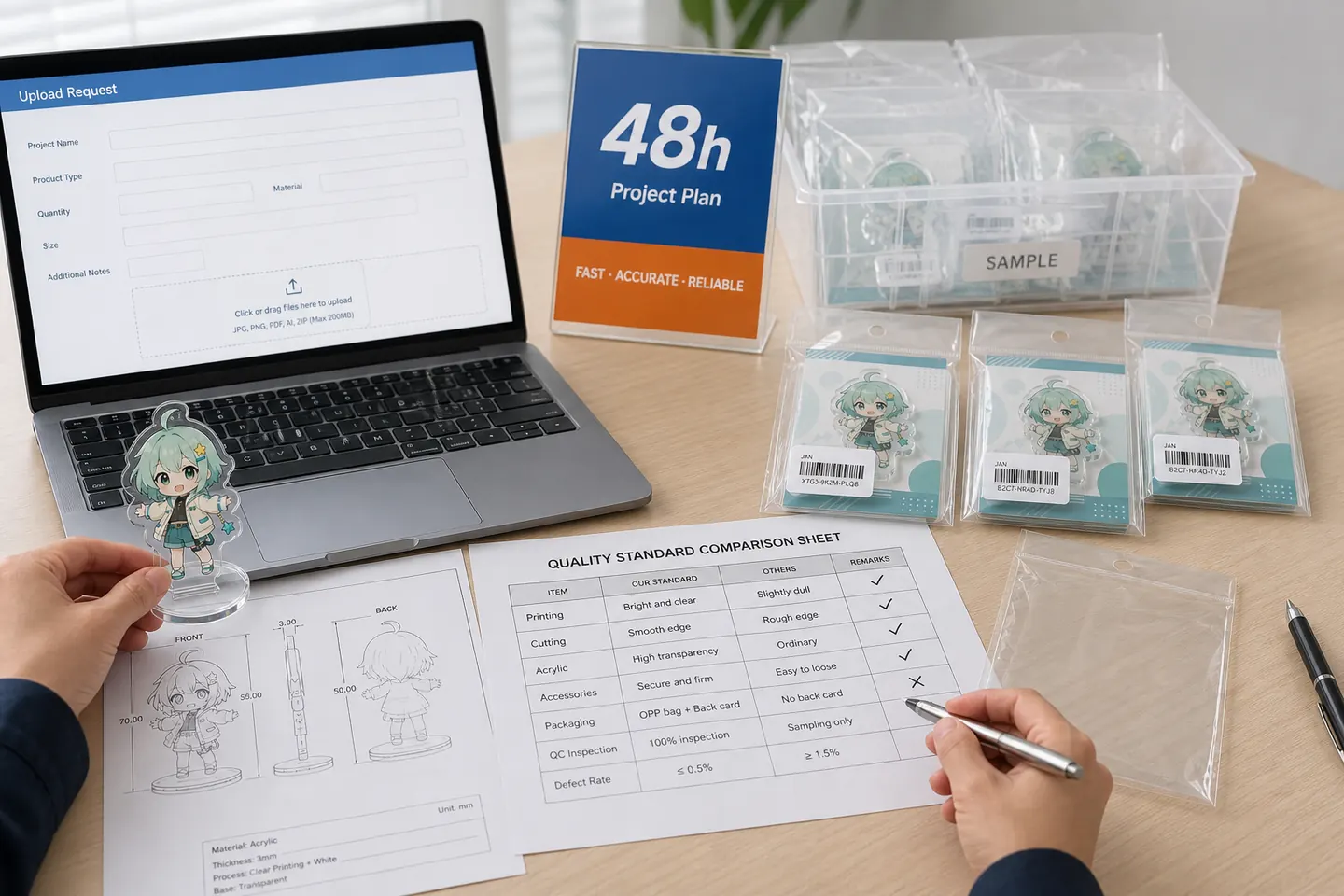
Send Drawings and Specs to Receive a QC Standard Comparison Within 48 Hours
Share drawings, quantity, SKUs, use case, packaging request, JAN status, and destination rules. We will organize which items should be checked 100%, which can follow AQL sampling, and which documents may be required.
Related Pages
FAQ
Are the same inspection criteria applied to every acrylic goods project?
No. Acrylic stands, keychains, badges, drinkware-related items, electronic accessories, and textile-composite items require different checks. At quotation stage, we confirm use case, target age, sales channel, material, print method, and packaging before preparing a project-specific QC standard sheet.
Do names such as T/CPQS, REACH, EN71, or GB 4806 mean the product is already certified?
No. On this page they are treated as candidate standards, regulations, or test items to confirm. The actual tests, certificates, and documents depend on the product use and delivery requirements, so availability and required documents are checked project by project.
Is pre-shipment inspection 100% inspection or AQL sampling?
We separate items that should be checked one by one, such as appearance, packing, JAN labels, and quantity, from items that can follow AQL sampling, such as dimensions, function, and packaging strength. For high-risk, first-run, or urgent projects, the full-check scope can be expanded.
Can you prepare inspection reports for Japan-facing buyers?
Yes. Reports can include photos, defect classification, quantity, judgment, corrective actions, packaging checks, and carton label verification in Japanese or English. If your company has a required format, we can align the report before mass production.
What additional QC checks are needed for DDP delivery to Japan?
Besides product inspection, we verify JAN/SKU matching, carton labels, carton quantity, destination sorting, export documents, and damage-prevention packing on the same project checklist so shipment and warehouse receiving are less likely to stop.
What should we send before quotation to receive a 48-hour quality standard comparison?
Please send drawings or product images, finished size, thickness, material, quantity, SKU count, use case, target age, packaging request, JAN status, delivery destination, required tests, and any sales-channel rules.
Decision framework: Acrylic Goods Quality Inspection
Use this acrylic goods quality inspection to decide and document defect classification and limit samples, inspection level and sampling plan, dimensions and tolerance method, print and surface viewing conditions, assembly and function tests, and pack-out and traceability report. The result should be an approval record that procurement, artwork, production, QC and packaging teams can apply to the same SKU.
Search intent boundary: This page owns the informational and risk-reduction intent for acrylic goods quality inspection. Commercial product terms remain on the related product pages, while this guide answers the pre-production decision.
What to lock before approval
A reliable decision has three parts: a written criterion, a representative finished sample and a repeatable verification method. Screenshots or verbal approvals are not enough when the decision affects material, fit, color, assembly or pack-out. The six controls below should appear in the same quotation, sample record and inspection instruction.
| Decision | What the buyer must define | Acceptable approval evidence |
|---|---|---|
| Defect Classification and Limit Samples | Define defect classification and limit samples by SKU before quotation and do not replace it with a vague good-quality instruction. | Keep an approved dimensioned specification or controlled reference that production and QC can identify during bulk release. |
| Inspection Level and Sampling Plan | Define inspection level and sampling plan by SKU before quotation and do not replace it with a vague good-quality instruction. | Keep an approved artwork proof and component record that production and QC can identify during bulk release. |
| Dimensions and Tolerance Method | Define dimensions and tolerance method by SKU before quotation and do not replace it with a vague good-quality instruction. | Keep an approved representative physical sample that production and QC can identify during bulk release. |
| Print and Surface Viewing Conditions | Define print and surface viewing conditions by SKU before quotation and do not replace it with a vague good-quality instruction. | Keep an approved sellable pack or use-condition check that production and QC can identify during bulk release. |
| Assembly and Function Tests | Define assembly and function tests by SKU before quotation and do not replace it with a vague good-quality instruction. | Keep an approved inspection photo and measured result that production and QC can identify during bulk release. |
| Pack-Out and Traceability Report | Define pack-out and traceability report by SKU before quotation and do not replace it with a vague good-quality instruction. | Keep an approved SKU-linked bulk report and carton trace that production and QC can identify during bulk release. |
Failure risks to close
- Defect Classification and Limit Samples is not controlled: suppliers can interpret the same request differently and the quotation is not comparable.
- Inspection Level and Sampling Plan is not controlled: the physical sample can pass while the wrong revision enters bulk production.
- Dimensions and Tolerance Method is not controlled: packing or use conditions reveal a failure that a loose visual sample did not show.
- Print and Surface Viewing Conditions is not controlled: the buyer cannot separate an isolated defect from a repeated batch or SKU problem.
Quote inputs
- project name and target market for Acrylic Goods Quality Inspection
- editable artwork and the latest revision code
- finished dimensions and quantity for every design
- defect classification and limit samples
- inspection level and sampling plan
- dimensions and tolerance method
- individual packaging, label and barcode requirements
- inspection evidence and acceptance criteria
- delivery destination and required arrival date
Sample-to-bulk control
Approve a finished sample that represents the intended artwork, construction and sellable package. Record the sample date, revision, dimensions, material or component codes, visual limits and function checks. If a later change affects artwork, material, hardware, assembly or packaging, identify the impacted SKUs and obtain a new approval instead of relying on the earlier sample.
For bulk inspection, use the same viewing conditions, measurement points and pass/fail language used during approval. The report should identify the purchase order, SKU, batch, sampled quantity and result. Photographs are useful evidence only when they show the relevant scale, lighting, label or test condition and can be traced to the inspected lot.
When comparing quotations, separate confirmed specifications from assumptions. Ask each supplier to identify exclusions, proposed substitutes, sampling scope, packaging labor and delivery basis. A lower figure is not equivalent when it omits a component, uses a different inspection level or assumes that several designs can share one uncontrolled pack. Close those differences before price approval so the purchase decision remains auditable.