B2B OEM / LIMITED CAFE CAMPAIGNS
Cafe Collaboration Acrylic Merchandise
Build cafe collaboration acrylic merchandise around the campaign journey: character lineup, menu or theme connection, sales format, in-store handling, approval rounds, SKU allocation and the fixed launch window. The product mix must work at the counter and remain traceable after production.
This page owns cafe collaboration planning and campaign execution intent. Acrylic stand, keychain and magnet product specifications remain on their product pages; general IP approval planning remains on the IP collaboration solution page.
DIRECT ANSWER
What buyers should know about cafe collaboration acrylic merchandise
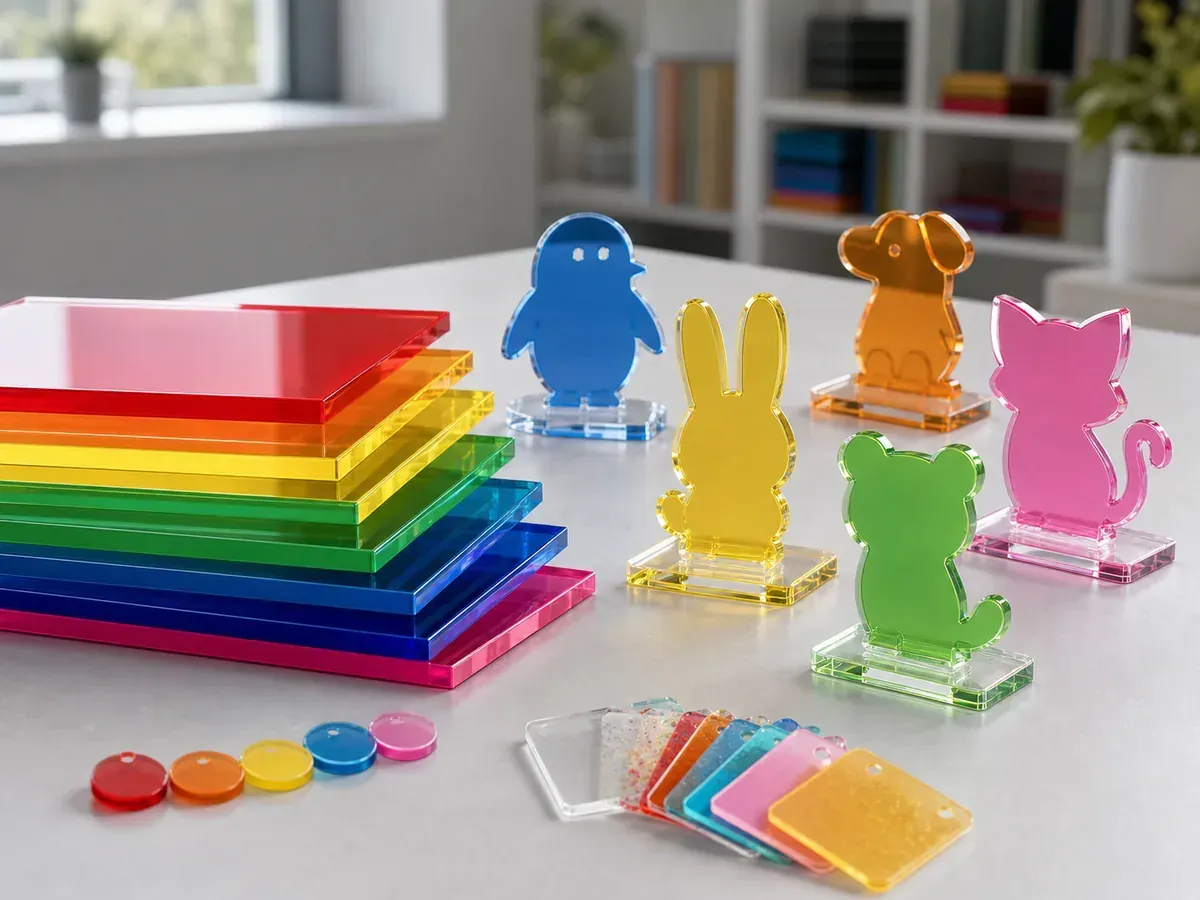
Cafe collaboration acrylic merchandise is a coordinated group of character goods produced for a limited cafe, themed menu, reservation program or venue campaign. The buyer is not choosing one isolated acrylic item. The project usually combines several characters, product formats, sellable packs and delivery points that must be ready for one announced launch.
The campaign brief should identify how guests encounter each SKU. A stand may support table photography or premium set sales; a keychain may suit a lower purchase threshold; a compact charm or magnet may be used as a bonus or add-on. The product role affects size, pack, price architecture and how much counter or stockroom space the merchandise requires.
A cafe project also has a service workflow. Character approvals, menu visuals, campaign copy and store operations can move on different schedules. The merchandise specification should use revision codes and approval owners so a late copy or design change does not silently enter the wrong artwork, backing card or carton label.
For the complete product family, use the Acrylic Goods OEM hub. Keep the distinct page intent in this guide instead of repeating one broad acrylic goods description.
PROJECT DECISIONS
Lock the decisions that define this page intent
A product name or channel name is not a complete production instruction. Record the decisions below before artwork, samples and packaging are released.
Guest purchase path
Define set sale, blind sale, reservation pickup, purchase bonus or menu-linked distribution.
Character assortment
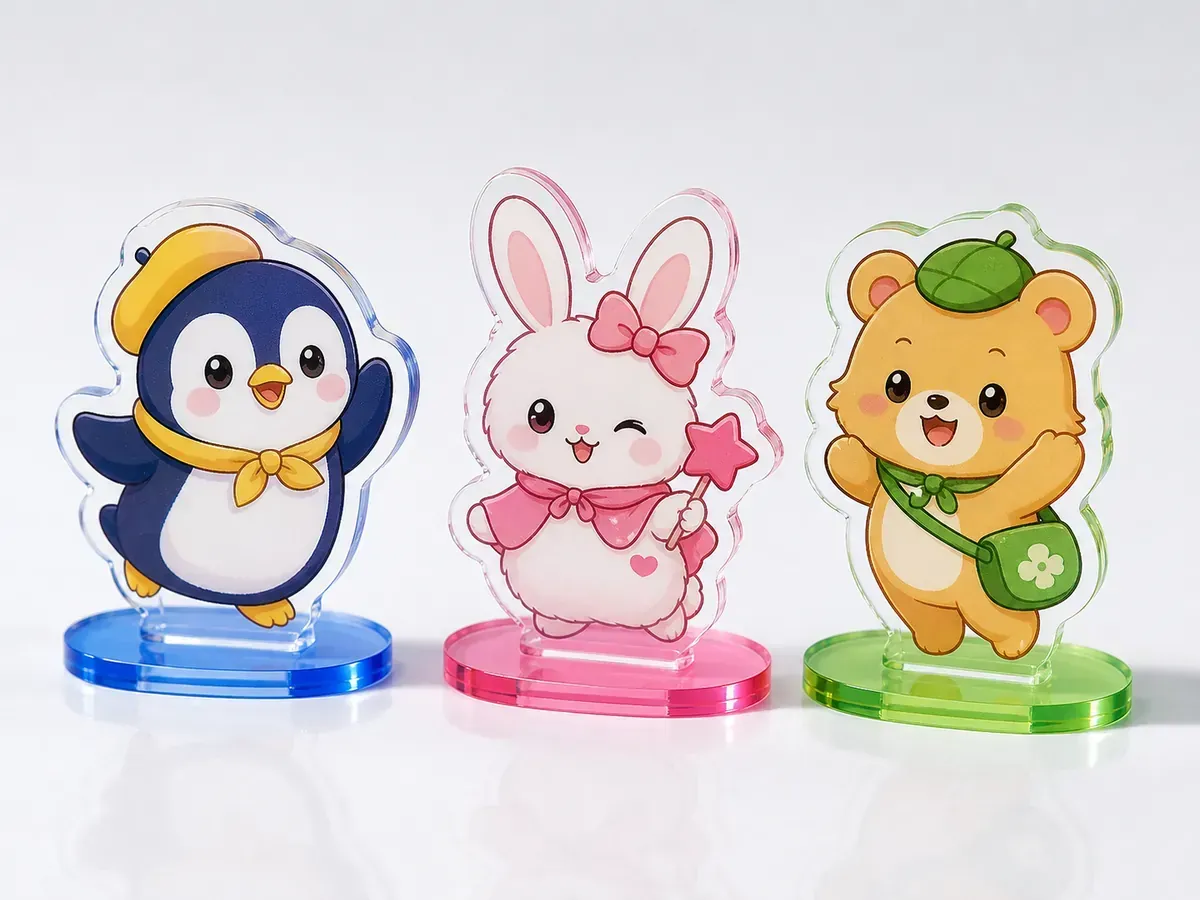
Record every character, pose, costume, rarity and quantity ratio in the SKU matrix.
Counter footprint
Review package dimensions, display method, replenishment and stockroom constraints for each venue.
Launch allocation
Split quantities among cafes, central warehouse, ecommerce and reserve stock before carton labeling.
SPECIFICATION CONTRACT
Build one quote-ready control sheet
Connect the artwork, physical product, package, SKU and delivery data in one revision-controlled matrix. Mark undecided fields for recommendation rather than allowing different teams to assume different specifications.
| Campaign identity | Campaign name, approved logo, collaboration period, venue list, legal copy and asset owner. |
|---|---|
| Product matrix | Format, character, artwork revision, finished size, material, print, hardware or base and quantity. |
| Sales method | Open, blind, set, bonus or reservation distribution with purchase limits and assortment rules. |
| Approval files | Editable artwork, cut lines, white ink, transparent areas, copyright line, card and label files. |
| Retail pack | OPP or opaque bag, backing card, JAN or SKU label, warning text, seal and display orientation. |
| QC evidence | Color proof, assembled sample, sellable pack, assortment count and pre-shipment inspection report. |
| Allocation | Quantity by venue, warehouse, ecommerce, reserve, inner pack and carton mark. |
| Delivery | Required arrival date, receiving hours, destination contacts and rules for split shipments or venue delivery. |
PROGRAM DESIGN
Assign each product a job in the cafe campaign
A coherent assortment uses different acrylic formats for different guest decisions. Keep product-specific search intent on the dedicated product pages while using this page to plan the campaign-level mix.
Table and photo moment
Acrylic stands can reinforce the collaboration theme when size, base stability and safe table handling are approved.
Accessible add-on
Acrylic keychains create a compact choice for guests who want one character without buying a larger set.
Blind assortment
Small acrylic items can support repeat purchase when design codes, randomization and inner ratios are controlled.
Premium bundle
Coordinate one stand, keychain or magnet with a menu or reservation package while keeping components and legal copy traceable.
SAMPLE APPROVAL
Approve evidence that answers production questions
Create one approval matrix that lists the character art, cut line, white ink, product mockup, physical sample, backing card, label and carton mark. Each asset needs an owner, revision code and decision date. This prevents a character pose approved for a menu visual from being mistaken for the merchandise production file.
Review a sellable unit, not only a loose acrylic piece. Cafe teams need to see how the product reads under indoor lighting, how the pack stands or hangs, whether copyright text remains legible and how staff identify the SKU during replenishment. A sample set should represent the highest-risk shapes and color ranges across the character lineup.
- Character art revision
- Copyright and logo line
- Cut and white-ink files
- Physical color sample
- Base or hardware assembly
- Final backing card
- Blind code and ratio
- Venue allocation label
VISUAL EVIDENCE
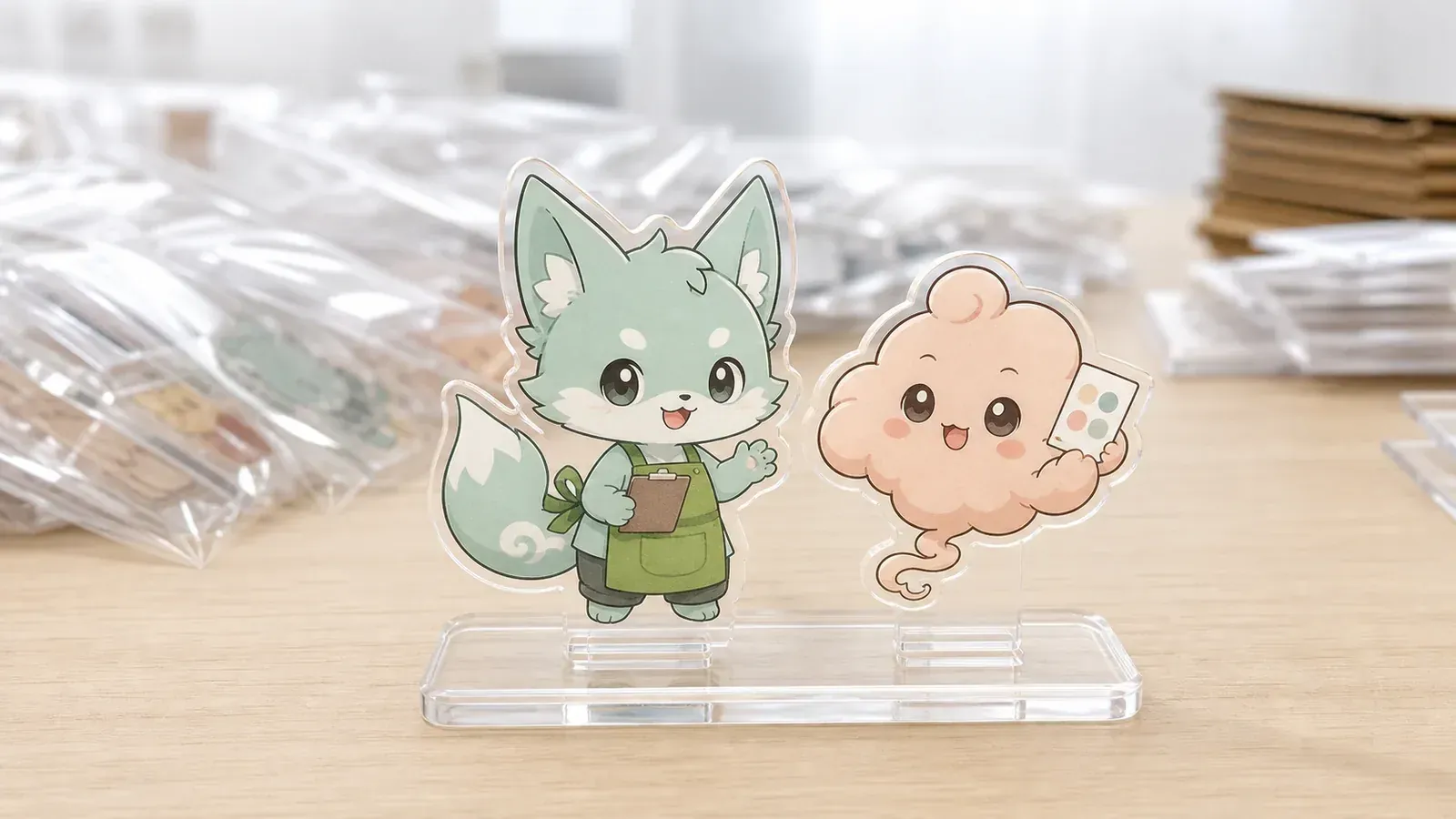
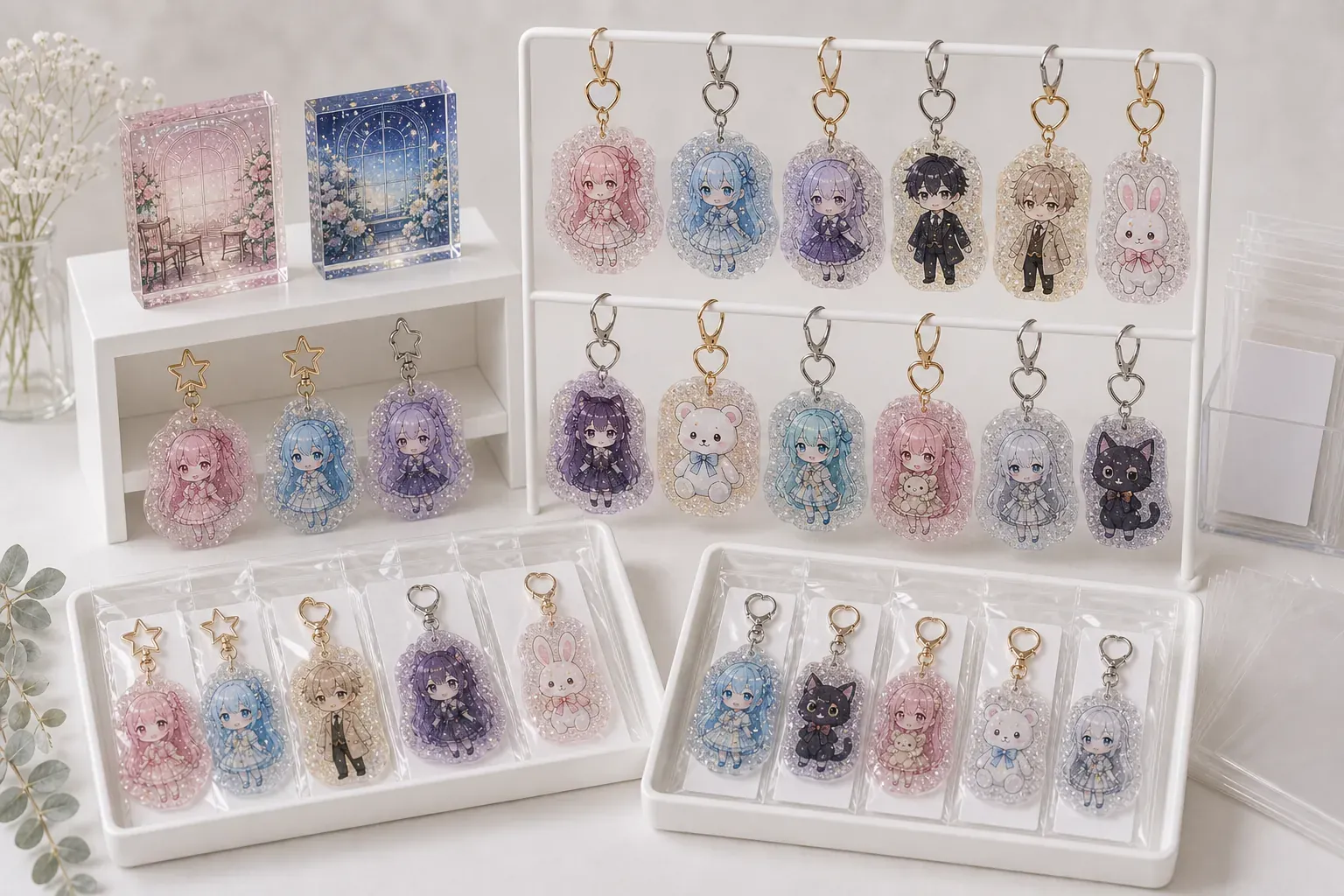
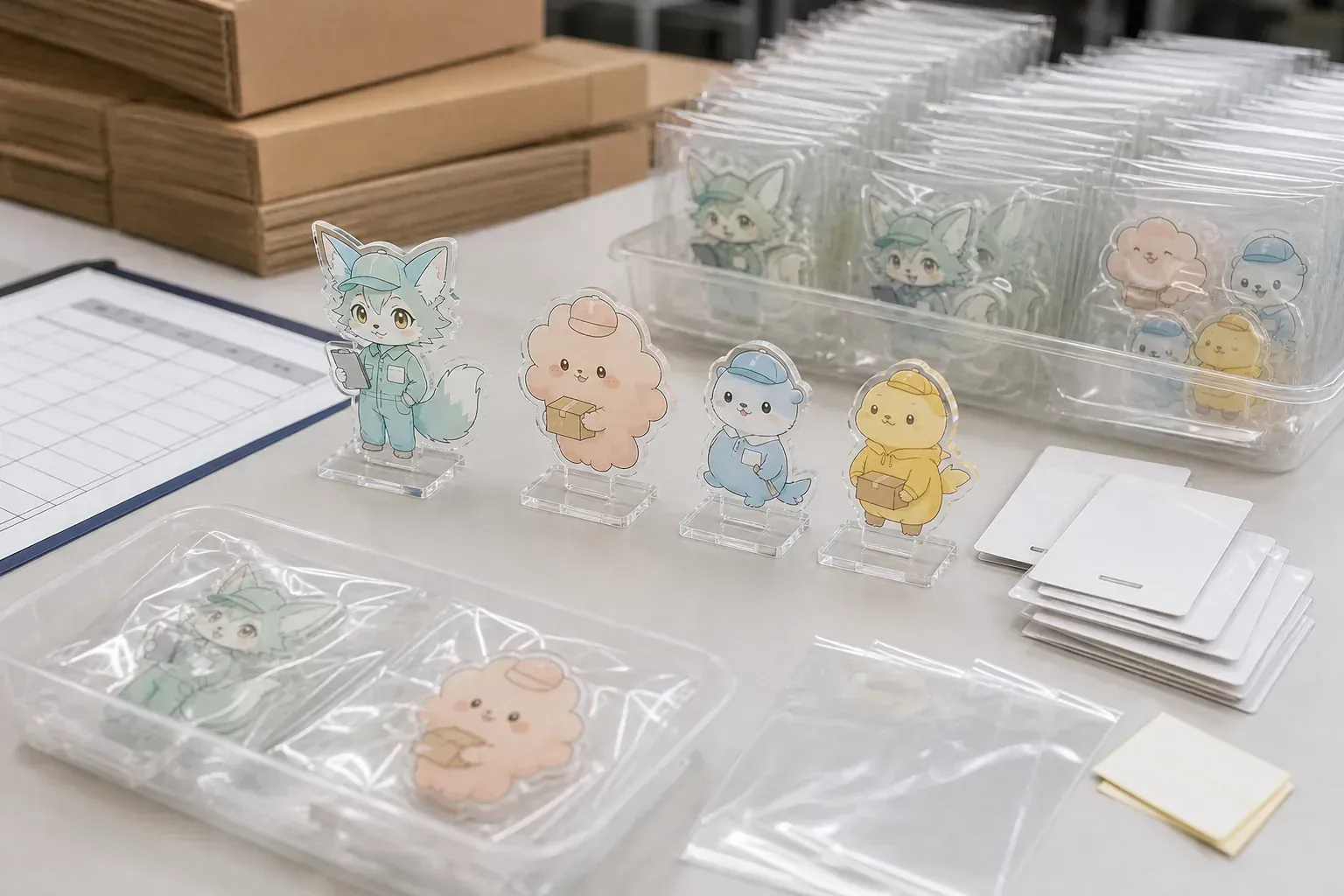
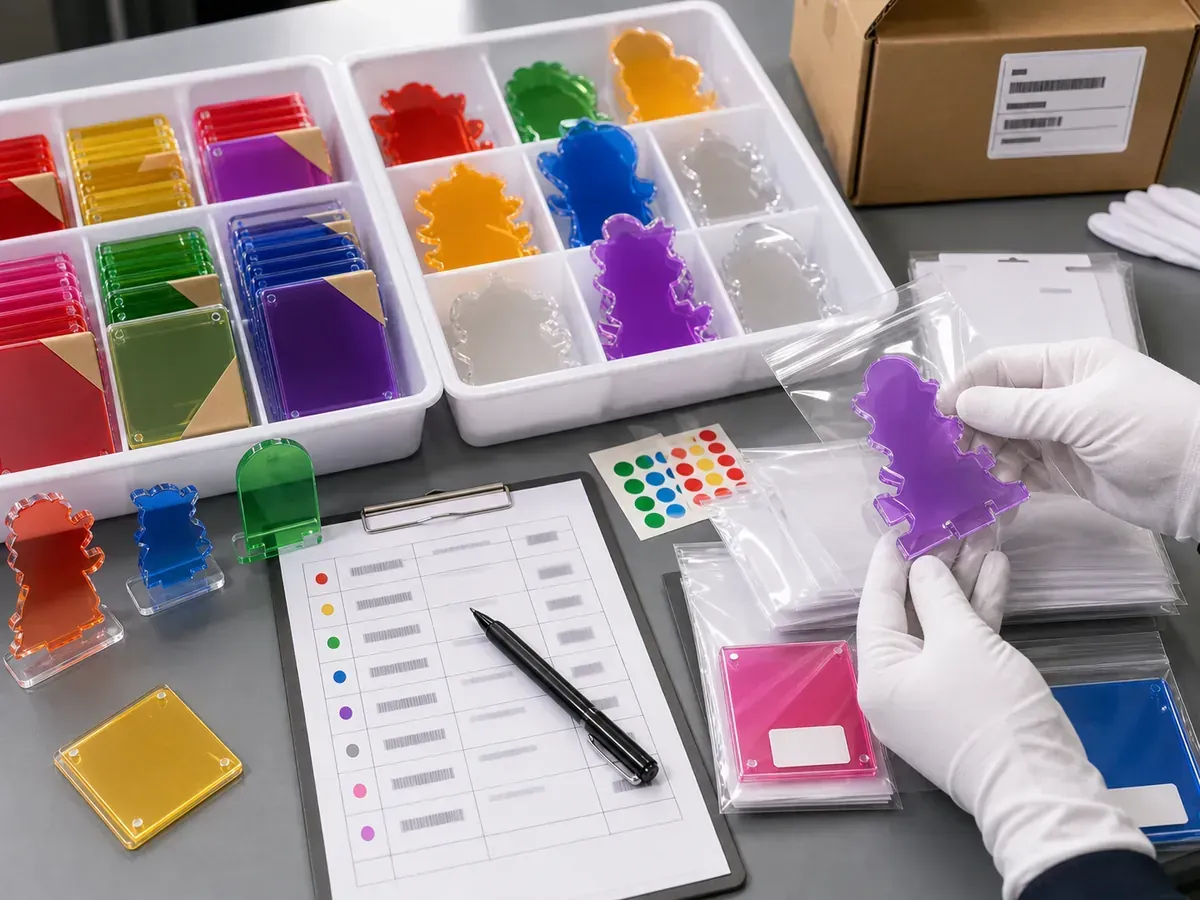
Use real product, packing and QC references
These references support product and process review. The approved physical sample and project-specific specification remain the production authority.
MASS-PRODUCTION RISK
Resolve the failure modes before the bulk release
Risk control is most useful when each failure is tied to a document, sample, inspection method or pack rule.
The campaign theme replaces a SKU matrix
Character, product and pack revisions become mixed during approval or packing.
Every format uses the same dimensions
Table, counter and bag handling differ, so one size rule produces weak display or inefficient packs.
Blind ratios are decided after packing
The factory cannot prove assortment balance or carton traceability.
Copyright copy arrives after sample approval
The pack must be revised without rechecking spacing, legibility and the correct character code.
All stock ships as one undifferentiated lot
Venue teams spend launch preparation time recounting and reallocating cartons.
Launch timing assumes no approval buffer
A late character or package revision consumes production and receiving time without a controlled decision point.
QUALITY CONTROL
Inspect against the approved SKU and sample
Use the Acrylic Quality Inspection guide to plan the sample size and evidence set. The checkpoints below keep this page's distinct buyer intent visible in QA.
| Artwork identity | Verify character, pose, costume, logo and copyright line against the approved matrix. |
|---|---|
| Print and cut | Check color, white ink, registration, transparent zones, dimensions and edge quality. |
| Assembly | Inspect base, hardware, magnet or component count according to the product format. |
| Retail unit | Confirm card, label, seal, display direction, warning text and barcode readability where used. |
| Assortment | Count design ratios, inner quantities and blind codes before cartons are closed. |
| Allocation | Match venue, warehouse and ecommerce carton marks to the approved delivery split. |
PACKAGING AND HANDLING
Protect the product and preserve SKU identity
Packaging is part of the sellable specification. Confirm the final unit before bulk packing and use the Acrylic Scratch-Prevention Packaging guide for surface-risk planning.
Counter display
Keep the retail unit compact, scannable and easy for staff to replenish without exposing hidden designs.
Blind sale
Use opaque packaging, a controlled internal code and verified assortment ratios.
Reservation pickup
Group or label preordered items so staff can identify the correct set without opening the sellable pack.
Venue split
Use destination-specific carton marks and packing lists so each cafe receives the planned character and format mix.
OPERATIONAL HANDOFF
Prepare the cafe team for launch-day receiving and replenishment
Share a destination packing list that a cafe manager can read without the production workbook. It should show carton number, product format, character range, sellable-unit quantity, inner quantity and any opening priority. Reserve or replacement stock should remain clearly separated from launch stock.
Use a short discrepancy process for receiving. If a carton count, label or assortment differs from the plan, the team should record the carton mark and SKU before redistributing pieces. This preserves traceability and avoids solving one venue shortage by creating an undocumented shortage at another venue.
QUOTE CHECKLIST
Information needed for a useful production review
Send known inputs and mark open decisions. Quantity by design, the distinct page-specific decision, packaging and destination are required to compare a practical route.
- Campaign name and launch date
- Venue count and destination split
- Product formats
- Character and design count
- Quantity by SKU
- Editable artwork and legal copy
- Finished size by format
- Open, blind, set or bonus sales method
- Backing cards and labels
- JAN or internal SKU requirements
- Inspection evidence
- Required arrival date
PRODUCTION WORKFLOW
From buyer brief to documented shipment
Timing is confirmed after artwork, specification, sample, packaging, inspection and destination conditions are known. Do not use an unsupported fixed lead-time claim for an unreviewed project.
- 01 BriefIntent, artwork, quantity and destination
- 02 ReviewProduct, SKU, pack and risk decisions
- 03 SamplePhysical evidence for the highest-risk points
- 04 ApprovalOne final controlled revision and matrix
- 05 ProductionManufacture, sort, pack and inspect by SKU
- 06 DeliveryCarton records and agreed destination split
See the complete OEM Order Process.
FAQ
Cafe Collaboration Acrylic Merchandise FAQ
What is the practical MOQ for a cafe collaboration project?
It depends on total quantity, quantity per character and product, material, pack and allocation. Share the full SKU matrix so the practical combination can be reviewed.
Can stands and keychains be produced in one campaign?
Yes. Keep each format on its own specification while linking both to one character and campaign matrix. Product-specific tolerances still need separate sample approval.
How should blind assortments be controlled?
Assign a concealed design code, target ratio, inner quantity, randomization rule and carton trace. Inspect assortment counts before shipment.
What files are required before sampling?
Provide editable character art, cut and white-ink data, logo and copyright line, backing card or label files, SKU matrix and the campaign approval contact.
Can stock be divided among several cafes and ecommerce?
Yes. Provide the quantity by destination and reserve stock before packing so inner boxes, carton marks and packing lists follow the approved allocation.
How is the launch schedule confirmed?
The schedule is confirmed after artwork, product specifications, samples, packaging, inspection and receiving conditions are approved. Build decision dates around the required arrival date.
RELATED RESOURCES
Continue the procurement review
PROJECT REVIEW
Prepare the Cafe Collaboration Acrylic Merchandise brief
Send the artwork, project-specific decisions, quantity by SKU, packaging, inspection needs and destination. Unconfirmed fields can be marked for recommendation.