
B2B OEM / 5 MM THICKNESS
5mm Thick Acrylic Stands
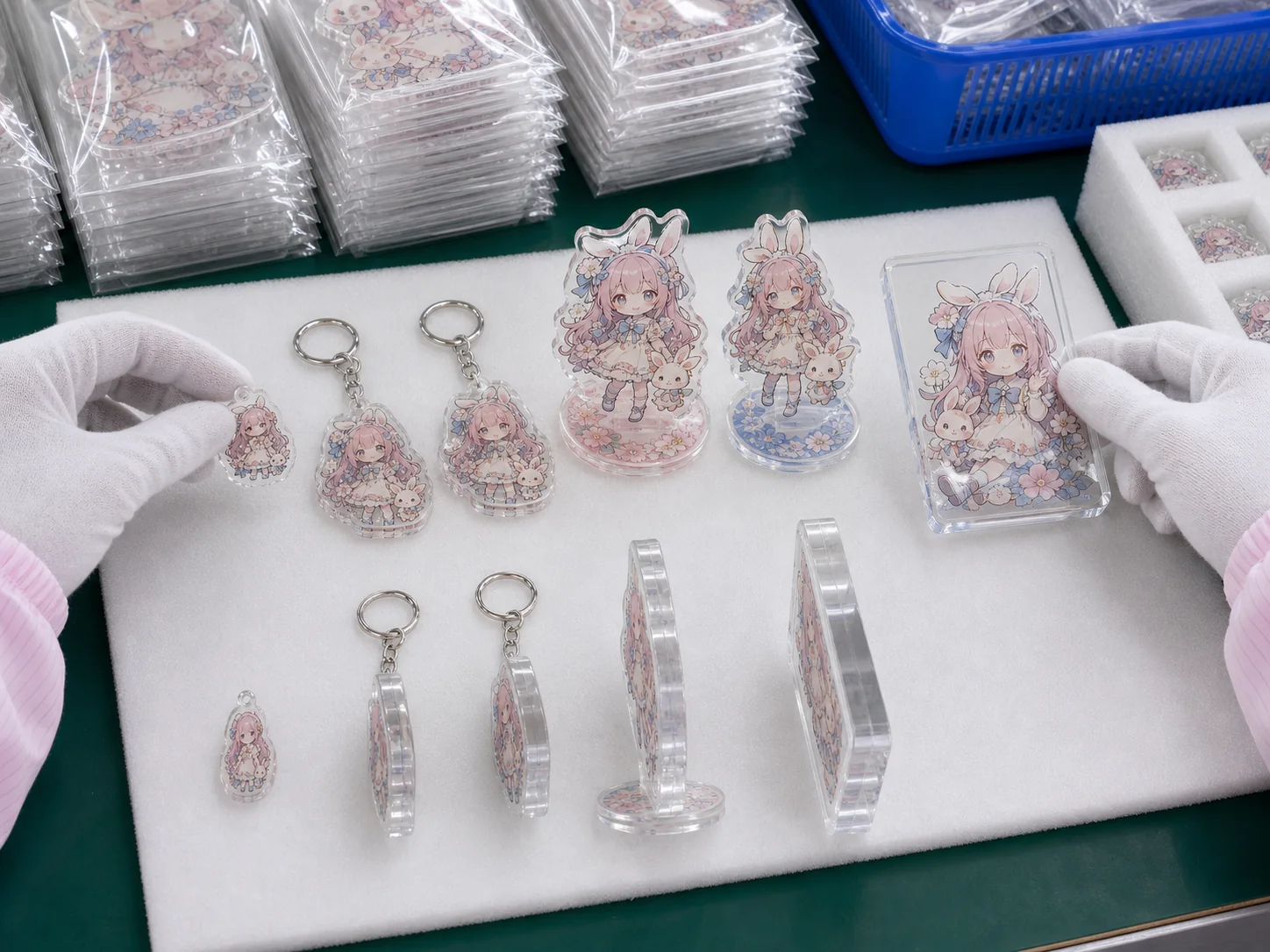
Source 5 mm thick acrylic stands by treating thickness, rigidity, unit weight, base support, slot fit and packaging as one production system. Approve the assembled sample, sellable pack and carton plan before bulk production.
Projects are quoted from finished body and base dimensions, design count, quantity per SKU, actual 5 mm sheet construction, print, packing, inspection scope and destination. Generic stand purchasing remains on the core stand page; lighter 3 mm construction remains on its own thickness page.

PRODUCT DEFINITION
What are 5 mm thick acrylic stands?
A 5 mm thick acrylic stand is a printed display item made from sheet material specified at a nominal 5 mm thickness, normally with a thicker body tab inserted into a matching base slot. Compared with a lighter construction, the thicker body creates a more visible edge, greater rigidity and more mass per finished part.
Those qualities can support a premium display concept, larger silhouettes or products that need a more substantial hand feel. They also change the engineering and logistics: the base must support the assembled center of gravity, the slot must accept the actual thicker tab, and the pack and carton must carry the additional depth and weight without edge pressure or surface rubbing.
For general stand materials, print, base choices and supplier evaluation without a thickness requirement, use the Custom Acrylic Standees page. For compact merchandise where lower weight and pack depth are priorities, compare the 3 mm Acrylic Stands page.
- 5 mm stand: owns the thicker-edge, greater-rigidity, added-weight and heavier-packaging purchase decision.
- 3 mm stand: remains the comparison route for lighter parts, shallower packs and conventional compact merchandise.
- Core stand page: owns generic custom acrylic standees and broad procurement intent; this page owns only 5 mm specification decisions.
5 MM OR 3 MM
Choose 5 mm for a defined product result, not as a quality shortcut
A thicker body can add rigidity and presence, but it does not automatically solve a narrow base, poor center of gravity or incorrect slot. Compare the complete physical products.
| Decision factor | 5 mm thick construction | When 3 mm may be preferable |
|---|---|---|
| Product impression | Use when a visibly thicker edge and more substantial hand feel are part of the merchandise concept. | Use when a lighter profile and familiar compact-stand format better match the range. |
| Rigidity | Can reduce visible flex in larger or wider bodies, subject to the actual cut shape and narrow points. | The body is compact and already meets the handling target without added thickness. |
| Stability | Added mass must be balanced by tab position, base footprint and center of gravity. | A lighter body improves balance on a small base or the base cannot be enlarged. |
| Packaging and freight | Accept additional pack depth, unit weight, inner-carton load and surface separation. | Shipping weight, card strength, pack depth or customer assembly effort must stay lower. |
| Approval rule | Approve the assembled 5 mm sample, finished pack and representative carton load. | Compare physical 3 mm and 5 mm samples when the tradeoff cannot be resolved from drawings. |
SPECIFICATION CONTRACT
Define the 5 mm body, base and shipment as one system
Use one specification to connect the thicker body, load-bearing base, artwork, fit, sellable pack, carton plan and every SKU.
| Sheet construction | Record nominal 5 mm material, project-specific thickness tolerance, clarity or color, protective film and any special finish. |
|---|---|
| Finished body | Record width, height, cut shape, narrow points, tab position, expected unit weight, edge condition and front-facing direction. |
| Base | Define base width, depth, shape, thickness, slot position, artwork direction and the footprint needed to support the heavier body. |
| Tab and slot | Record approved production dimensions, insertion force, visible gap, wobble limit, removal expectation and matching body/base code. |
| Print layers | Separate color, white ink, transparent zones, cut line, tab area and base artwork. Confirm the viewed face and reverse appearance. |
| Stability | Review center of gravity, body height, horizontal reach, body mass, base footprint and behavior on a level surface. |
| Retail packing | Define loose or assembled packing, bag or card strength, separator, film instructions, edge protection and pack depth. |
| Carton plan | List SKU, quantity, inner count, gross-weight target, divider or stacking rule, carton mark and destination split. |
SHEET TOLERANCE
Treat 5 mm as a nominal sheet specification until the sample is measured
A sheet sold as 5 mm can have a project-specific tolerance. Cutting behavior, protective film, tab width, edge treatment and the body/base material pairing can also change the finished insertion result. For that reason, a production slot should not be released from the number 5.00 alone.
Confirm the actual sample thickness at representative body locations and record the approved material construction. If an order mixes clear, colored or effect sheets, check whether every material route can use the same base slot or needs its own fit sample and base code.
- Nominal 5 mm construction
- Measured sample thickness
- Confirmed material tolerance
- Protective film condition
- Cutting route and edge finish
- Body/base material pairing
- Sample revision and date
- Approved insertion force
Do not convert nominal thickness directly into a slot value
The working slot is a production output. It should account for the actual thicker tab, material lot, cutting route, base construction and desired assembly force. Record the approved result in the final drawing so bulk production does not depend on an assumed 5.00 mm value.
Keep the fit decision visible to buyers
For 5 mm parts, record the insertion force, visible gap, slot-edge condition, wobble and whether removal is expected. The acceptable result can differ between factory-assembled retail packs, consumer assembly and a permanent display product.
TAB AND SLOT FIT
Engineer slot fit for a thicker tab and realistic assembly force
Slot fit is a relationship among actual body thickness, tab width and depth, base slot geometry, material route and expected assembly behavior. With a thicker tab, excessive insertion force can chip the slot edge, stress the base or make consumer assembly difficult. An overly loose slot can still produce lean or wobble despite the added body mass.
Review insertion on production-style samples made from the intended material and cutting route. Test representative body/base pairs on a level surface, remove and reinsert where the product is designed for consumer assembly, and inspect the tab shoulder and slot edge after the test.
- Thick-tab geometry: width, depth, shoulder radius, corner shape and distance from critical print.
- Supporting-slot geometry: production width, length, depth, wall strength, corner treatment and distance from the base edge.
- Fit result: insertion force, visible gap, wobble, removal behavior, slot-edge condition and stability after packing or transport.
Use the Acrylic Stand Base Design guide when planning shared bases, unusual shapes or tight footprints.

RIGIDITY AND STABILITY
Use added rigidity without confusing mass with balance
A 5 mm body can feel more rigid and substantial, but its additional mass also increases the load carried by the tab and base. Stability still comes from geometry.
Overall height
Taller bodies create more leverage at the thicker tab and can increase the load on a small base.
Horizontal reach
Wide poses and off-center props can shift a heavier body's center of gravity beyond the footprint.
Narrow sections
Added thickness does not remove stress at thin connectors, sharp internal corners or tab shoulders.
Base footprint
Base width, depth and weight distribution should support the actual assembled center of gravity.
Base thickness
The base construction and slot depth must support the body without creating weak walls or edge cracks.
Shared base risk
One slot may fit several bodies, but a taller or wider 5 mm SKU can require a different footprint.
Display surface
Test on the intended flat surface and define an acceptable wobble or lean reference from the sample.
Lighter alternative
Compare 3 mm when added mass creates packing, assembly or balance problems without buyer value.
WEIGHT AND CARTON LOAD
Plan unit weight, inner quantity and carton handling together
Moving from a lighter sheet to a 5 mm construction increases material volume for the same face area. The exact unit and carton weights depend on the finished body, base, design count and packaging, so they should be calculated from approved samples rather than estimated from thickness alone.
Finished unit
Record the sample weight of the body, base and completed sellable pack for each representative size.
Backing support
Confirm that cards, hang holes, bags and seals support the heavier parts without tearing or distortion.
Inner quantity
Set the number per inner pack from actual stack pressure, handling convenience and SKU control.
Carton loading
Review gross weight, divider strength, layer count, void space and whether mixed SKUs need separate inners.
Surface pressure
Prevent rigid body and base edges from pressing directly against printed faces during stacking.
Destination split
Use carton marks and allocation data when stock is divided by event, warehouse, region or retail channel.
Handling test
Review a representative packed carton for movement, compression and missing-part risk before shipment.
Quote impact
Freight and packing comparisons require finished dimensions, pack format, inner count and destination.
PRINT AND ARTWORK
Coordinate print layers with the more visible 5 mm edge
The artwork file should separate the body and base into named production layers. Color, white ink, cut line, tab, base slot and transparent zones need independent review. A thicker clear edge can become a deliberate part of the product appearance, while a colored or effect sheet can alter edge color and perceived print contrast.
Keep important faces, text and logos away from cut edges, tab shoulders and areas covered by the base. Define the intended viewed face, reverse appearance and transparent zones. The physical sample should confirm color density, white-ink registration, edge appearance, reflections and the assembled orientation under realistic display light.
- Editable color artwork
- Separate white-ink layer
- Body cut line
- Tab geometry and safe area
- Base outline and slot
- Transparent or no-white zones
- Front and reverse direction
- SKU naming and revision
Review the Acrylic Artwork Data Guide before sample submission.
Use the edge as a specified visual surface
Record whether the buyer expects a clear, colored or effect edge and whether protective film remains for delivery. Edge chips, residue and inconsistent polish are more visible when thickness is part of the value proposition.
Mechanical edits still require artwork review
Changing the thicker tab, slot, base footprint or overall body size can move printed details relative to cut edges. Treat those changes as both mechanical and graphic revisions before releasing the final file.
SAMPLE APPROVAL
Approve the 5 mm stand, sellable pack and carton evidence
Bulk production should not be released from an isolated print proof. The approval unit includes the thicker body, supporting base, finished pack and representative loading plan.
Define the 5 mm objective
Record the required edge presence, rigidity target, finished size, display environment and pack format.
Lock body and base geometry
Confirm cut lines, thicker tab, slot, base footprint, orientation and all finished dimensions.
Review print and edge
Approve color, white ink, transparency, visible edge, protective film and every SKU revision.
Test fit and balance
Check measured thickness, insertion force, slot edge, wobble, center of gravity and level standing.
Approve pack and weight
Record sample unit weight, pack depth, separators, card strength, inner count and surface protection.
Release one revision
Consolidate geometry, artwork, fit, packing, carton and inspection changes before production.
MASS-PRODUCTION RISK
Failure risks to resolve before bulk production
Slot is copied from 5.00 mm
Nominal thickness alone does not account for actual material, cutting route or required assembly force.
Thickness is treated as stability
A heavier body can still tip when the center of gravity falls outside an undersized base footprint.
The slot wall is overloaded
A tight thick tab or shallow wall can chip the base, stress the slot edge or frustrate consumer assembly.
Narrow points are assumed safe
Greater thickness does not remove stress around sharp internal corners, connectors or tab shoulders.
Pack strength is copied from 3 mm
A heavier unit may bend cards, tear hang holes or create excess stack pressure inside the carton.
Body and base SKUs are mixed
Similar parts require matching codes, labeled trays, pack records and final carton checks.
Rigid edges rub printed faces
Loose body and base parts can scratch or pressure-mark surfaces without separators and film control.
Bulk material differs from sample
A changed sheet construction or tolerance should trigger fit, edge and weight review before release.
QUALITY CONTROL
QC checkpoints for thick bodies, supporting bases and packed units
Inspection criteria should follow the approved physical sample and final specification. For a 5 mm program, the scope should connect sheet construction, measured thickness, visible edges, body/base fit, balance, unit weight, packaging accuracy and pre-shipment carton checks.
- Material and dimensionsConfirm the approved 5 mm construction, body and base dimensions, tab, slot and representative measured thickness.
- Print, white ink and edgeReview color density, registration, white halos, transparency, viewed face and the intended thick-edge appearance.
- Cut and visible edgeInspect chips, cracks, narrow points, tab shoulders, thicker-edge appearance, residue and protective film.
- Fit and stabilityCheck representative pairings for insertion force, slot-edge condition, wobble, balance and level standing.
- SKU and load accuracyMatch each body to its approved base, stronger card or bag, label, inner quantity and carton plan.
- Pack and cartonVerify sample unit weight, separators, card or bag strength, inner quantity, carton load, mark and destination split.
See the Acrylic Goods Quality Inspection guide for inspection planning.

PACKAGING
Protect heavier parts from rubbing, pressure and card failure
Loose body-and-base packing can limit assembled depth, but it creates rigid parts that must remain matched and separated. Define whether the parts share one bag, use individual sleeves, attach to a stronger backing card or require a divider between the printed body and base.
Protective film instructions should be clear if film remains for delivery. Check whether the bag seal, card, hang hole, inner pack and outer carton support the finished 5 mm unit weight. The packing code should connect body, base, card, barcode or label, set rule, inner count and destination.
Individual retail
Body, base, separator, reinforced card or bag, label and film instruction controlled as one unit.
Blind merchandise
Opaque pack strength, design code, randomization rule, base count and inner-box load.
Multi-piece set
Correct combinations, pressure separation, assembly guide, weight check and missing-part control.
Event fulfillment
Quantity by SKU, manageable carton loads, destination split and venue or warehouse labels.
Review the Acrylic Stand Breakage-Prevention Packaging guide before approving the final pack.

MULTI-SKU CONTROL
Link each heavier body to its approved base, pack and carton rule
Character stand programs often contain similar silhouettes, shared bases, color variants or sets. The order matrix should give each body and base a controlled identifier and show whether the base, pack material and inner quantity are unique or shared.
Labeled work-in-process trays, packing records and carton checks reduce mixups. A shared slot does not prove that every heavier body has the same balance or packing load. Test each representative geometry and prohibit substitution unless the approved dimensions, artwork, weight range and pack rule match.
- Body SKU, revision and sample weight
- Base SKU and orientation
- Shared or unique base rule
- Quantity per design
- Card and barcode mapping
- Pack or set code
- Approved inner quantity
- Carton weight and destination split

QUOTE CHECKLIST
Information needed for an accurate 5 mm stand quote
Unconfirmed items can be marked for recommendation. Include enough geometry and packing data to compare material use, base support, unit weight and shipment conditions realistically.
- Artwork for every body and base
- Finished body width and height
- Nominal 5 mm material and edge intent
- Body cut line and thick-tab geometry
- Base footprint, thickness and slot
- Color, white-ink and transparent layers
- Front direction and reverse appearance
- Shared or unique base rule
- Total quantity and quantity per SKU
- Individual, blind or set packaging
- Card strength, inner count and labels
- Arrival date, destination and shipment split
ORDER CONDITIONS
MOQ, sampling and delivery depend on the complete 5 mm specification
Quantity and schedule cannot be confirmed from thickness alone. Finished size, material use, number of designs, supporting base, unit weight, packaging labor, carton plan, inspection scope and destination all affect the practical route.
Quantity per SKU
Share total volume and the split by approved body, base, pack format, inner count and destination code.
Sample scope
Identify which body sizes, base footprints, edge effects, print layers, pack formats and weight classes need approval.
Bulk schedule
Timing is confirmed after artwork, 5 mm material, fit sample, weight evidence, packing materials and inspection conditions are approved.
Delivery plan
Provide the country, destination, arrival date, shipment split, carton-weight constraints and venue or warehouse requirements.
PRODUCTION WORKFLOW
From 5 mm specification review to shipment
- 01 InquiryArtwork, dimensions, quantities, packaging and destination
- 02 ReviewMaterial, body, base, tab, slot, layers and SKU matrix
- 03 SampleMeasured thickness, edge, print, fit, balance, pack and weight
- 04 ApprovalOne final artwork and specification revision
- 05 ProductionManufacturing, matching, weight-controlled packing and QC
- 06 DeliveryCarton load, labels, documents and agreed shipment
Review the complete OEM order process before scheduling artwork submission and sample approval.
FAQ
5 mm custom acrylic stand FAQ
Does 5 mm acrylic automatically make a stand more stable?
No. A 5 mm body adds thickness, rigidity and mass, but stability still depends on body height, horizontal reach, center of gravity, tab position, base footprint and slot fit. Approve the complete assembled sample rather than treating thickness as a substitute for base engineering.
Should the base slot be exactly 5.0 mm wide?
Do not release the slot from the nominal sheet thickness alone. Actual sheet tolerance, cutting route, tab geometry, base material and the required insertion force all affect fit. Approve the 5 mm body and matching base as one physical sample and record the final production dimensions.
When is a 5 mm stand preferable to a 3 mm stand?
Consider 5 mm when the product concept needs a visibly thicker edge, greater body rigidity, more physical presence or a different premium display feel. The decision should also account for added unit weight, base design, package depth, carton load and shipping handling. Compare physical samples when geometry alone does not settle the choice.
What artwork and specification files are needed for a 5 mm acrylic stand?
Provide editable color artwork, white-ink data, cut lines, tab and slot geometry, base artwork and transparent zones as separate named layers. Add finished body and base dimensions, 5 mm material intent, front direction and a SKU list linking every body to its base and packaging code.
How should the added weight of 5 mm parts affect packaging?
The packaging plan should account for part-to-part rubbing, rigid-edge pressure, bag or card strength, body-and-base separation, inner quantity and carton weight. Individual bags, backing cards, opaque packs, sets, labels and reinforced dividers can be reviewed against the actual sellable unit and shipment plan.
How are MOQ, sampling and delivery timing confirmed?
They are confirmed after finished body and base dimensions, design count, quantity by SKU, 5 mm material route, pack strength, inner count, inspection scope and destination are known. Release bulk production only after the assembled sample, finished pack and final specification revision are approved.
RELATED RESOURCES
Continue the acrylic stand review
PROJECT REVIEW
Prepare a 5 mm acrylic stand specification
Send the artwork, body and base dimensions, 5 mm material intent, quantity by SKU, pack format, inner count and delivery destination. Unconfirmed items can be marked for recommendation.