B2B OEM / JAPAN MARKET
Blind Pack Acrylic Keychains
Multi-SKU planning and blind packaging.JAN control and inspection.IP data handling and DDP delivery terms.Organized from a procurement point of view.
SHORT ANSWER
What should be decided first for oshi acrylic keychain OEM?
Single-item sales, random blind packaging, and lottery prizes require different bags, backing cards, JAN labels, and carton markings.
Artwork quantities, spare quantities, assortment ratios, and insert instructions are made visible before mass production.
NDA needs, sharing scope, sample photos, and disposal records for defective goods are reviewed according to the project conditions.
SKU OPERATIONS FLOW
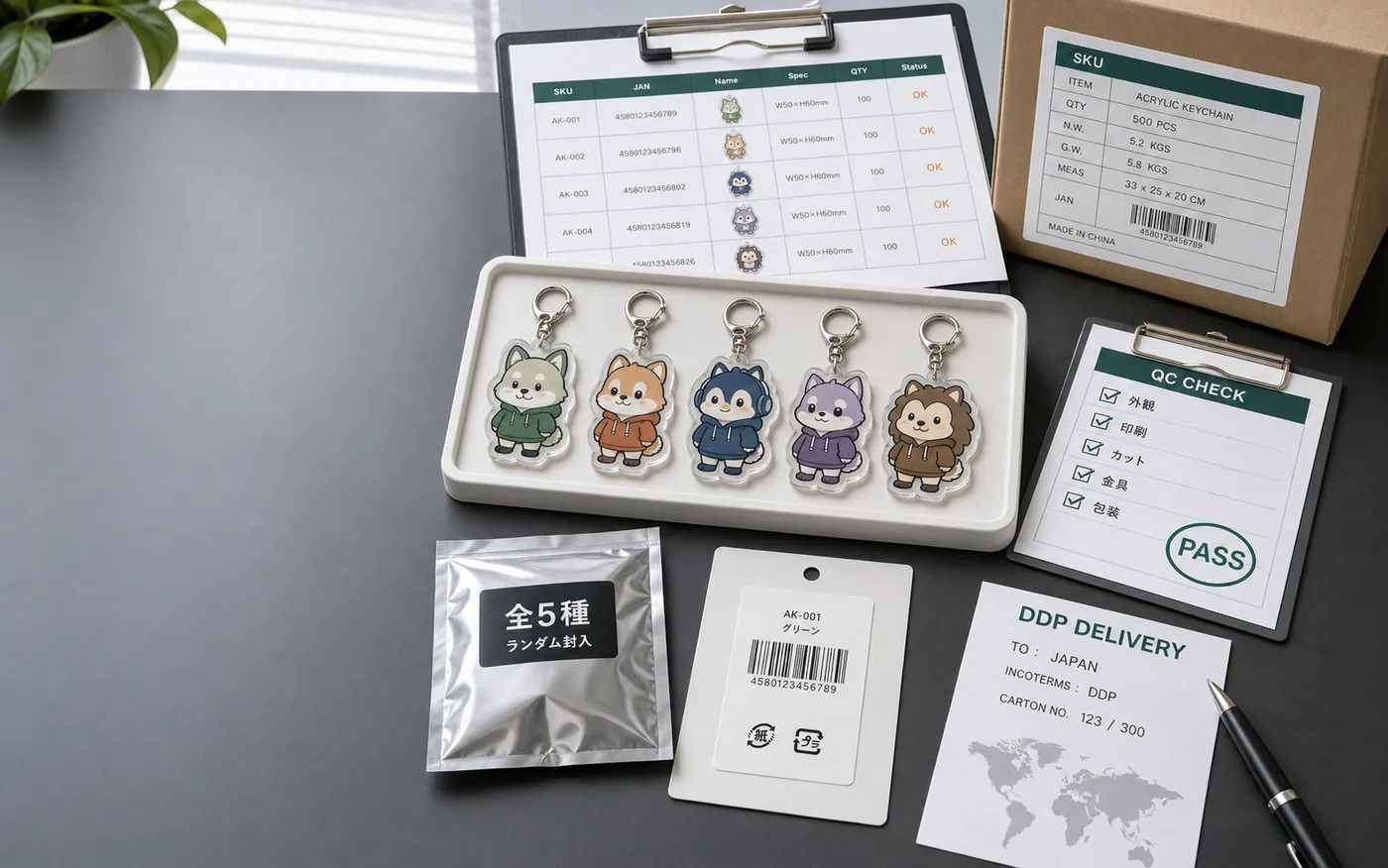
From product planning to delivery in Japan, the project is managed by SKU.
For oshi merch, the question is not only whether the item can be produced. Buyers also need to know which SKU is delivered, in what quantity, and to which destination. Specifications, packaging, inspection, and delivery terms are organized in the same control sheet to reduce misunderstandings.
Confirm size, thickness, fittings, and SKU setup
Review temporary terms and physical samples
Manage printing, cutting, and fitting assembly
Silver bags, backing cards, JAN, carton labels
Check appearance, inserts, quantity, and labels
Organize DDP terms, warehouse, and venue delivery
SPEC CONFIRMATION
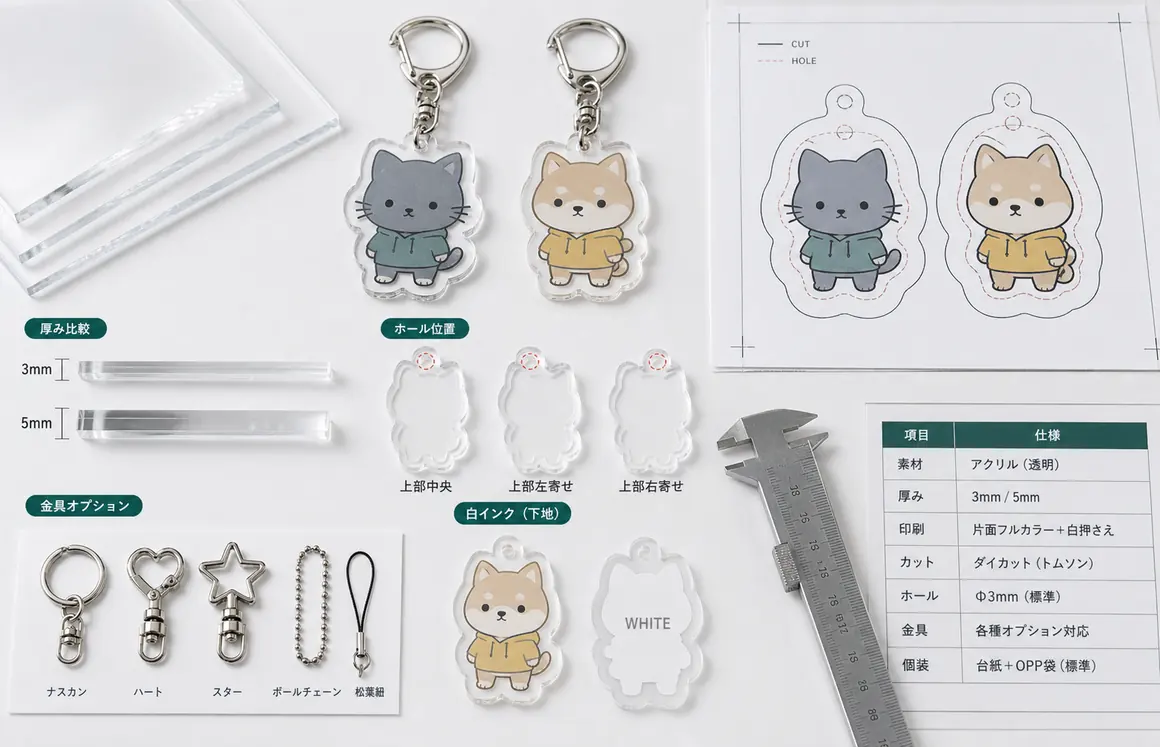
Acrylic keychain specifications should be organized from the selling price and use case.
Oshi acrylic keychains are affected not only by transparency and color reproduction, but also by attachment to bags or pouches, bundling with cards, and packaging for random sales. Even when details are not final, temporary specifications can be set to organize quotation conditions.
| Acrylic material | Clear, colored, or special-expression acrylic can be reviewed according to appearance and budget. |
|---|---|
| Size / thickness | From common oshi merch sizes to larger formats, hole position and breakage resistance are reviewed together. |
| Printing / white ink | Single-sided, double-sided, white ink areas, transparent effects, and color checking conditions are organized. |
| Fittings | Lobster clasps, ball chains, key rings, and other fittings are selected according to use and unit-cost conditions. |
BLIND PACKAGE / SKU
Blind packaging, JAN labels, and carton marks should reduce work after arrival.
For event merchandise, lottery prizes, and online sales, sorting errors after arrival can create more pressure than the product itself. Aligning SKU names, quantities, JAN data, backing cards, silver bags, and carton marks in advance helps warehouses and sales teams check items more easily.
| Insert format | Individual OPP, backing-card packing, silver bags, specified insertion, and random insertion are reviewed by project. |
|---|---|
| Label content | JAN, item number, caution text, material information, back-side card content, and carton labels are organized. |
| Control unit | Quantity and shipping instructions are checked by SKU, box, and carton unit. |
| Delivery site | Japan warehouse, event venue, or assigned address conditions are checked during quotation. |
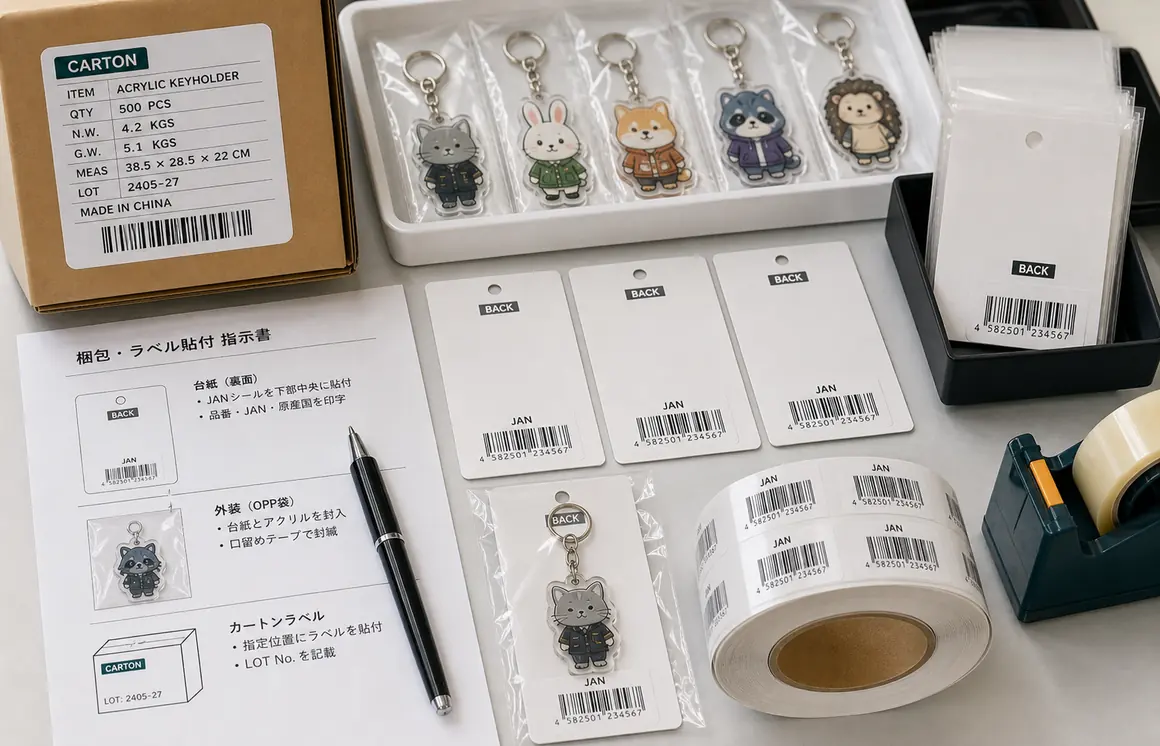
LABELING CONTROL
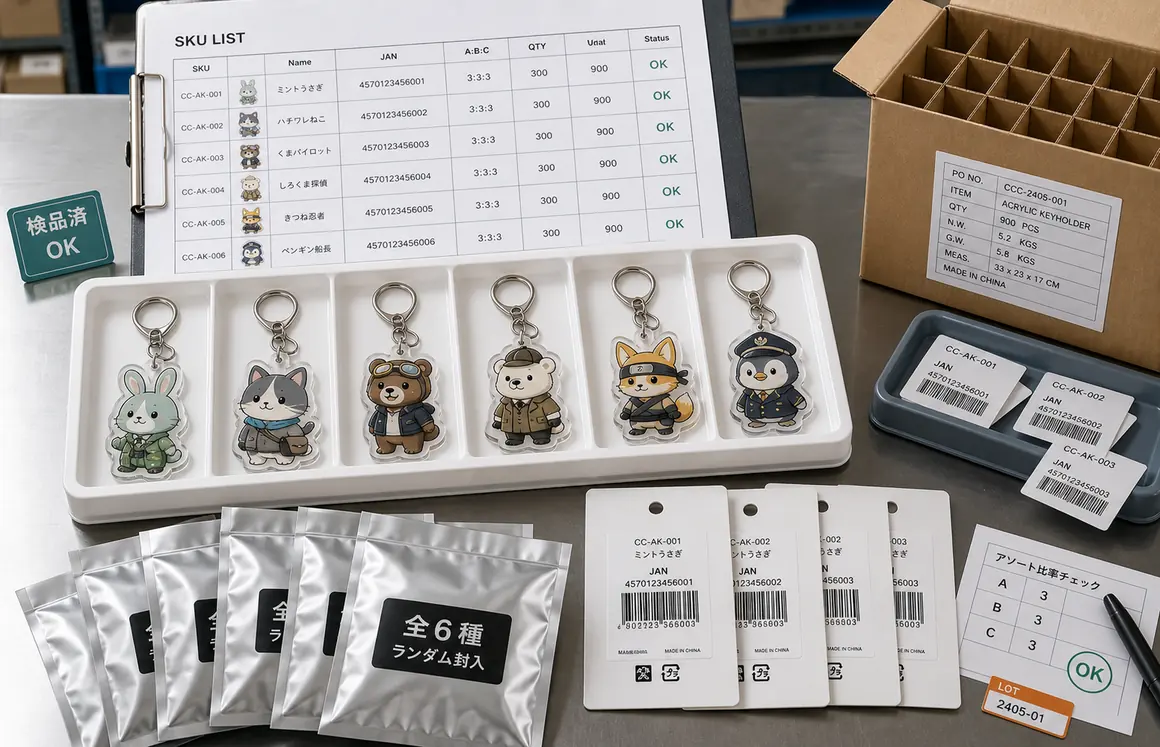
JAN, backing cards, and carton labels should be managed without disturbing the front artwork.
Barcodes and management numbers do not need to crowd the character artwork. They can be organized on back-side backing cards, SKU sheets, carton labels, and delivery documents. Label content is checked from supplied data, including print position and readability.
Back-side card
JAN, item number, caution text, and material information.
SKU sheet
Product name, artwork, quantity, and insertion conditions.
Carton label
PO, carton number, SKU, and quantity for cross-checking.
IP / DATA HANDLING
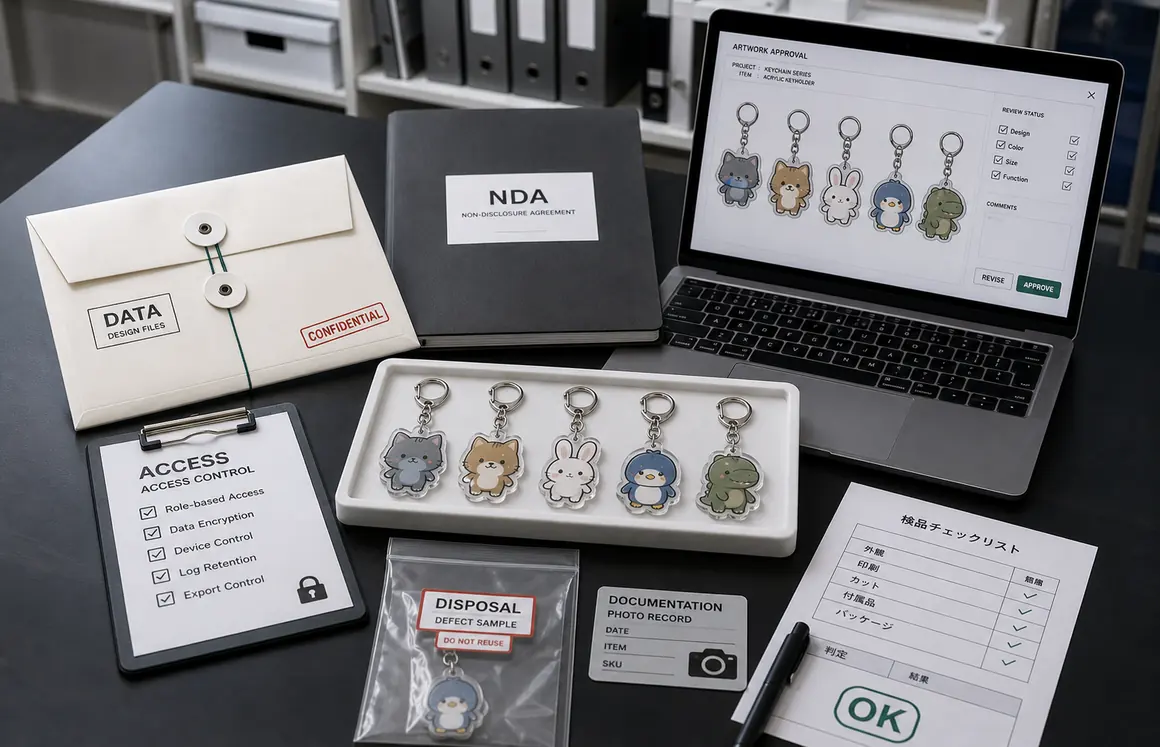
Unreleased artwork and IP data handling should also be confirmed as production conditions.
For IP holders, licensees, and event operators, artwork data, sample photos, defective goods, and surplus goods are important control points. Depending on the project, NDA terms, data sharing scope, sample photography rules, and disposal-record submission can be organized before production.
NDA review
Contract format, signing timing, and sharing scope.
Data sharing scope
Artwork data, proof images, and sample photo rules.
Disposal records
Defective goods, scrap material, and surplus goods by project.
INSPECTION / DELIVERY
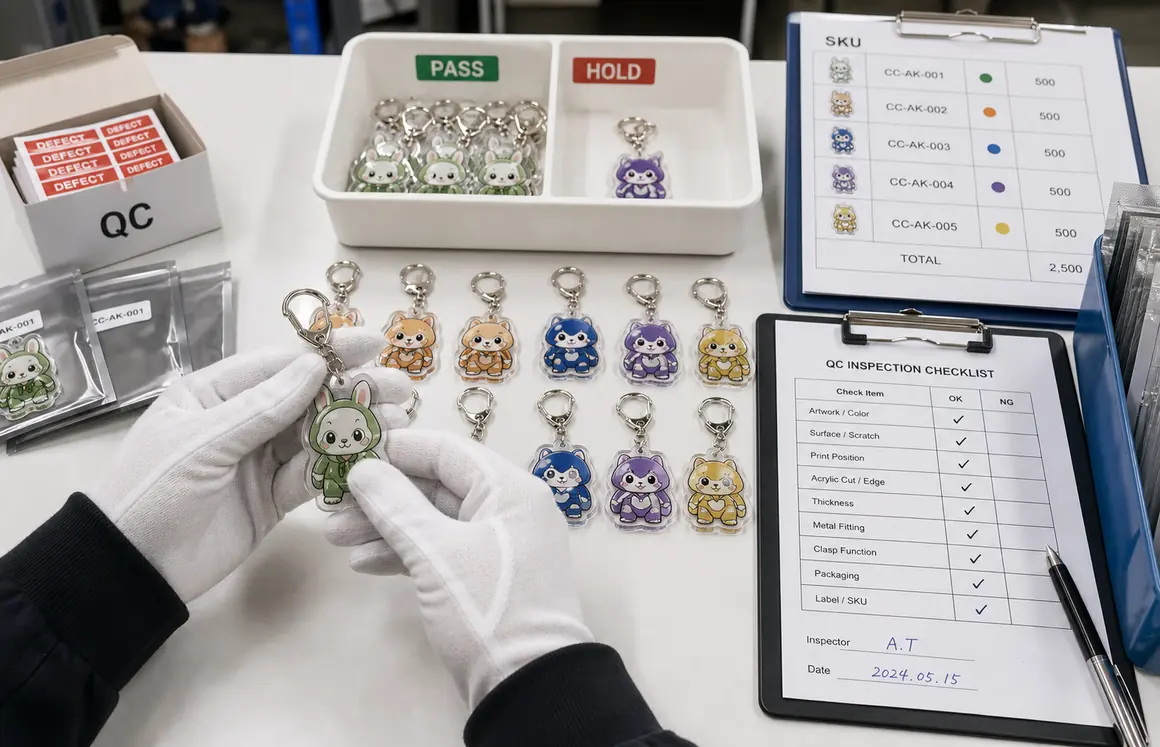
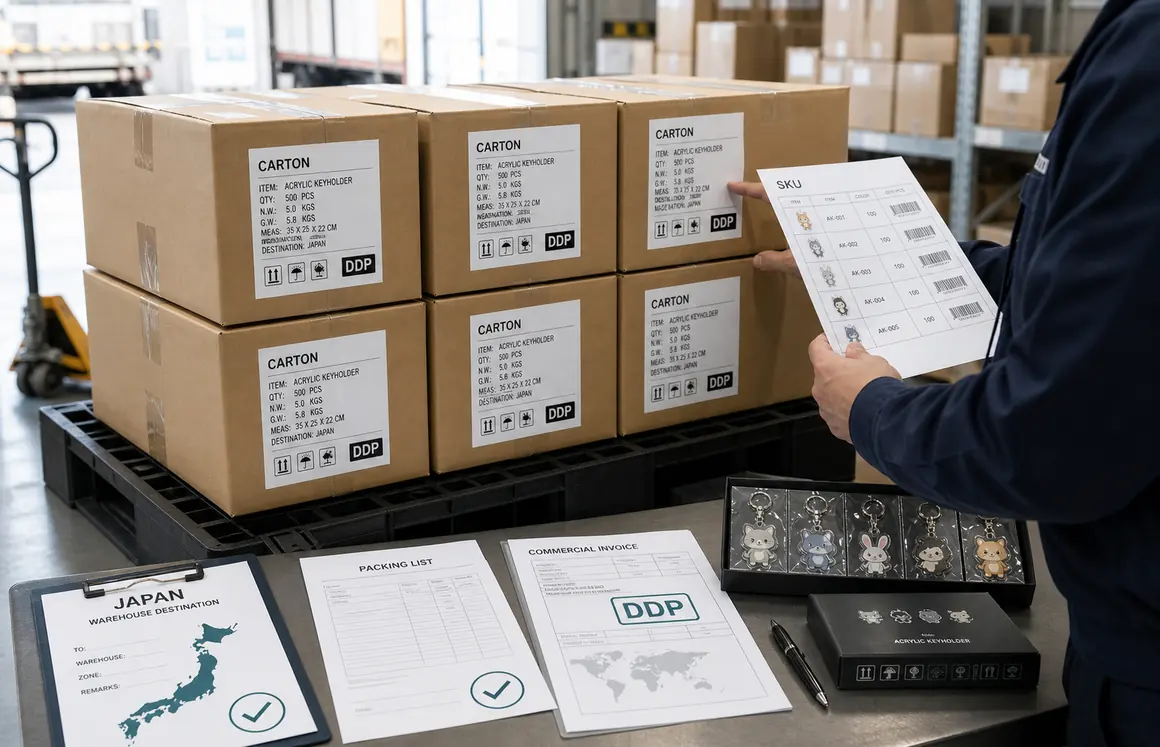
Inspection, packing, and DDP delivery should be planned backward from the event date.
Inspection is not only checking for visible scratches. SKU, insertion, label, quantity, packing, and delivery documents can also be part of the check. For event or launch-date projects, sample approval and shipping terms should be organized early.
| Common risk | Pre-production countermeasure |
|---|---|
| SKU mix-up | SKU sheet, item number, carton label, and insertion instructions are checked in the same control table. |
| Wrong insertion ratio | Random ratio, assigned ratio, box unit, and carton unit are written clearly. |
| Label errors | JAN, item number, caution text, and material information are cross-checked with supplied data and samples. |
| Delivery date or site gap | Target timing, warehouse conditions, DDP availability, and required documents are checked at quotation. |
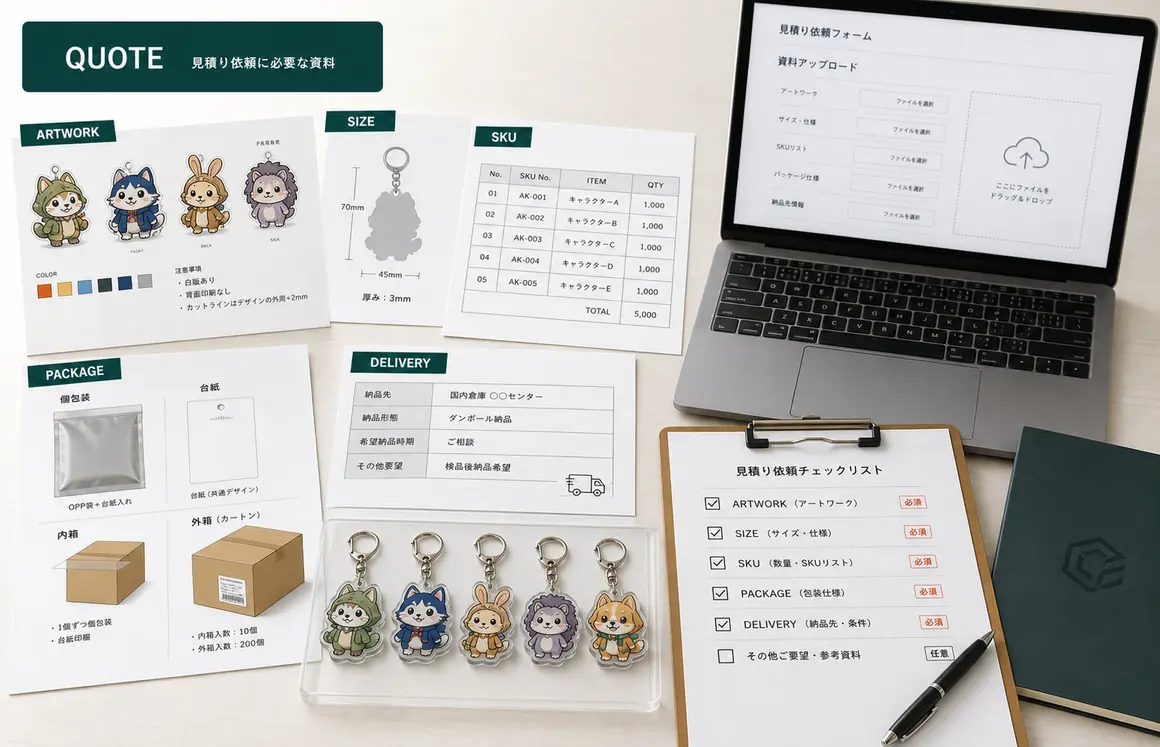
QUOTE MATERIALS
Materials to share before quotation
You can still consult us before every document is ready. First, we separate confirmed and unconfirmed items, then organize temporary conditions for unit cost, samples, mass production, packaging, and delivery review.
* Final unit cost and lead time are checked individually according to specifications, quantity, packaging, inspection, and delivery conditions.
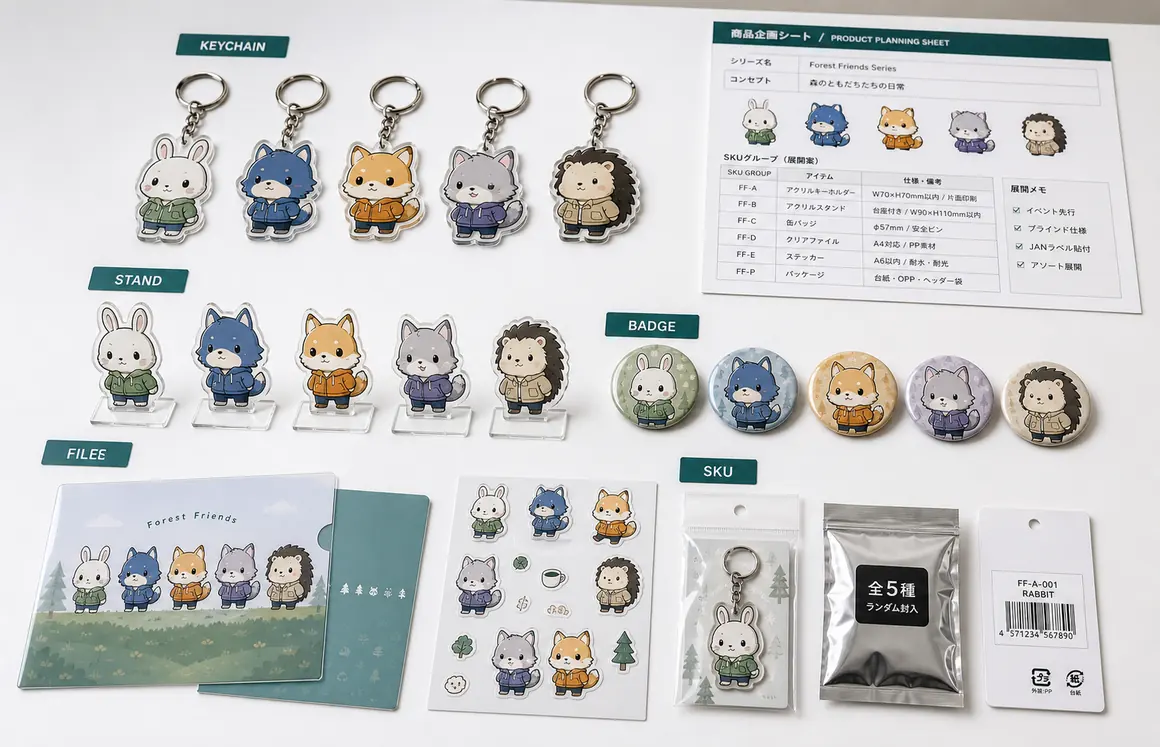
RELATED OEM
Related goods can be planned with the same SKU table.
In addition to acrylic keychains, acrylic stands, can badges, clear files, stickers, and other related goods can be organized as one character series with shared SKU and packaging conditions.
FAQ
FAQ for oshi acrylic keychain OEM
Can you support acrylic keychains with multiple characters or random blind packaging?
Yes. We organize quantity tables by character, artwork, and packaging type, then confirm SKU names, JAN information, assortment ratios, carton labels, and inspection units before mass production.
How can unreleased artwork and IP data be handled?
Depending on the project, NDA requirements, artwork sharing scope, sample photo rules, and disposal records for defective or surplus goods can be confirmed before production.
Can JAN labels, backing cards, silver bags, and carton labels be arranged together?
Individual OPP bags, backing cards, silver blind bags, JAN labels, carton labels, SKU sorting, and assortment instructions can be organized according to the sales method. JAN data and label content are checked from supplied information.
Can DDP delivery to a warehouse in Japan be discussed?
DDP delivery can be discussed according to project conditions. Delivery address, quantity, carton size, target timing, and required documents are reviewed at the quotation stage.
What should be prepared before requesting a quotation?
Please share artwork data, target size, thickness, quantity, SKU list, fittings, packaging requirements, JAN or backing-card information, delivery address, and target timing. If some items are not fixed yet, temporary conditions can be organized first.
CONTACT
Discuss oshi acrylic keychain OEM with multi-SKU or blind packaging requirements
Even if specifications are not finalized, we can separate SKU tables, packaging, inspection, and delivery conditions. Share your project outline, target quantity, and planned launch timing.
Project controls for Blind Pack Acrylic Keychains
Blind Pack Acrylic Keychains programs are planned for event, blind-pack and fan-merchandise planners. Before mass production, align character SKU quantities, concealed design coding, randomization and ratio rules, fitting and backing-card data, sealed-pack verification, and event and retail allocation in one project matrix so artwork, sellable units and delivery cartons use the same approved SKU data.
Search intent boundary: This page owns the buyer and use-case intent for blind pack acrylic keychains. Product engineering remains on the dedicated stand, keychain and acrylic product pages, preventing the pages from competing for broad product terms.
What to lock before approval
Treat the program as a controlled release, not as a group of unrelated artwork files. The commercial quote, approval list, packaging data and destination split should reference the same project and SKU codes. The six controls below should appear in the same quotation, sample record and inspection instruction.
| Decision | What the buyer must define | Acceptable approval evidence |
|---|---|---|
| Character SKU Quantities | Define character SKU quantities by SKU before quotation and do not replace it with a vague good-quality instruction. | Keep an approved dimensioned specification or controlled reference that production and QC can identify during bulk release. |
| Concealed Design Coding | Define concealed design coding by SKU before quotation and do not replace it with a vague good-quality instruction. | Keep an approved artwork proof and component record that production and QC can identify during bulk release. |
| Randomization and Ratio Rules | Define randomization and ratio rules by SKU before quotation and do not replace it with a vague good-quality instruction. | Keep an approved representative physical sample that production and QC can identify during bulk release. |
| Fitting and Backing-Card Data | Define fitting and backing-card data by SKU before quotation and do not replace it with a vague good-quality instruction. | Keep an approved sellable pack or use-condition check that production and QC can identify during bulk release. |
| Sealed-Pack Verification | Define sealed-pack verification by SKU before quotation and do not replace it with a vague good-quality instruction. | Keep an approved inspection photo and measured result that production and QC can identify during bulk release. |
| Event and Retail Allocation | Define event and retail allocation by SKU before quotation and do not replace it with a vague good-quality instruction. | Keep an approved SKU-linked bulk report and carton trace that production and QC can identify during bulk release. |
Failure risks to close
- Character SKU Quantities is not controlled: suppliers can interpret the same request differently and the quotation is not comparable.
- Concealed Design Coding is not controlled: the physical sample can pass while the wrong revision enters bulk production.
- Randomization and Ratio Rules is not controlled: packing or use conditions reveal a failure that a loose visual sample did not show.
- Fitting and Backing-Card Data is not controlled: the buyer cannot separate an isolated defect from a repeated batch or SKU problem.
Quote inputs
- project name and target market for Blind Pack Acrylic Keychains
- editable artwork and the latest revision code
- finished dimensions and quantity for every design
- character SKU quantities
- concealed design coding
- randomization and ratio rules
- individual packaging, label and barcode requirements
- inspection evidence and acceptance criteria
- delivery destination and required arrival date
Sample-to-bulk control
Approve a finished sample that represents the intended artwork, construction and sellable package. Record the sample date, revision, dimensions, material or component codes, visual limits and function checks. If a later change affects artwork, material, hardware, assembly or packaging, identify the impacted SKUs and obtain a new approval instead of relying on the earlier sample.
For bulk inspection, use the same viewing conditions, measurement points and pass/fail language used during approval. The report should identify the purchase order, SKU, batch, sampled quantity and result. Photographs are useful evidence only when they show the relevant scale, lighting, label or test condition and can be traced to the inspected lot.
When comparing quotations, separate confirmed specifications from assumptions. Ask each supplier to identify exclusions, proposed substitutes, sampling scope, packaging labor and delivery basis. A lower figure is not equivalent when it omits a component, uses a different inspection level or assumes that several designs can share one uncontrolled pack. Close those differences before price approval so the purchase decision remains auditable.