Break down lead-time conditions first
We first confirm target delivery dates, sample needs, quantity, delivery destination, and packaging conditions, then translate them into a production-ready workflow.
OEM for Live and Concert Merchandise
From lead-time planning and member-specific SKUs to random sales and venue delivery, this page organizes what buyers should confirm before mass-producing acrylic goods that are easy to sell at live events and easy for fans to carry home.
SHORT ANSWER
Acrylic keychains, acrylic stands, carabiner clips, and linked charms are highly photogenic, but as member counts, venue counts, and sales formats increase, SKU control and packaging rules become critical.
We first confirm target delivery dates, sample needs, quantity, delivery destination, and packaging conditions, then translate them into a production-ready workflow.
Transparency, reflection, size, and stand display are checked at sample stage so the final goods work well for venue photos and fan posts.
Member colors, random sales, carton units, and venue-specific delivery are translated into labeling and packing rules that reduce confusion on sales day.
PRODUCT RANGE
Formats and packaging can be combined for single-item sales, member-specific sales, random packs, and venue-limited sets.
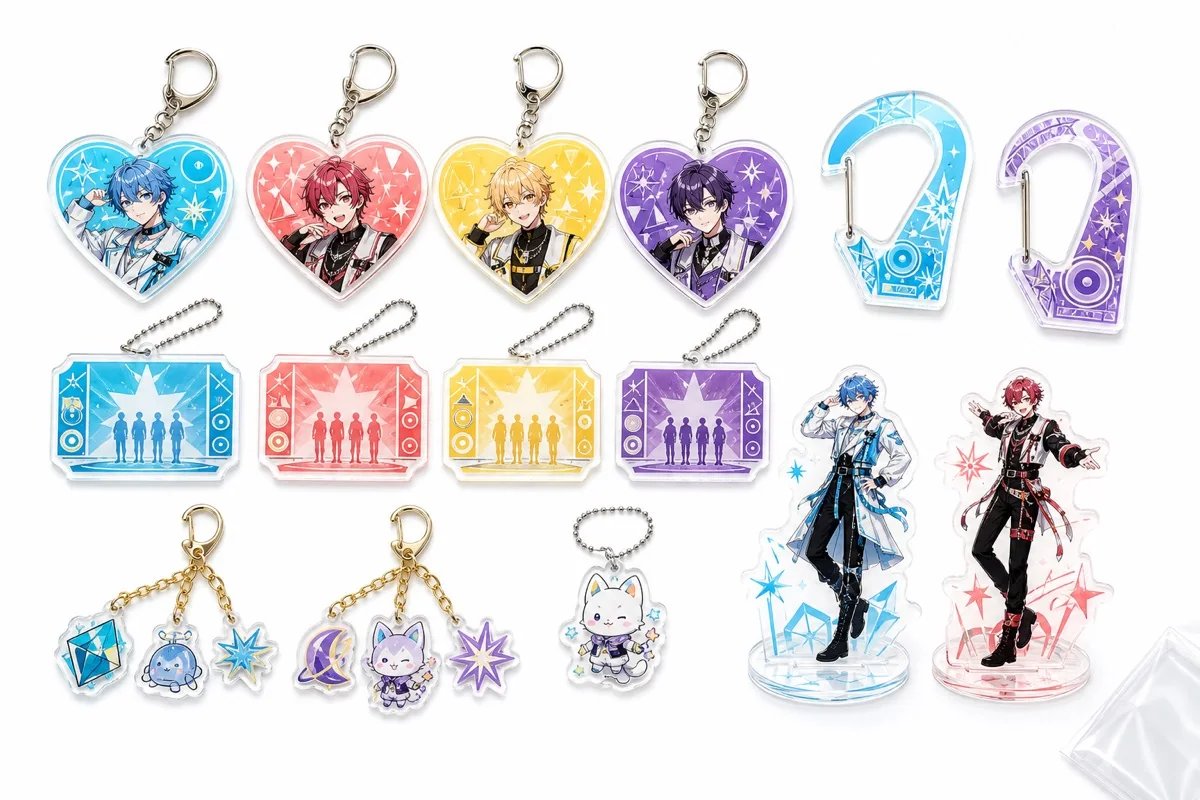
Organizing product formats first makes it easier to separate price tiers, sales methods, and packaging rules within the same IP.
PRE-CHECK
In addition to ordinary acrylic goods specifications, live merch projects should confirm sales dates, sales quantity, member colors, random-pack requirements, and venue-level sorting at the same time.
| Check item | Buyer-side decision | Risk to review before production |
|---|---|---|
| Lead time | Sales date, warehouse arrival date, venue delivery need, sample review date | Artwork approval delays, added packaging, delivery constraints for venues |
| SKU | Member count, color variants, random packing, carton-unit sorting | Mixed item numbers, wrong color insertion, venue quantity mismatch |
| Material and thickness | Clear acrylic, color acrylic, thickness, hardware specification | Scratches inside bags, edge chips, hardware direction and hole position |
| Packaging | OPP bag, backing card, protective film, JAN/label requirements | Sales display, scratch prevention, ease of venue restocking |
| Inspection | Print shift, scratches, hardware, quantity, SKU label check scope | Going into production without clear pre-shipment acceptance criteria |
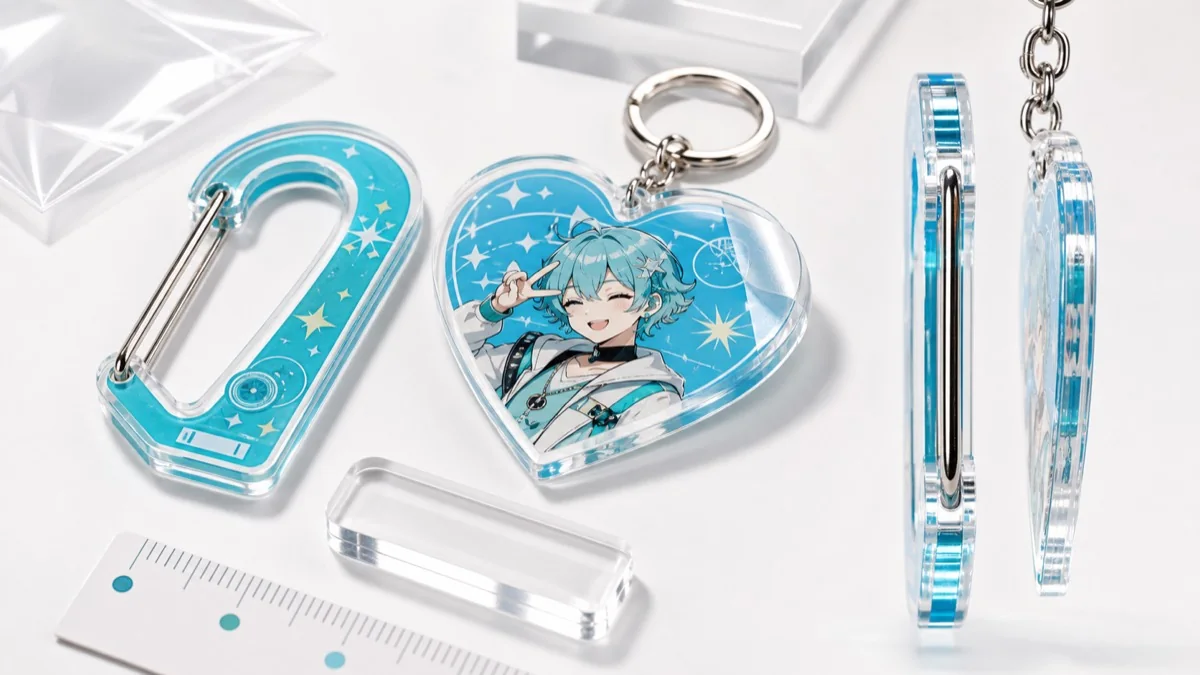
Thickness, hole position, and hardware should be checked with fan carry use in mind.
MATERIAL & PARTS
At live venues, fans often attach goods to bags immediately or carry multiple items, so usability during carrying matters as much as appearance.
SKU CONTROL
For live merch, restocking speed on sales day is part of product quality. Linking member color, product format, venue, and carton number helps reduce mispacking and quantity gaps.
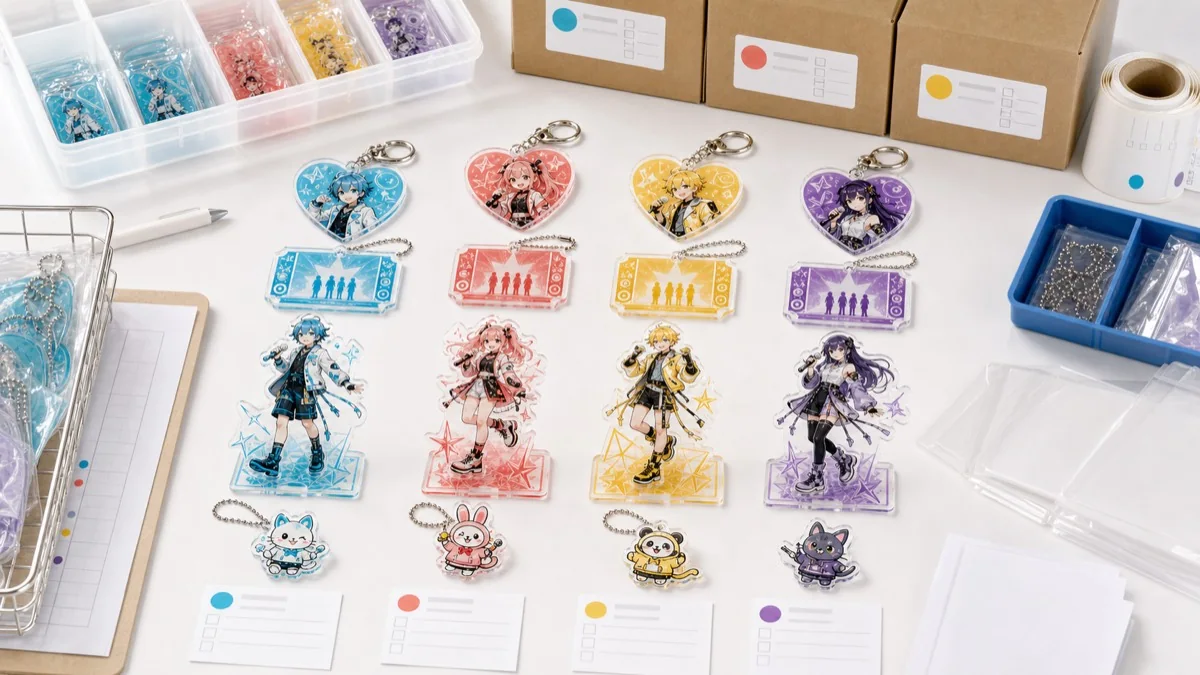
Checking SKU sheets, color labels, and carton labels together makes random sales and venue-level delivery easier to manage.
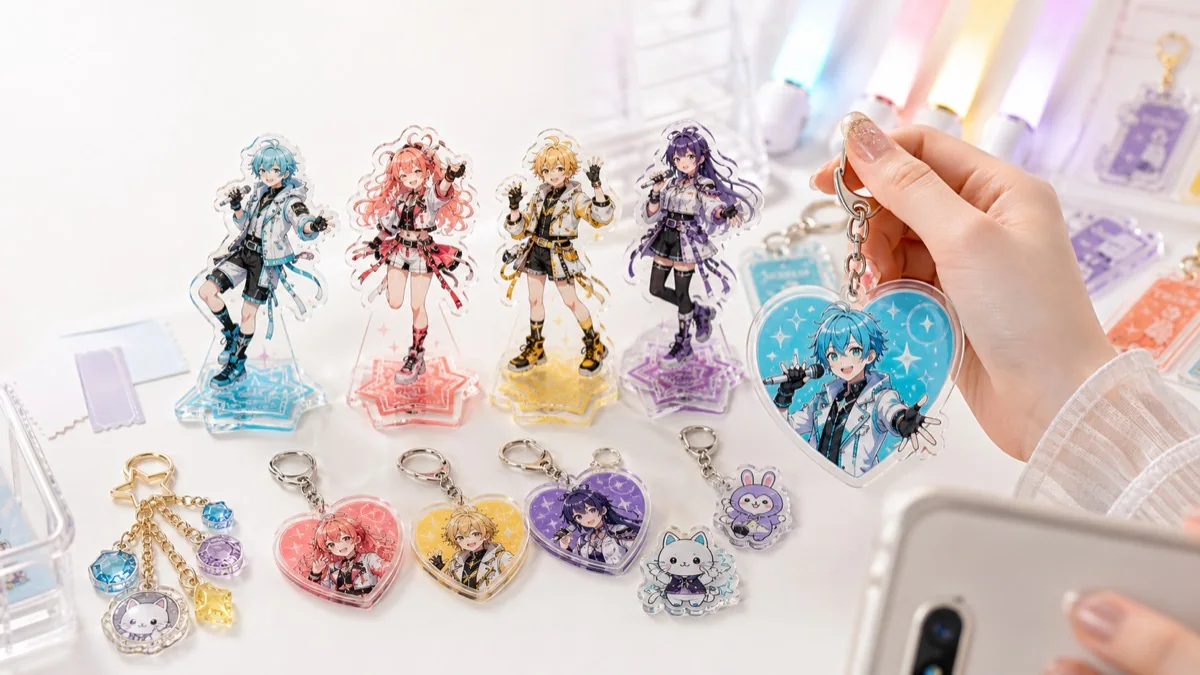
Social-media appeal should be checked at sample stage through color consistency, transparency, and hand-held size.
SNS & FAN USE
Live merch is often photographed and posted right after purchase, so reflection, background visibility, portable hardware, and scratch-prevention packaging should be considered together.
PACKAGING & DELIVERY
Venue-friendly packaging affects not only scratch prevention, but also display, restocking, and inventory checks. When JAN codes or labels are needed, they should be managed on backing cards or carton labels.
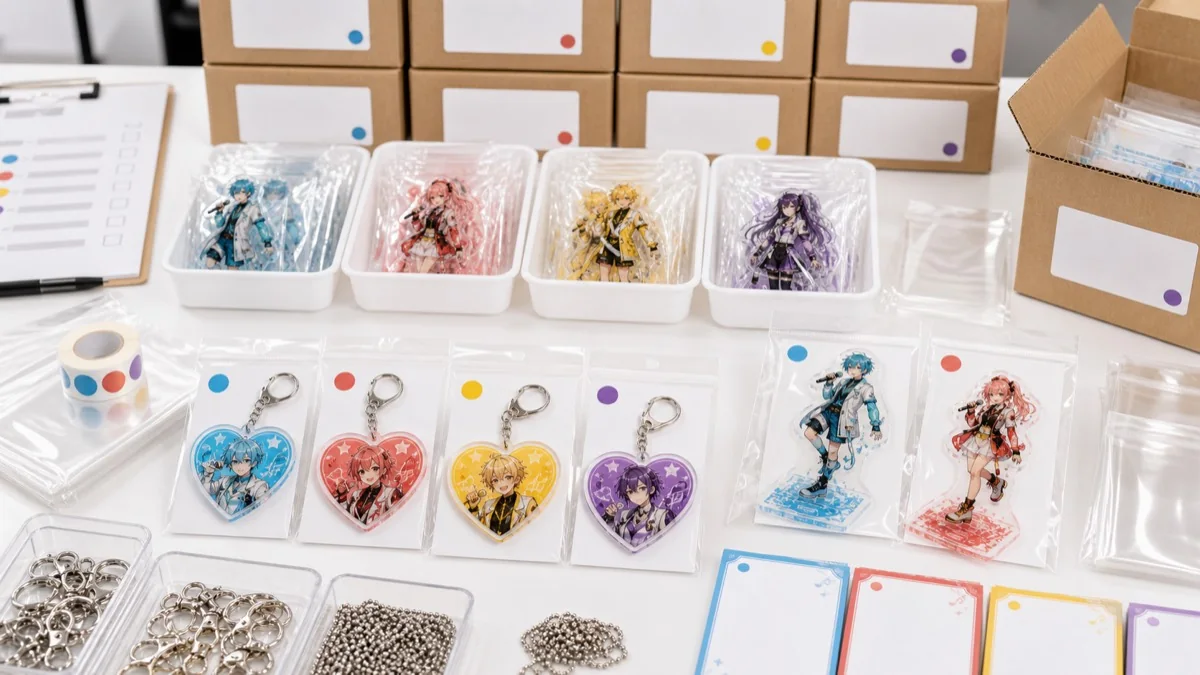
Packaging affects both quotation and lead time, so deciding the required scope before mass production helps stabilize the schedule.
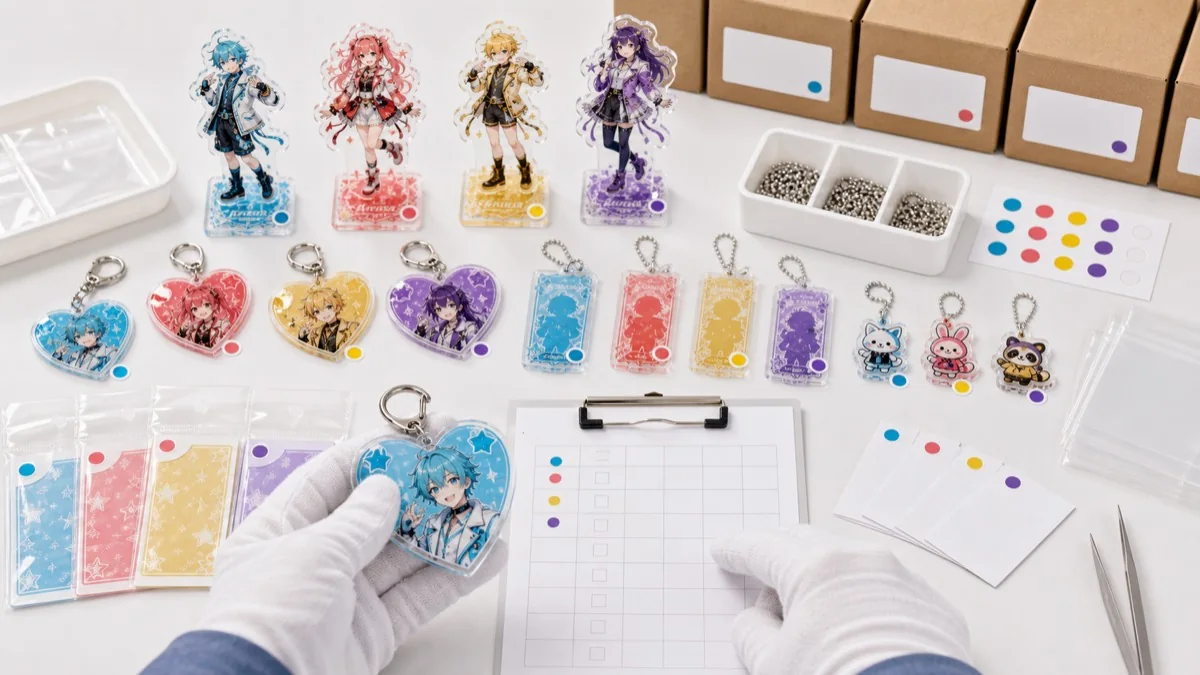
Inspection standards are adjusted by project. Print, edge finish, hardware, quantity, and label check scope should be shared in advance.
QC CHECK
Acceptance criteria differ by project. Align the judgment standard during sample review and define what will be checked after mass production.
QUOTE MATERIALS
To improve the first quote, confirm not only artwork but also lead time, quantity, packaging, and delivery destination.
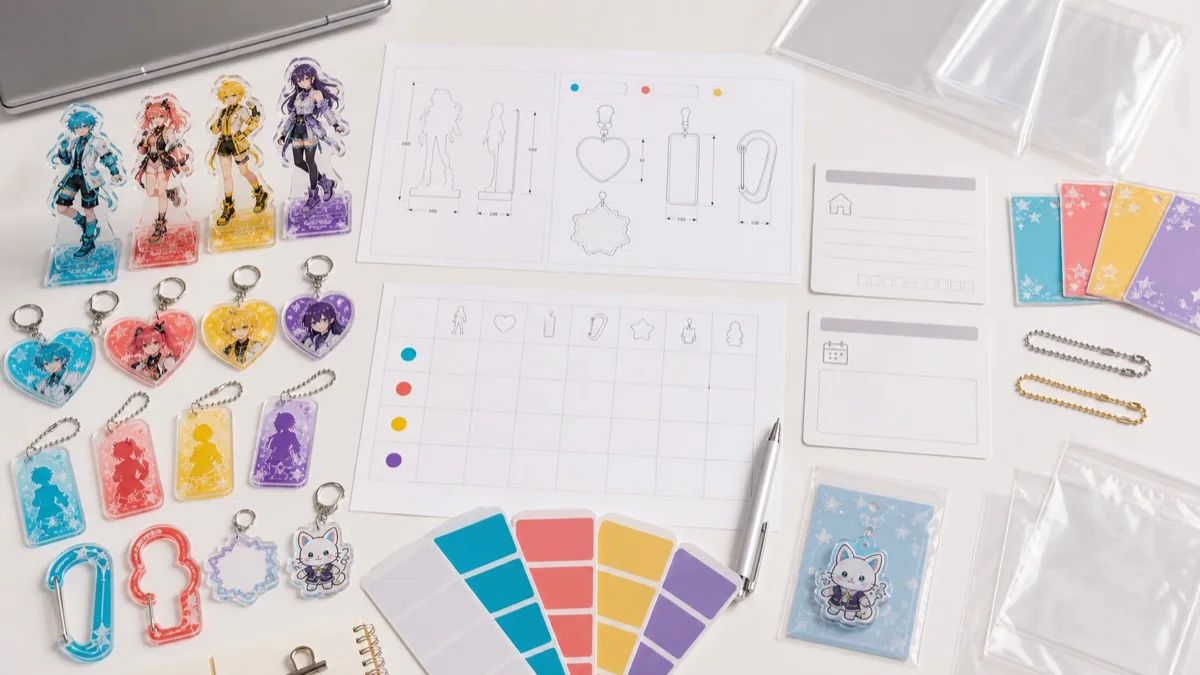
When size drawings, quantity sheets, delivery destination, and packaging conditions are ready, lead-time and unit-cost review becomes smoother.
FAQ
It depends on the project details, quantity, specification, packaging, and delivery destination. Share the target delivery date and sales date, and we will review a realistic schedule.
Yes. We can organize member colors, item numbers, packing ratios, carton units, and venue-level quantities to reduce mixing risk.
Yes. Transparency, size, reflection, hand-held usability, and stand display can be reviewed at sample stage.
Yes, after confirming shape, hole position, hardware, and thickness. Strength and moving parts require more careful review than ordinary keychains.
Yes. Backing cards, OPP bags, protective film, color labels, and carton labels can be combined according to the sales method.
It can be discussed depending on project conditions. Please share delivery destination, venue receiving rules, carton count, and label requirements early.
We check print position, color tone, edge finish, scratches, hardware, quantity, packaging, and SKU labels according to project-specific standards.
Artwork data, size, thickness, hardware, quantity, SKU count, packaging, delivery destination, and desired lead time help the quotation process move smoothly.
RELATED PAGES
CONTACT
Even if the specification is not final, we can organize pre-production checkpoints when the desired lead time, quantity, sales method, and delivery destination are known.
Concert Acrylic Merchandise programs are planned for concert, idol, tour and live-event merchandise teams. Before mass production, align artist or member roster, tour date and venue schedule, product and color SKU matrix, fan-retail packaging, venue replenishment quantities, and split delivery and reserve stock in one project matrix so artwork, sellable units and delivery cartons use the same approved SKU data.
Search intent boundary: This page owns the buyer and use-case intent for concert acrylic merchandise. Product engineering remains on the dedicated stand, keychain and acrylic product pages, preventing the pages from competing for broad product terms.
Treat the program as a controlled release, not as a group of unrelated artwork files. The commercial quote, approval list, packaging data and destination split should reference the same project and SKU codes. The six controls below should appear in the same quotation, sample record and inspection instruction.
| Decision | What the buyer must define | Acceptable approval evidence |
|---|---|---|
| Artist or Member Roster | Define artist or member roster by SKU before quotation and do not replace it with a vague good-quality instruction. | Keep an approved dimensioned specification or controlled reference that production and QC can identify during bulk release. |
| Tour Date and Venue Schedule | Define tour date and venue schedule by SKU before quotation and do not replace it with a vague good-quality instruction. | Keep an approved artwork proof and component record that production and QC can identify during bulk release. |
| Product and Color SKU Matrix | Define product and color SKU matrix by SKU before quotation and do not replace it with a vague good-quality instruction. | Keep an approved representative physical sample that production and QC can identify during bulk release. |
| Fan-Retail Packaging | Define fan-retail packaging by SKU before quotation and do not replace it with a vague good-quality instruction. | Keep an approved sellable pack or use-condition check that production and QC can identify during bulk release. |
| Venue Replenishment Quantities | Define venue replenishment quantities by SKU before quotation and do not replace it with a vague good-quality instruction. | Keep an approved inspection photo and measured result that production and QC can identify during bulk release. |
| Split Delivery and Reserve Stock | Define split delivery and reserve stock by SKU before quotation and do not replace it with a vague good-quality instruction. | Keep an approved SKU-linked bulk report and carton trace that production and QC can identify during bulk release. |
Approve a finished sample that represents the intended artwork, construction and sellable package. Record the sample date, revision, dimensions, material or component codes, visual limits and function checks. If a later change affects artwork, material, hardware, assembly or packaging, identify the impacted SKUs and obtain a new approval instead of relying on the earlier sample.
For bulk inspection, use the same viewing conditions, measurement points and pass/fail language used during approval. The report should identify the purchase order, SKU, batch, sampled quantity and result. Photographs are useful evidence only when they show the relevant scale, lighting, label or test condition and can be traced to the inspected lot.
When comparing quotations, separate confirmed specifications from assumptions. Ask each supplier to identify exclusions, proposed substitutes, sampling scope, packaging labor and delivery basis. A lower figure is not equivalent when it omits a component, uses a different inspection level or assumes that several designs can share one uncontrolled pack. Close those differences before price approval so the purchase decision remains auditable.