
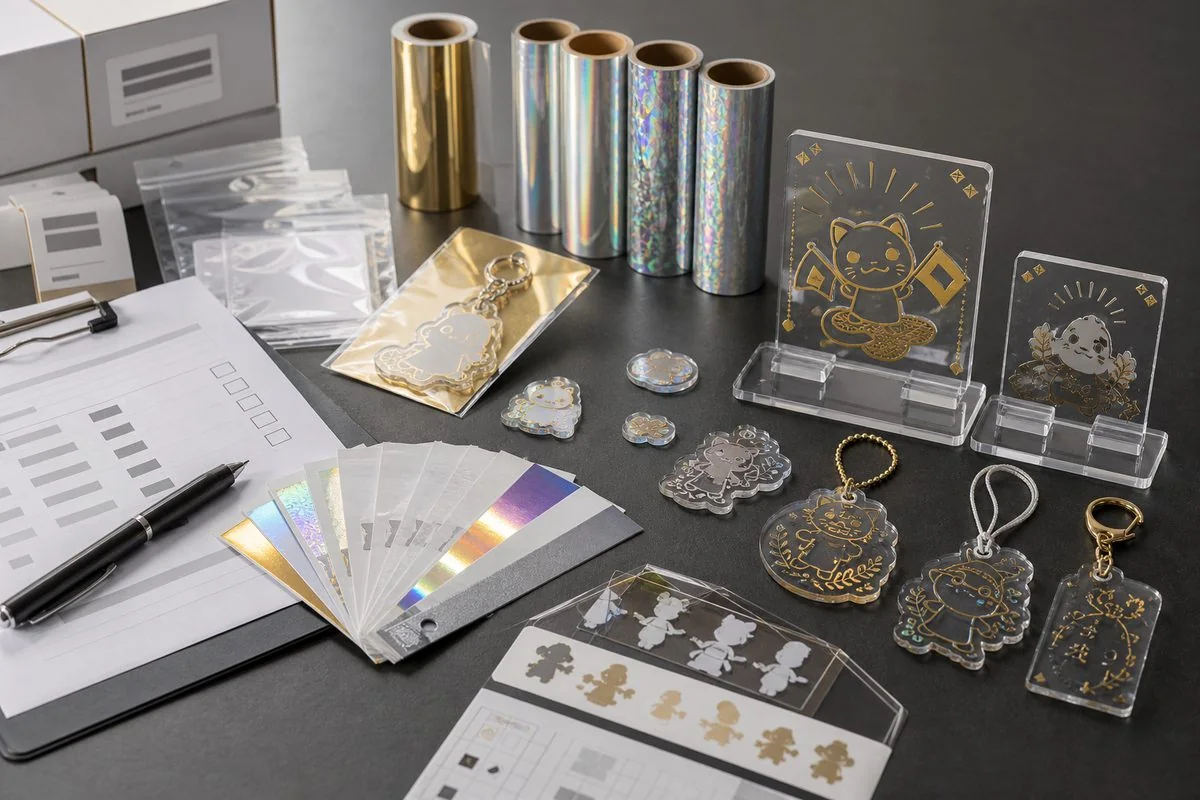
Foil Stamped Acrylic Goods OEM
Foil-Stamped Acrylic Goods
A Japan-facing OEM planning page for deciding how gold, silver, holographic, pearl, and color foils should look on acrylic goods, how artwork data should be separated, and how sample approval, SKU packaging, inspection, and quote materials should be prepared before mass production.
Short Answer
Foil stamping is not only a premium finish. It also adds production checkpoints before mass production.
Beyond making an attractive sample, buyers need to confirm foil type, stamped area, fine lines, distance from cut edges, packaging contact, and SKU sorting. Defining these points early helps reduce alignment differences and surface surprises during production.
What this page helps organize
- Which foil direction fits the project look and budget range
- Which artwork elements should become a separate foil layer
- What to check during sample approval
- Packaging conditions for retail, lottery prizes, and event merchandise
- Documents that make quotation and specification review faster
Use Cases
Projects where foil stamped acrylic goods work well
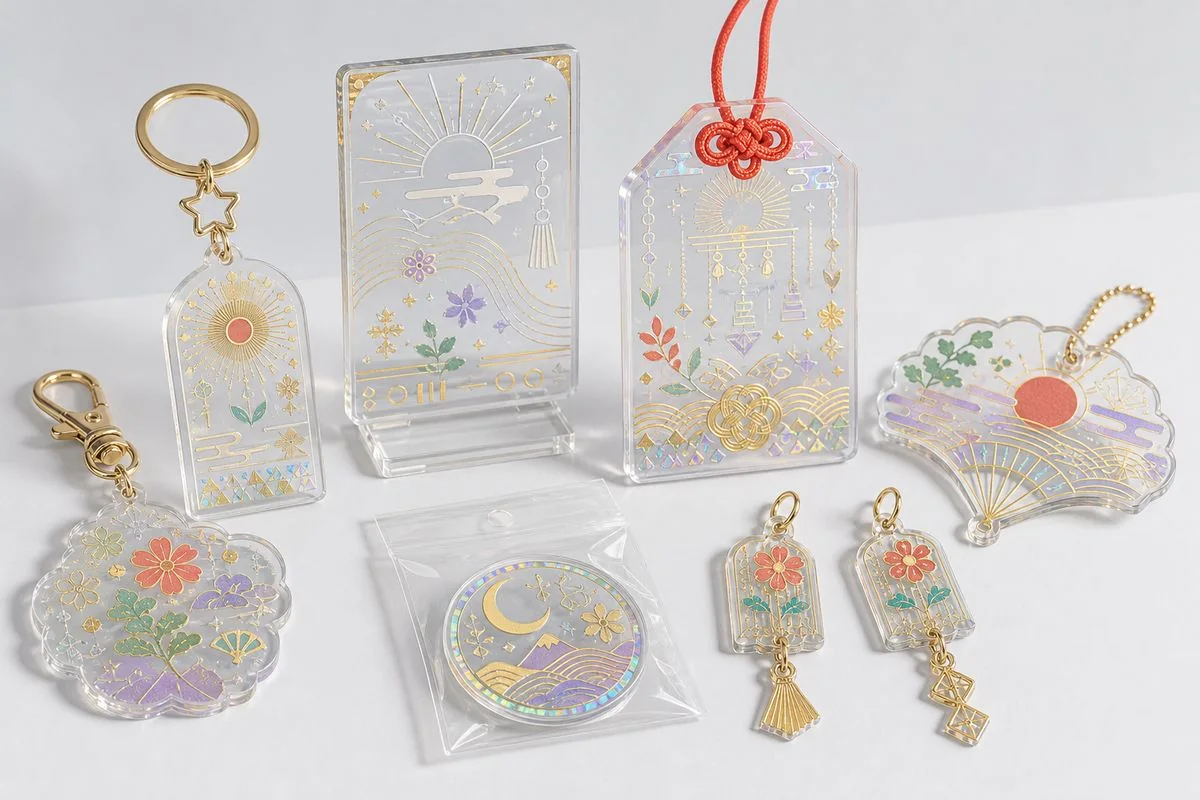
Foil stamping is useful when a product needs a limited-edition feeling or stronger shelf visibility. The details, packaging protection, and production controls should be adjusted by use case.
IP and character goods
For limited runs, anniversaries, and commemorative products, foil on logos, frames, and background motifs can help separate premium versions from standard versions.
Lottery and trading goods
When foil colors or stamped areas change by rarity, confirm the foil material, packing ratio, carton labels, and sorting method for each SKU before production.
Souvenir and gift programs
For regional motifs, seasonal events, and corporate gifts, the impression after opening depends on the acrylic part, backing card, and individual packaging together.
Foil Selection
Foil type changes the appearance, adhesion review, and cost direction.
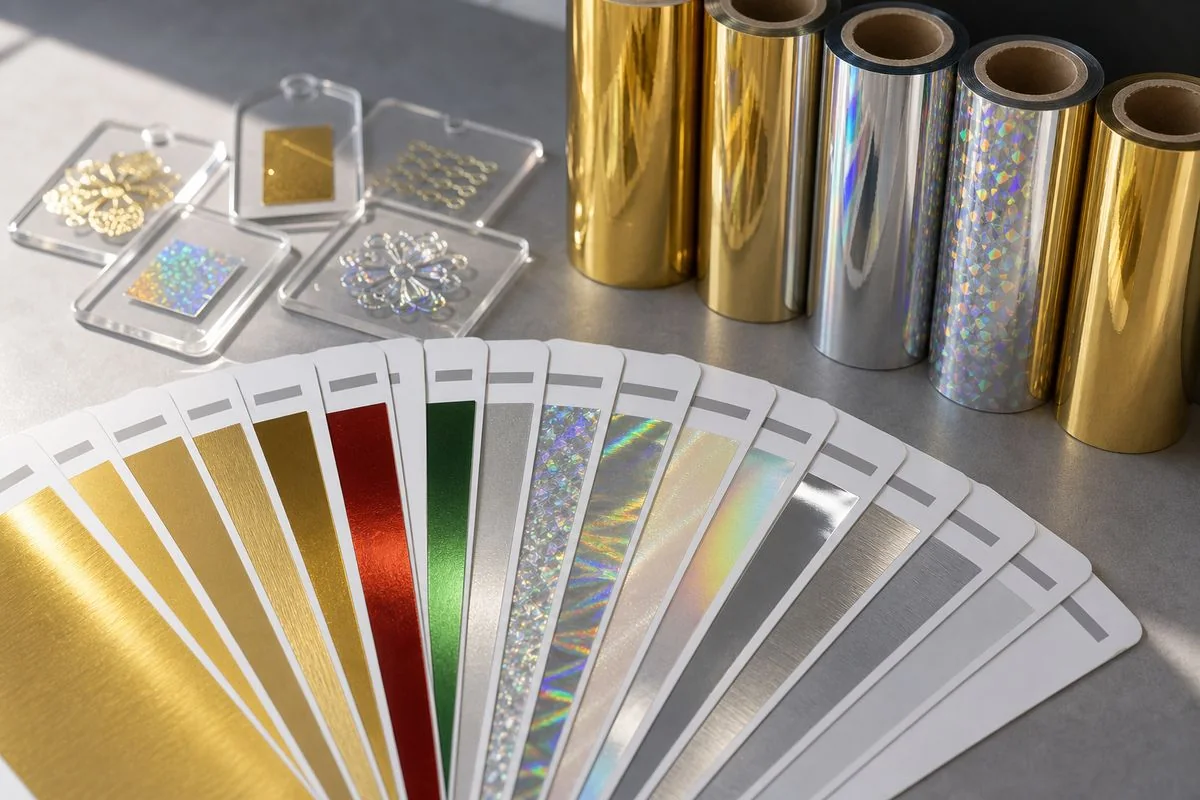
Gold and silver foils are only the starting point. Holographic, pearl, matte, hairline, and color foils can make the same artwork feel very different. Selection should be reviewed together with the usage scene, background color, stamped area, and sample approval method.
| Foil direction | Typical use | Pre-production check |
|---|---|---|
| Gold and silver | Logos, borders, commemorative items, limited editions | Contact-prone positions and contrast with the background color |
| Holographic | Lottery prizes, trading goods, event merchandise | Color shift under light and how the product photographs |
| Pearl and matte | Gift programs, pale-color designs, elegant product lines | Visibility on clear acrylic and compatibility with white layers |
| Color foil | Brand colors, regional themes, seasonal releases | Material availability, lot difference, and SKU control method |
Product Forms
The product form changes how foil is shown and where risk appears.
Flat parts
Foil works well for logos, pattern accents, borders, and highlight marks. Foil close to edges should be reviewed together with the cutline.
Stands and bases
When foil is used on a base or background part, check contact around insertion areas and the final appearance after assembly.
Hanging parts
If foil sits near a hardware hole, the hole position, margin, hardware type, and packaging contact should be reviewed together.
Backing-card products
Retail presentation should consider the foil surface, OPP bag, backing card, label position, and carton labeling as one package.
Artwork Data
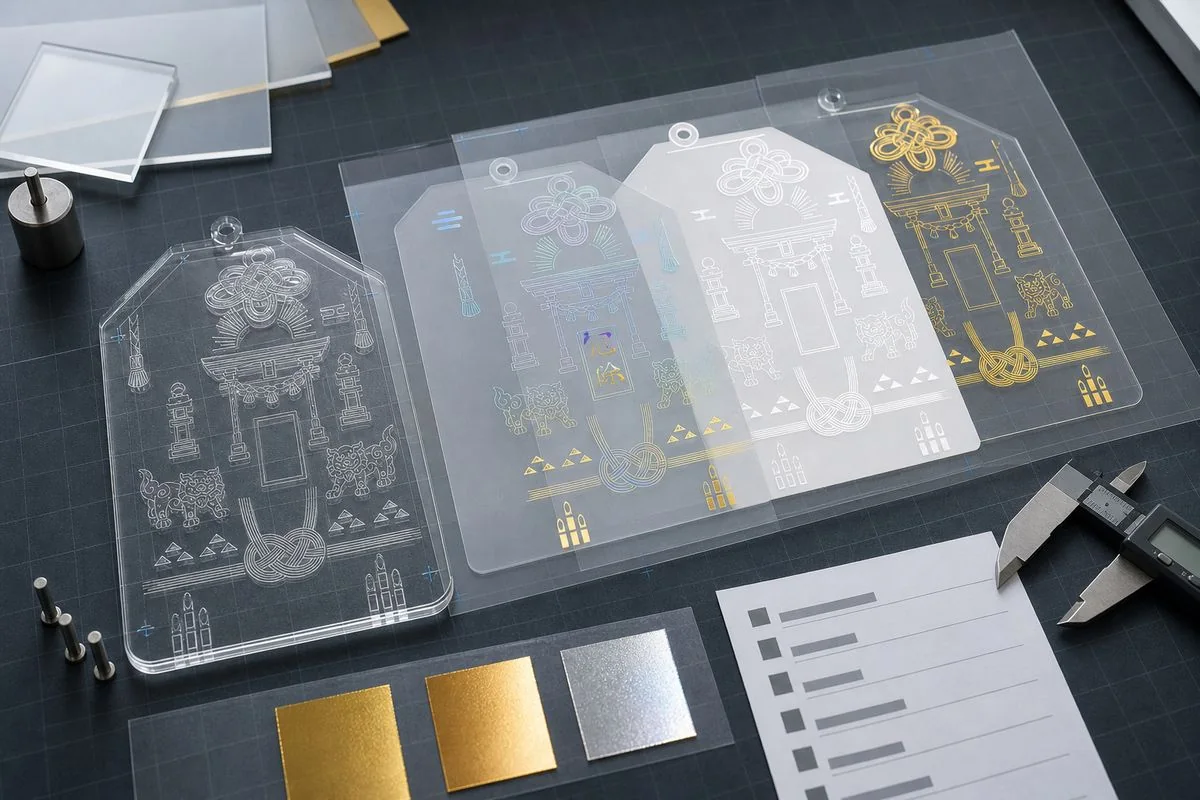
Foil stamping data should be separated from print layers.
Foil stamping is not a direct replacement for gradients or very fine printed details. Decide which logos, lines, motifs, and background accents should be foil, then review how they overlap with white layers and UV printing before sampling.
Risk Checklist
Risks to review before mass production
Even after a sample is approved, surface appearance can change with packaging, transport, and SKU switching. Separating the risk checklist before quotation helps reduce rework.
| Check item | Common issue | Pre-production response |
|---|---|---|
| Fine lines and small text | Foil can break, merge, or become difficult to read | Review line width, area size, and whether some parts should become print |
| Near edges or holes | Cutting or hardware contact may mark the foil surface | Confirm margins, hole position, hardware type, and packaging condition |
| Large foil areas | Uneven appearance, rubbing, fingerprints, or protection differences may stand out | Review stamped area, protective film, OPP bag, and cushioning method |
| Multiple SKUs | Foil color, backing card, or bagging mix-ups can occur | Control with SKU sheets, carton labels, and approved sample numbers |
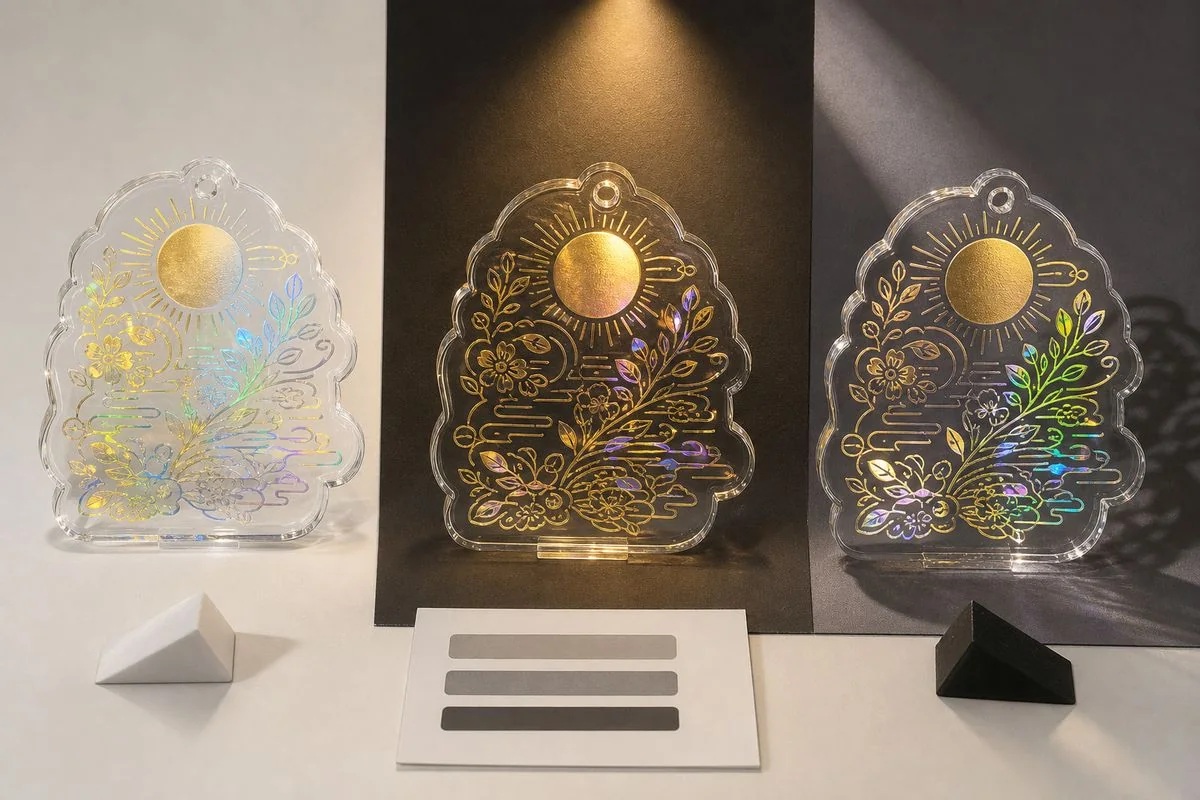
| Lighting and background | Retail shelves and product photos may show different impressions | Approve samples under light close to the expected use scene |
Sample Approval
Sample approval should not stop at whether the sample looks beautiful.
Foil changes with viewing angle. Before moving to mass production, define how the product should look in photos, retail lighting, event venues, and OPP bags.
- Foil color, reflectivity, and contrast with the background
- Condition around edges, holes, and hardware areas
- Registration between print and foil
- Appearance inside OPP bags and with backing cards
- Acceptable range for alignment and visible surface condition
Packaging & SKU
Packaging protection and SKU sorting should be designed together.
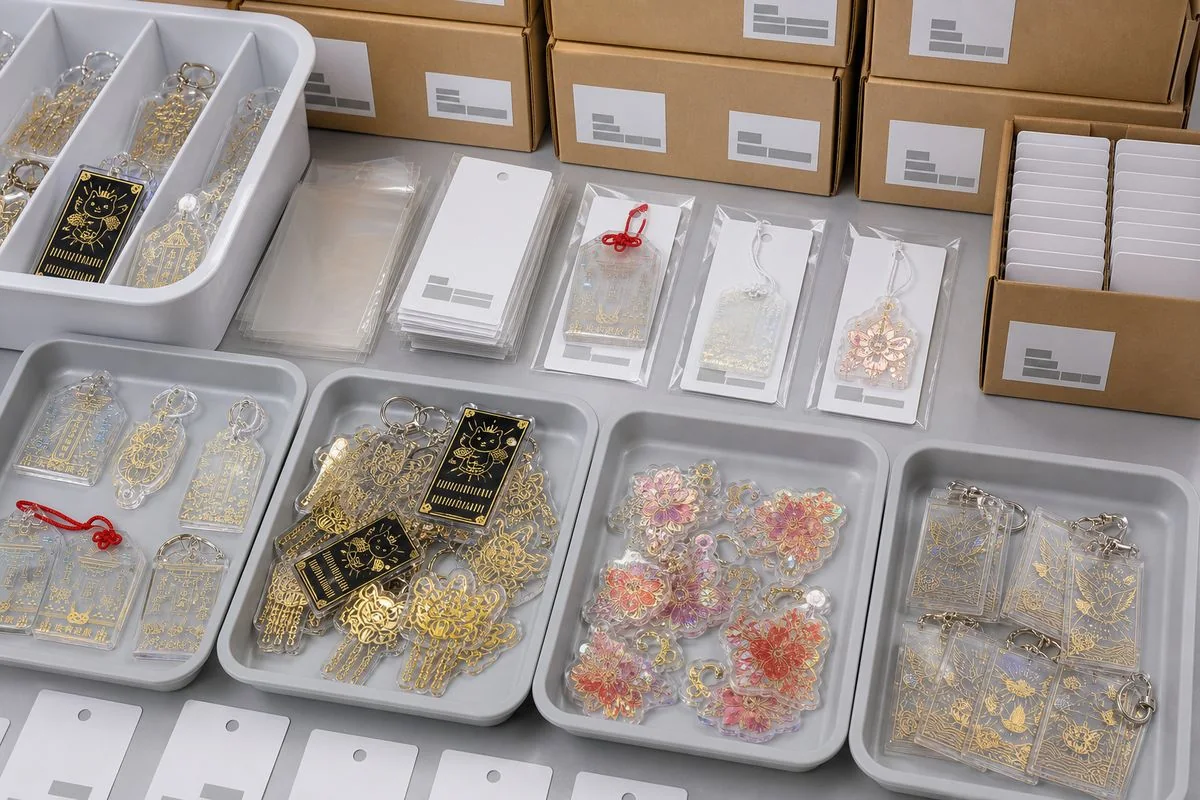
Foil stamped goods should be reviewed not only as bare products but also as bagged, carded, sorted, labeled, and boxed items. For retail and lottery programs, downstream checking and sorting matter as much as the front design.
Individual packaging
OPP bags, backing cards, protective inserts, and hardware direction should be chosen with foil-surface contact in mind.
SKU sorting
Match carton labels and quantity sheets by design, foil color, backing-card version, and packing method.
Quality Check
Inspection criteria should match the project and delivery format.
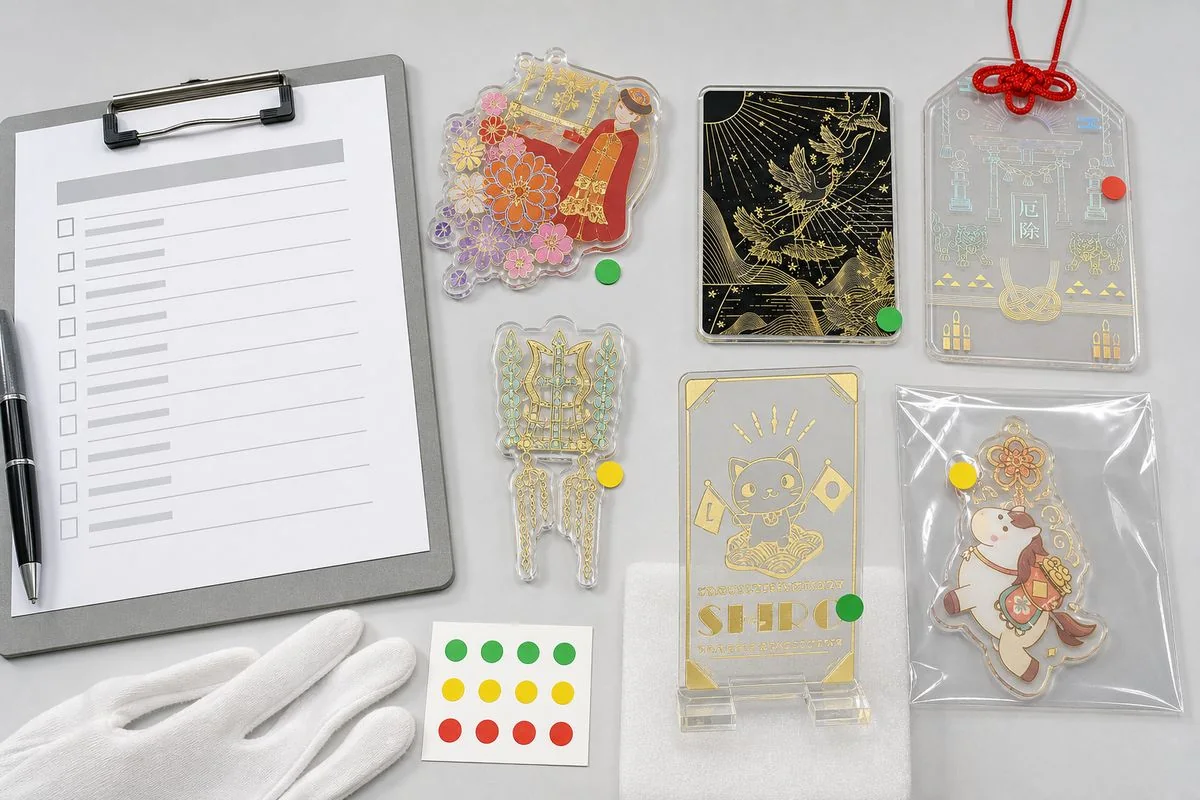
Foil stamping inspection is not limited to peeling or lifting. It can include registration, rubbing, fingerprints, edges, and contact after bagging. The method and acceptance range should be confirmed according to the project conditions.
| Inspection point | What to review |
|---|---|
| Foil surface | Missing areas, lifting, rubbing marks, visible unevenness, and fingerprints |
| Registration | Alignment among print, white layer, foil, and cutline |
| Edges | Cutting marks, hardware-hole area, and corner treatment |
| Packaging | OPP bag, backing card, hardware direction, SKU quantity, and carton label |
Quote Materials
Quote materials to prepare before asking for pricing
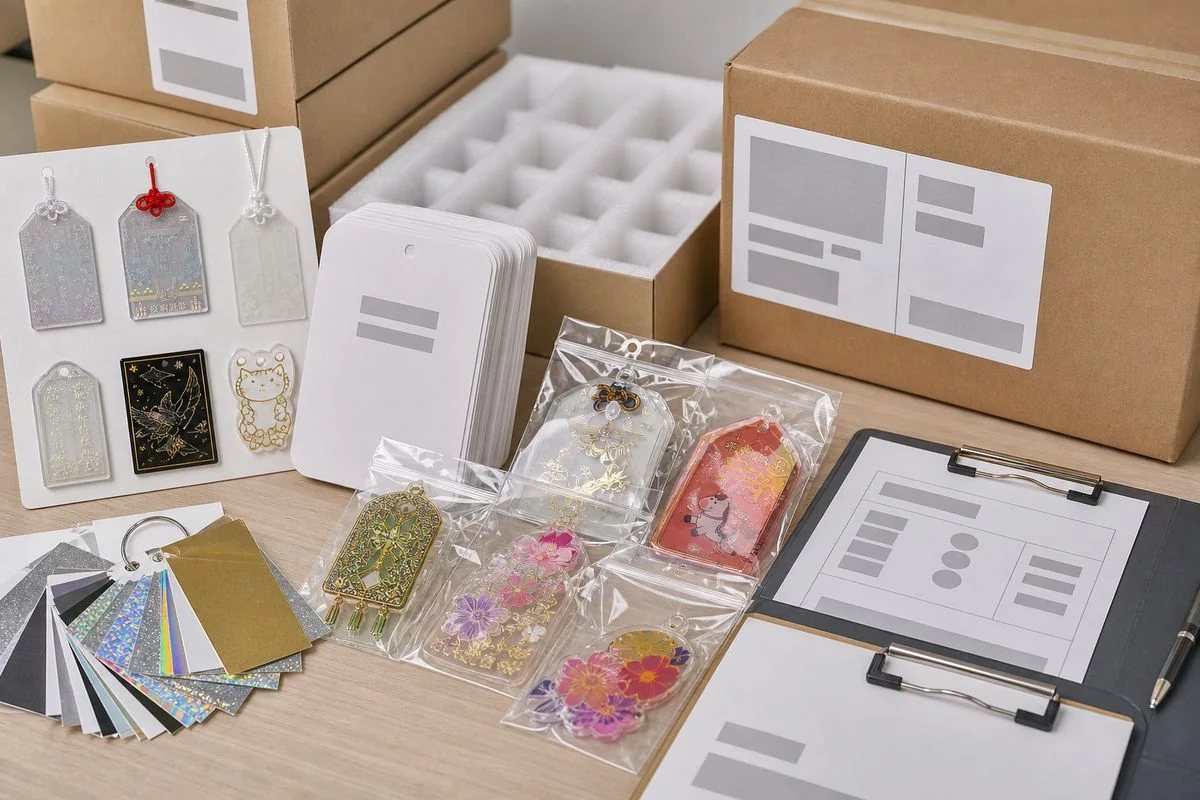
Foil stamping has more checkpoints than ordinary printing. When the first inquiry includes enough specifications, it becomes easier to suggest a workable direction and quote the project accurately.
- Product form, size, thickness, hole position, and hardware type
- Print data, white layer, desired foil area, and cutline
- Preferred foil direction or reference texture
- Number of SKUs, quantity by SKU, random packing, and ratio control needs
- Packaging conditions, backing cards, JAN labels, carton labels, and delivery destination
FAQ
Foil Stamped Acrylic Goods OEM FAQ
Pricing and lead time depend on specification, quantity, foil material, packaging, and inspection conditions. This FAQ focuses on the decisions buyers usually need before quotation.
How is foil stamping different from UV printing?
UV printing uses ink to express colors and artwork. Foil stamping transfers a metallic or reflective foil with heat and pressure. Many projects use UV printing for color detail and foil stamping for premium highlights.
Can fine lines and small letters be foil stamped?
It depends on the design. Very thin lines and isolated points can be more likely to break, merge, or become difficult to see. During artwork review, we can separate parts that should remain foil from parts better handled by print.
Can holographic foil or color foil be discussed?
Yes. Foil availability, lot difference, stamped area, and compatibility with the background color should be checked, then compared during the sample stage.
What should be checked on samples?
Check foil color, reflection, registration with print, edge and hole areas, and how the product looks inside an OPP bag or with a backing card. Reviewing under light close to the retail or event environment is helpful.
Can multiple SKUs or random packing be arranged?
It can be discussed when the SKU sheet, quantity by design, foil color, backing card, bagging method, and carton labels are organized in advance. Packing ratio and inspection method are confirmed by project.
What information is needed for a quotation?
Useful materials include size, thickness, quantity, number of designs, foil type, foil area, print specification, hardware, packaging, delivery destination, and any desired schedule.
Related Procurement Pages
Related pages
You can also review acrylic category specifications, keychain details, acrylic stand options, and the order flow.
Next Step
You can discuss foil areas and packaging conditions before every detail is fixed.
If you have rough artwork, reference foil textures, planned quantity, and sales format, we can help organize the checkpoints needed before mass production.
How to specify Foil-Stamped Acrylic Goods
Use foil-stamped acrylic goods only after the buyer has approved separate foil artwork layer, foil type and viewing effect, registration to printed artwork, adhesion and edge continuity, lighting sample comparison, and foil-safe packaging. The finish must be reviewed on the intended acrylic, print and white-ink construction because a digital mockup cannot prove the physical viewing effect or surface durability.
Search intent boundary: This page owns the finish-selection intent for foil stamped acrylic goods. General acrylic sourcing stays on the hub, while stand and keychain pages own their product-specific construction terms.
What to lock before approval
Approve the effect as a named material and process combination. Record the viewing face, sample lighting, acceptable variation and packaging rule so bulk production is compared with physical evidence rather than an image on screen. The six controls below should appear in the same quotation, sample record and inspection instruction.
| Decision | What the buyer must define | Acceptable approval evidence |
|---|---|---|
| Separate Foil Artwork Layer | Define separate foil artwork layer by SKU before quotation and do not replace it with a vague good-quality instruction. | Keep an approved dimensioned specification or controlled reference that production and QC can identify during bulk release. |
| Foil Type and Viewing Effect | Define foil type and viewing effect by SKU before quotation and do not replace it with a vague good-quality instruction. | Keep an approved artwork proof and component record that production and QC can identify during bulk release. |
| Registration To Printed Artwork | Define registration to printed artwork by SKU before quotation and do not replace it with a vague good-quality instruction. | Keep an approved representative physical sample that production and QC can identify during bulk release. |
| Adhesion and Edge Continuity | Define adhesion and edge continuity by SKU before quotation and do not replace it with a vague good-quality instruction. | Keep an approved sellable pack or use-condition check that production and QC can identify during bulk release. |
| Lighting Sample Comparison | Define lighting sample comparison by SKU before quotation and do not replace it with a vague good-quality instruction. | Keep an approved inspection photo and measured result that production and QC can identify during bulk release. |
| Foil-Safe Packaging | Define foil-safe packaging by SKU before quotation and do not replace it with a vague good-quality instruction. | Keep an approved SKU-linked bulk report and carton trace that production and QC can identify during bulk release. |
Failure risks to close
- Separate Foil Artwork Layer is not controlled: suppliers can interpret the same request differently and the quotation is not comparable.
- Foil Type and Viewing Effect is not controlled: the physical sample can pass while the wrong revision enters bulk production.
- Registration To Printed Artwork is not controlled: packing or use conditions reveal a failure that a loose visual sample did not show.
- Adhesion and Edge Continuity is not controlled: the buyer cannot separate an isolated defect from a repeated batch or SKU problem.
Quote inputs
- project name and target market for Foil-Stamped Acrylic Goods
- editable artwork and the latest revision code
- finished dimensions and quantity for every design
- separate foil artwork layer
- foil type and viewing effect
- registration to printed artwork
- individual packaging, label and barcode requirements
- inspection evidence and acceptance criteria
- delivery destination and required arrival date
Sample-to-bulk control
Approve a finished sample that represents the intended artwork, construction and sellable package. Record the sample date, revision, dimensions, material or component codes, visual limits and function checks. If a later change affects artwork, material, hardware, assembly or packaging, identify the impacted SKUs and obtain a new approval instead of relying on the earlier sample.
For bulk inspection, use the same viewing conditions, measurement points and pass/fail language used during approval. The report should identify the purchase order, SKU, batch, sampled quantity and result. Photographs are useful evidence only when they show the relevant scale, lighting, label or test condition and can be traced to the inspected lot.
When comparing quotations, separate confirmed specifications from assumptions. Ask each supplier to identify exclusions, proposed substitutes, sampling scope, packaging labor and delivery basis. A lower figure is not equivalent when it omits a component, uses a different inspection level or assumes that several designs can share one uncontrolled pack. Close those differences before price approval so the purchase decision remains auditable.