
OEM process guide
What Is Acrylic Immersion Dyeing? Custom Translucent Color vs Colored Sheet, and How to Approve a Sample
Acrylic immersion dyeing dips clear PMMA parts in a dye bath to create a custom translucent color, tonal variation, or a gradient. It is not the same as buying a colored sheet, applying face paint or print, or coloring only the cut edge. Approve a physical sample made on the production material under agreed viewing conditions before quotation and mass production.
Request a dyeing specification review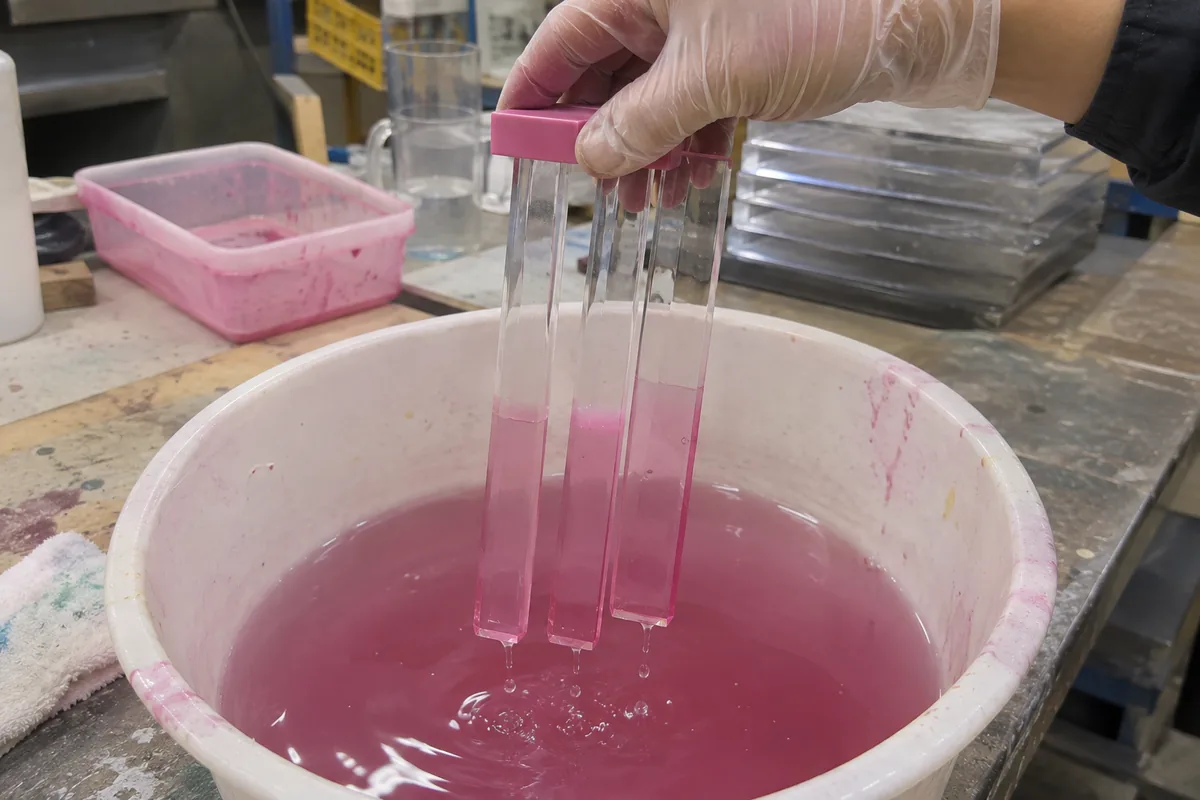
FIRST ANSWER
Settle these points first- Use immersion dyeing for a custom translucent color or gradient on a clear part
- Treat colored sheet, face print or paint, and edge painting as different routes
- Lock sheet type, grade, thickness, shape, and process order before shade approval
- Keep a physical master and compare later lots under the same conditions
METHOD SELECTION
Compare four coloring methods before the RFQ
Choose from the visual job and production constraints, then approve a sample on that route.
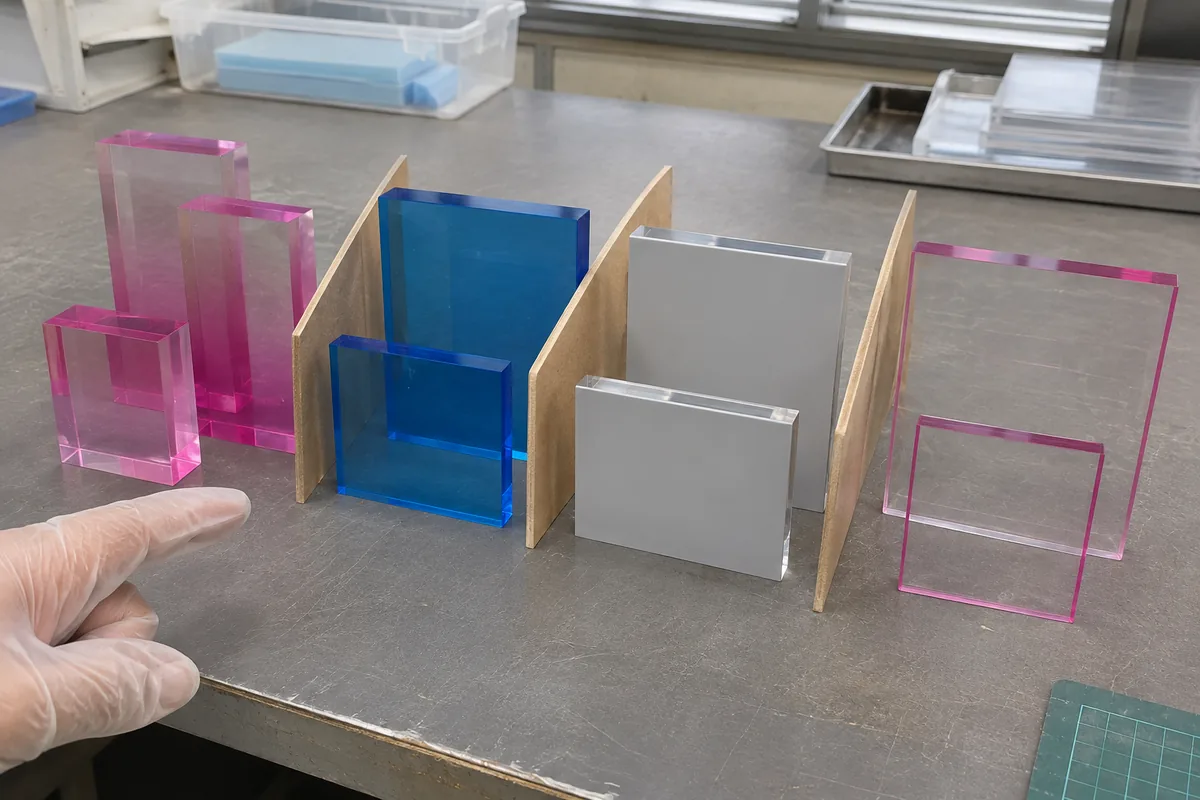
Immersion dyeing
For a custom translucent color, tonal variation, or gradient. Confirm the real production material and finished-state sample.
Colored acrylic sheet
For a specified sheet color and repeatable material supply. Check material code, thickness, transparency class, and lot continuity. See Colored acrylic stands and colored-sheet OEM.
Surface paint or print
For artwork, logos, opaque areas, or local graphics on the face. Check artwork layers, white ink, adhesion, and finished appearance. Compare UV printing vs offset for badges and acrylic goods.
Edge painting
For color on the cut edge while faces remain clear. Check the edge scope, adhesion, and boundary with the face. See Custom acrylic edge painting.
PROCESS EVIDENCE
What the process includes—and what the source cannot prove
The evidence supports material check, cleaning, dye-bath preparation, dipping and lifting, washing and drying, and visual review. It does not prove a transferable dye formula, bath temperature, dip time, lightfastness rating, or production capacity; those remain project-specific.
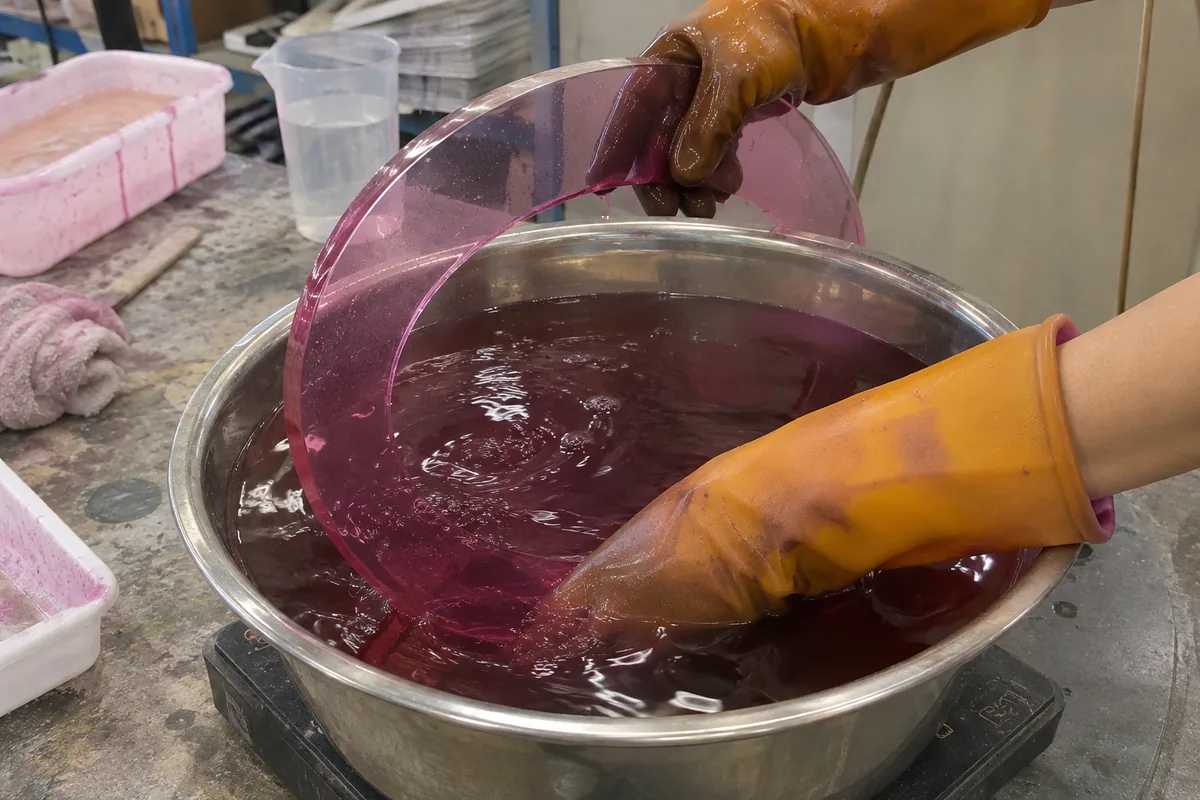
- 01Material checkType, grade, thickness
- 02CleaningOil, adhesive, residue
- 03Bath recordProject conditions
- 04Dip and liftDensity and boundary
- 05Wash and dryRemove surface dye
- 06Visual checkSame light and background
MATERIAL & PROCESS
Lock material, thickness, shape, and process order first
A color target is not a complete specification.
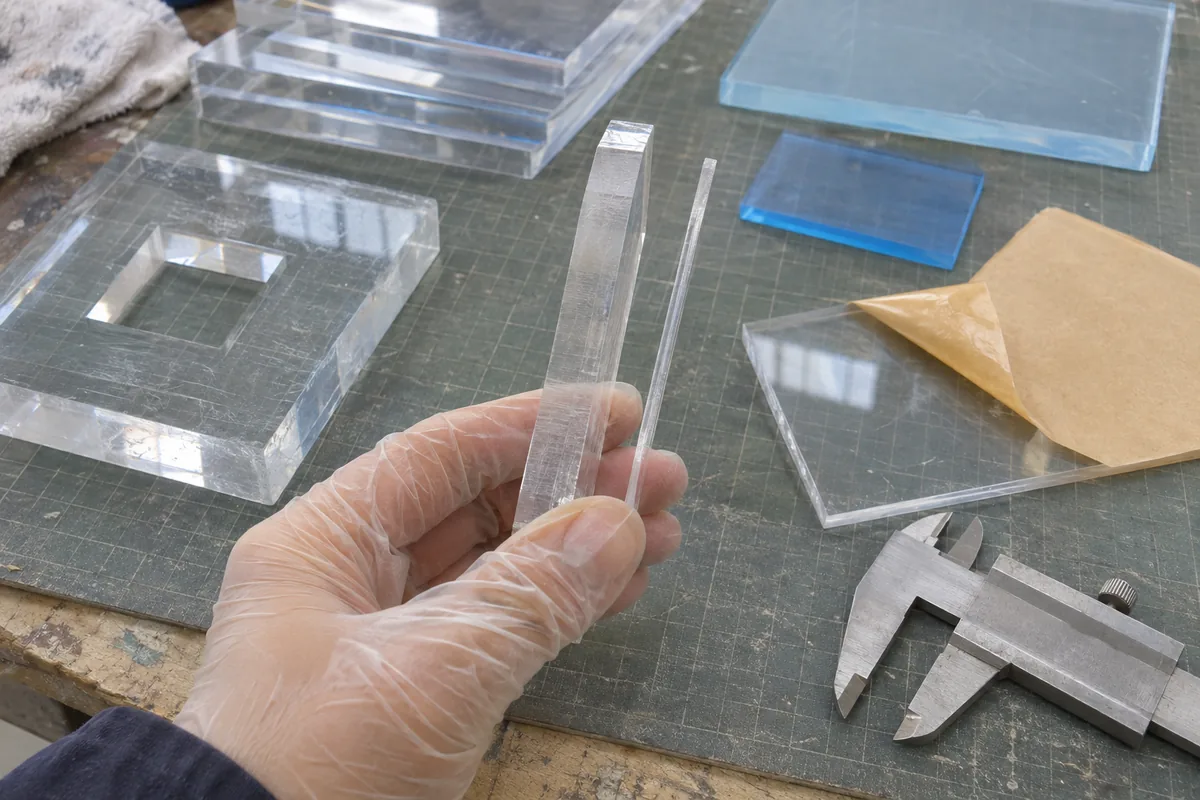
Cast or extruded sheet
The same bath can read differently. Do not rank one as universally easier; sample the production sheet type, grade, and thickness.
Faces, thickness, and edges
A thin sheet, thick block, curved part, or already-machined part may not show the same color from every view.
Later process order
Printing, cutting, polishing, bending, and bonding can affect color, dimensions, adhesion, cracks, or whitening.
SAMPLE APPROVAL LAB NOTE
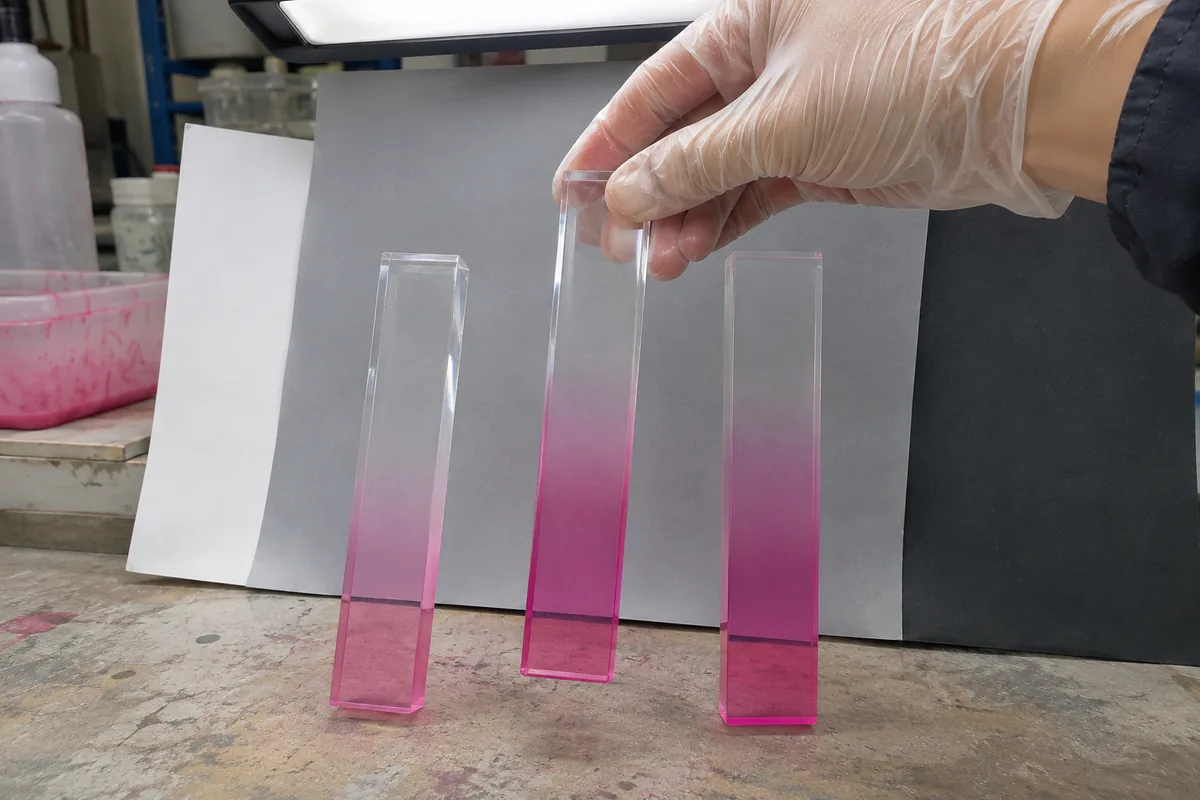
Approve a physical sample, not a color code
Pantone, DIC, RAL, or HEX can set direction. The acceptance standard is a physical master made on the production material and judged under recorded conditions.
- 01Production sheet type, grade, and thickness
- 02Sample ID and revision
- 03Approval light
- 04White, grey, black, and in-use background
- 05Viewing face and orientation
- 06Gradient direction and range
- 07Density, boundary, and uneven-color examples
A
Light, background, viewing face
Fix the light, background, distance, face, and orientation used for approval.
B
Gradient direction and boundary
Record dark and light sides, start and end, transition range, and acceptable boundary shift.
C
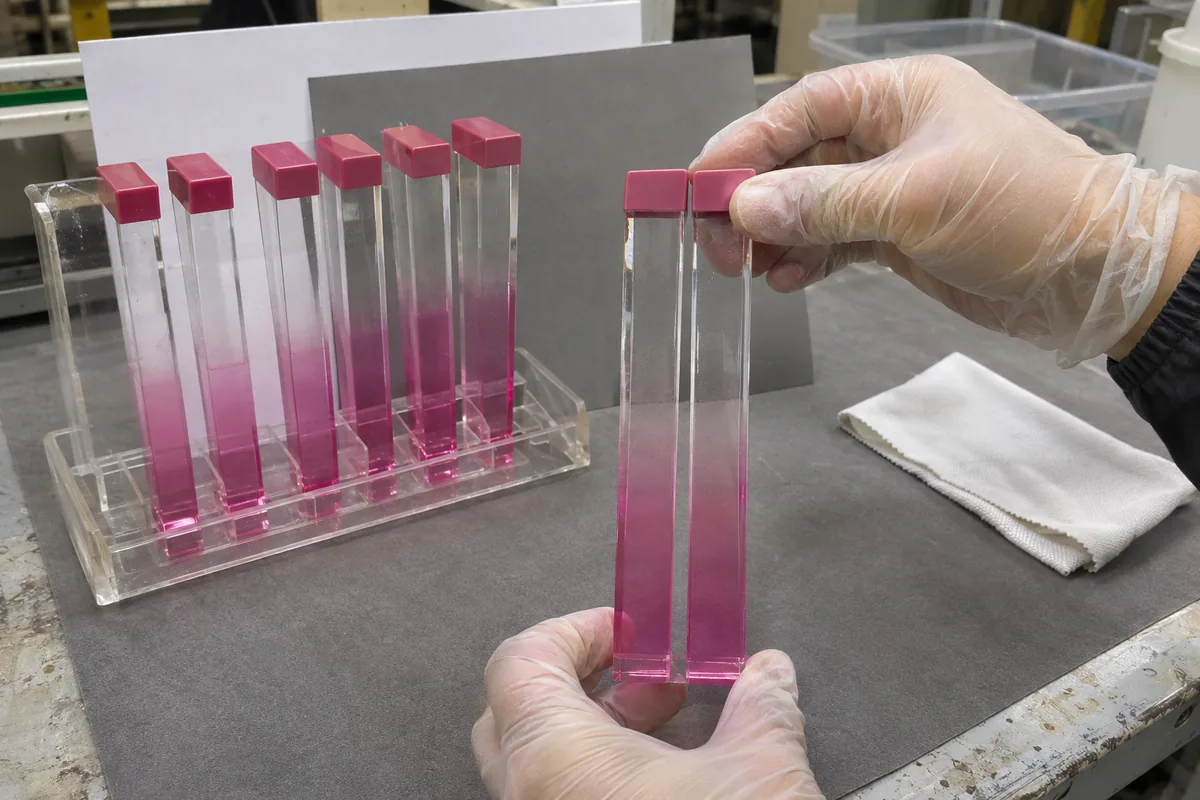
Master versus production lot
Retain the physical master and compare each lot and reorder under the same conditions.
GRADIENT & PARTIAL IMMERSION
Specify the transition as a range, not a screen effect
Do not assume every production piece will match a sample fade exactly.
CONTROL 01
Direction
Mark the dark side, light side, top, and bottom on the finished-part drawing.CONTROL 02
Start and end
Agree where the transition begins and ends and what shift remains acceptable.CONTROL 03
Method decision
If the boundary must be very tight, compare print or another route before artwork is frozen.APPROVED MASTER / LOT QC
Compare the approved master with production and reorders
Record boundary position, appearance, later-process result, and key dimensions—not shade alone.
Acrylic goods quality inspectionChina OEM acrylic goods quality control
PROTECTIVE PACKING
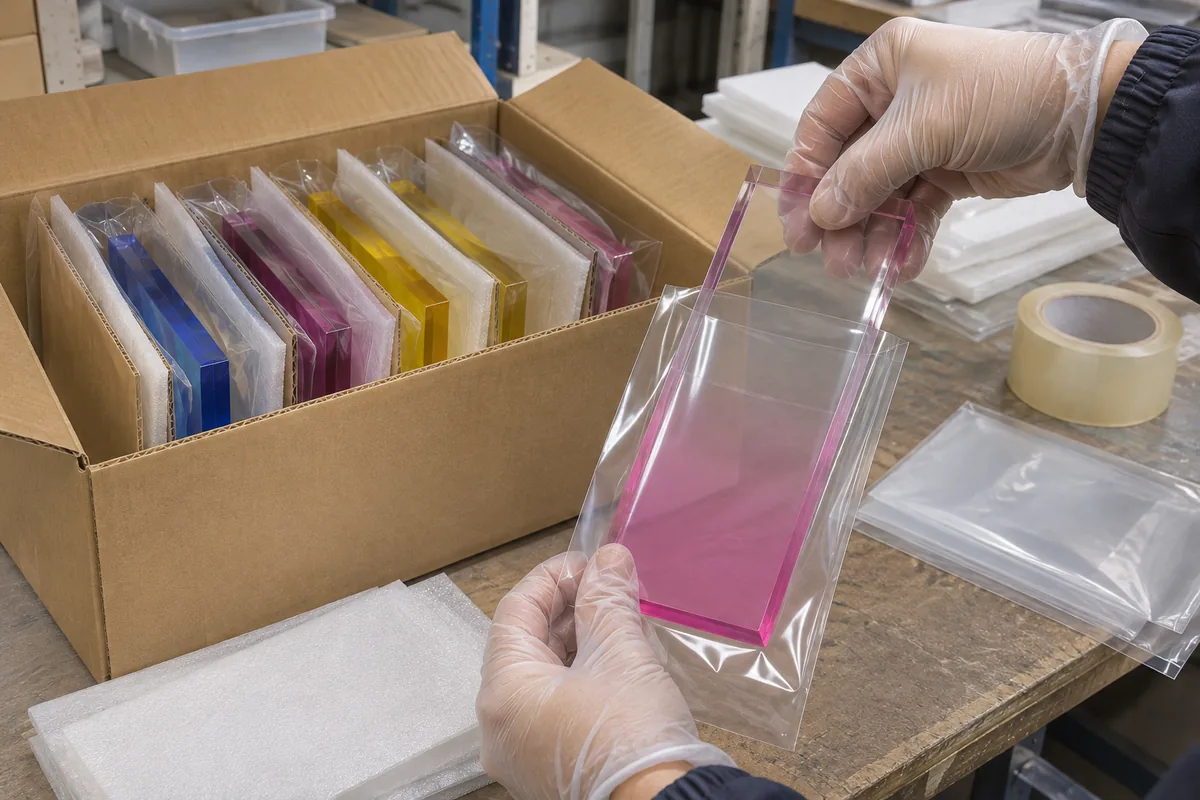
Protect dyed faces and edges from rubbing
Approve packing on the finished shape; this page does not publish a fixed pack format or price.
A translucent dyed face can show fine scratches, dust, and scuffs. Choose film, tissue, separators, individual bags, and carton restraint from the finished part and later assembly work.
- Dyed and printed faces do not rub together
- Edges, holes, and raised features do not mark the next part
- Parts do not slide or flip inside the bag or carton
- Protection can be removed without slowing set-up
- SKU labels stay readable across multiple colors or gradients
SUPPLIER CHECK
Seven questions before an immersion-dyeing RFQ
These are project questions, not claims of fixed factory capacity.
- 01Can the sample use the production sheet type, grade, and thickness?
- 02Can a physical chip, previous part, or approved master set the target direction?
- 03How will feasibility be judged for large, curved, or thick parts?
- 04Can material, dyeing conditions, and sample revisions be recorded?
- 05Can the part be reviewed after print, cut, bend, or bond steps?
- 06Can lot, split-shipment, and reorder re-approval rules be agreed?
- 07Can protection, individual packing, and separators fit the shape?
RFQ TEMPLATE
Start with quantity, budget range, and a requested date
You do not need a complete technical file to open the discussion. Add the target color, material, gradient, later processes, inspection, and packing notes as they become available.
Acrylic immersion dyeing enquiry

Quantity:
Budget range:
Requested delivery date:

Optional details
Use / environment:
Size, thickness, and sheet type:
Target color or physical reference:
Gradient direction and range:
Later processes:
Inspection and packing notes:
FAQ
Frequently asked questions
Answers stay within the approved evidence and do not invent production parameters.
Q01What is the difference between immersion dyeing, a colored acrylic sheet, paint, and edge painting?
Immersion dyeing adds post-process color to a clear part. A colored sheet carries color in the material; paint or print sits on the face; edge painting colors only the cut edge. Choose the route from the visual job and approve a sample on that route.
Q02Do faces, thickness, and edges keep the same translucency and color?
Not automatically. Thickness, shape, and viewing direction can change the reading. Review each required view on a production-material sample.
Q03Is the color only on the surface, or does it go through the part?
Do not treat either statement as universal. Judge the actual sample, including later engraving, drilling, or cutting when required.
Q04Can a Pantone, DIC, or RAL code be the approval standard?
A code can set direction but should not be the only standard. Approve a physical sample at production thickness under agreed light and background.
Q05Should the sample use the same sheet type, grade, and thickness as mass production?
Yes. A different sheet or thickness can mislead both color approval and later-process checks.
Q06Does cast acrylic dye differently from extruded acrylic?
It can. This guide does not rank one as easier. Sample the sheet type planned for production.
Q07Can gradients or partial dips be produced consistently?
They can be sampled and specified, but exact identity should not be assumed. Approve direction, start, end, and an acceptable boundary range.
Q08In what order should cutting, polishing, dyeing, printing, bending, and bonding happen?
No single order fits every design. Freeze the order in the specification and approve a part close to the finished state.
Q09If the part is engraved or machined after dyeing, might undyed material show?
It might. Treat this as a sample check rather than a universal penetration-depth claim.
Q10What should be cleaned off the part before the dye bath?
Oil, fingerprints, adhesive, protective-film residue, cutting dust, and coolant can disturb color. Agree the cleaning step before dyeing.
Q11What should be checked after dyeing, and how should lots and reorders be compared?
Check density, evenness, boundaries, bubbles, whitening, warping, scratches, and dimensions. Compare with the retained master under the same light, background, and orientation.
Q12Can dyed acrylic be used outdoors or under long-term lighting?
This page does not publish a fade rating or outdoor-life claim. Share the use period, light, temperature, cleaning, and chemical exposure so the project can be evaluated.
Q13What is enough to start an RFQ?
Quantity, budget range, and requested delivery date are enough to start. Price, MOQ, and lead time remain project-specific and are not stated as fixed figures here.