
Custom Plush Barcodes: Who Assigns the GTIN and When to Finalize Each SKU
A barcode added after the backing card is already approved can force an artwork revision, delay retailer item setup, or put the wrong product data on a finished package. The practical solution is to separate allocation responsibility, trade-item decisions and print execution before production begins.
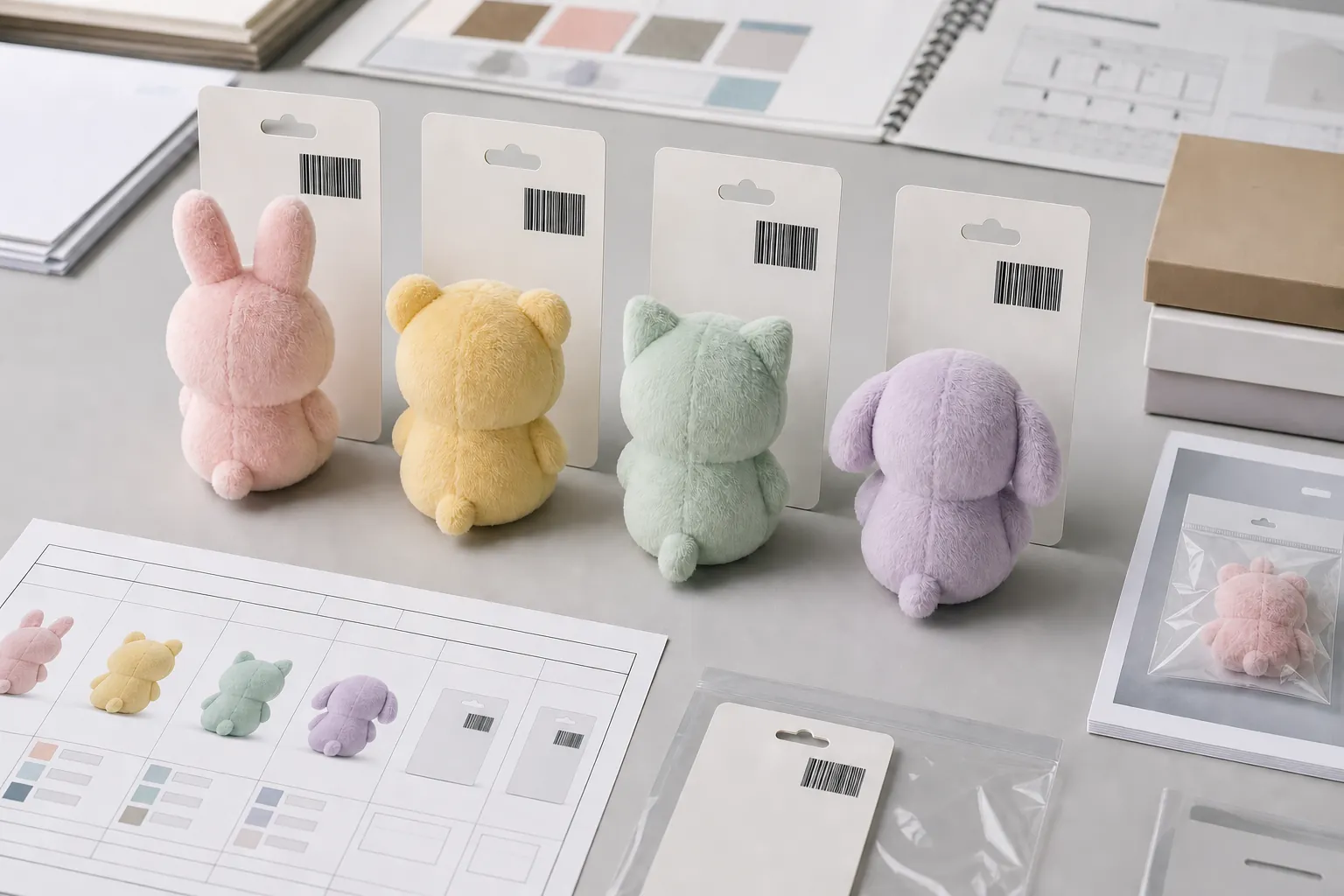
GTIN, UPC, EAN and JAN: keep the terms separate
A GTIN identifies a trade item. A UPC-A barcode commonly carries a GTIN-12, while an EAN-13 barcode commonly carries a GTIN-13. JAN is the Japanese use of the EAN-13 or GTIN-13 framework. The barcode is the machine-readable symbol; the GTIN is the identifier encoded in it.
Who assigns the GTIN, and who prints the barcode?
“Ask the factory for a barcode” mixes two different jobs. The organization that owns the trade-item specifications normally controls allocation and approval. The factory and printer execute the approved packaging data without inventing, reusing or redrawing the number.
| Party | Primary responsibility | Handoff | Control point |
|---|---|---|---|
| Brand owner / GTIN allocator | Allocate and approve the GTIN; maintain the SKU relationship | Approved identifier, product name, selling unit and barcode artwork | Prevent duplicate, reused or mismatched numbers |
| Merchandise / data team | Define variants, sets, packaging levels and retailer records | SKU-to-GTIN master, item setup deadline and revision status | Keep sales, artwork and warehouse data aligned |
| OEM factory | Place approved data on the specified pack and prepare a proof | Artwork proof, packaging sample and production references | Do not change the identifier without written approval |
| Printer / label supplier | Output the symbol at the approved size and location | Printed proof and version details | Protect quiet zones, contrast, scale and print quality |
| Retail / logistics partner | Register and use the item in POS, ecommerce or warehouse systems | Required fields, deadlines and verification criteria | Share requirements before packaging approval |
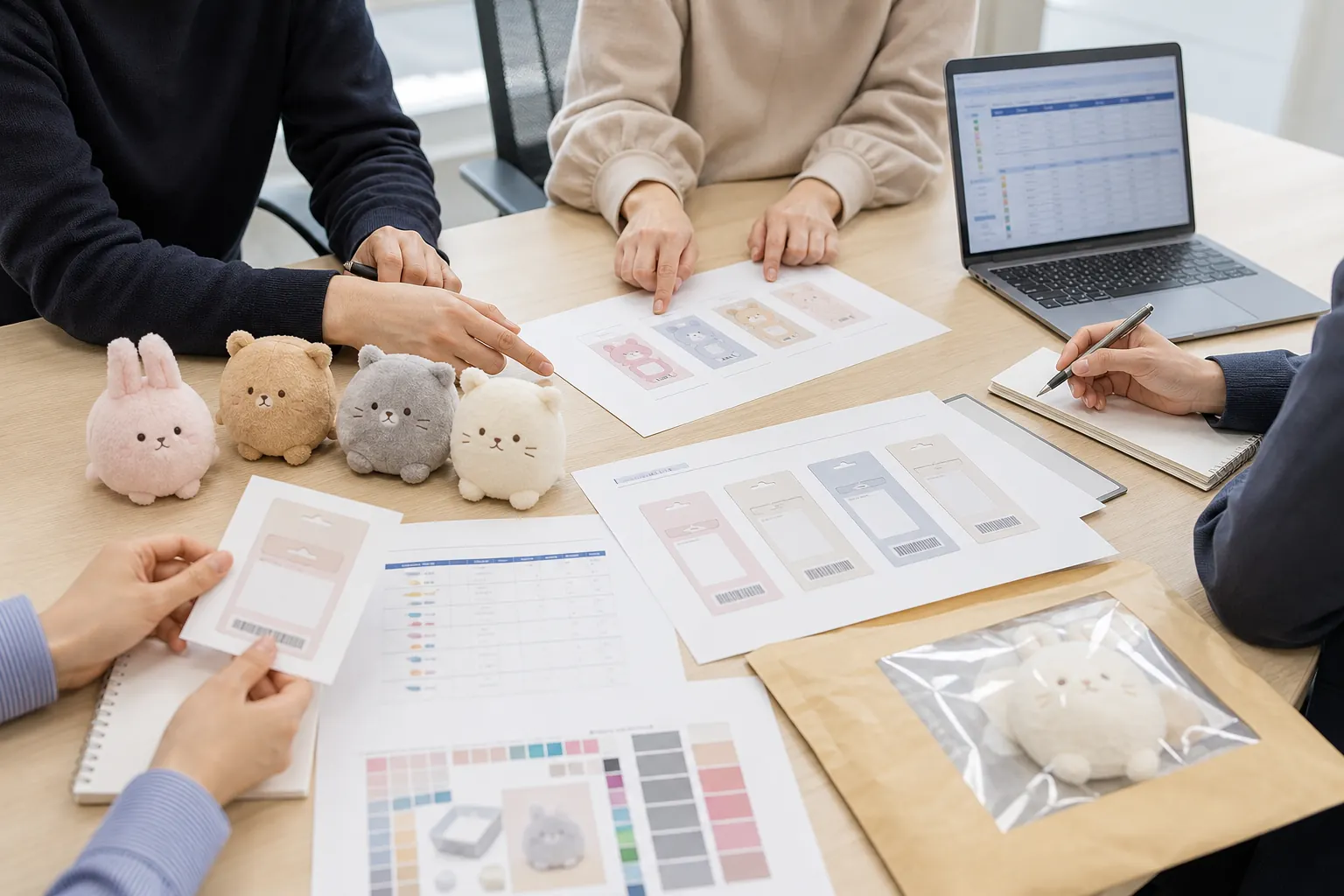
Does each plush SKU need a different GTIN?
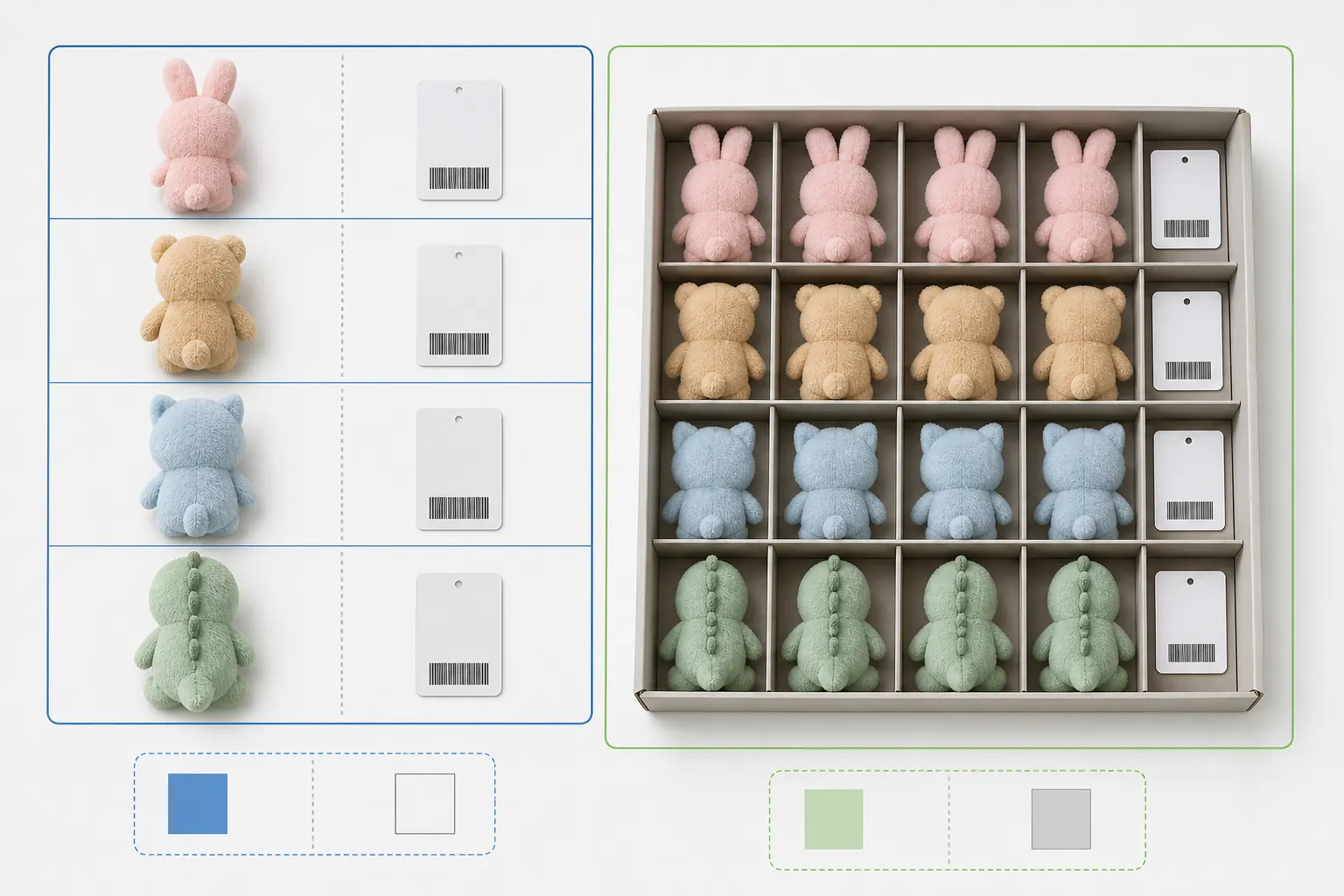
Not every internal SKU automatically needs a GTIN, and a GTIN is not simply a factory part number. The decision starts with the trade item: can a buyer or trading partner order, price, sell or inventory this unit separately?
| Change | Why a separate GTIN may be needed | Question to settle first |
|---|---|---|
| Character or color variant | Customers may select it and stores may hold separate inventory | Is it sold openly, or supplied inside a random assortment? |
| Size variant | The description, price, dimensions and packaging usually change | Is the size a distinct selling unit? |
| Single item versus set | The content count and sales unit are different | Does the set have its own item record and package? |
| Different pack quantity or packaging level | The consumer unit, inner pack and case can serve different ordering levels | Which levels are traded and identified? |
| Channel-specific backing card | It may be treated as a separate product by one retailer | Do the specifications or trading-partner records differ? |
| Production-only revision suffix | A process code may not change the consumer trade item | Can the buyer distinguish or order the revision? |
When to freeze each GTIN: a six-stage workflow
- Confirm channels and deadlinesIdentify retail, ecommerce, event, giveaway and warehouse requirements, including item-setup dates.
- List every potential selling unitSeparate open variants, random assortments, sets, pack quantities and packaging levels.
- Approve the SKU specificationFreeze the name, character, color, size, set contents, selling unit and packaging concept.
- Allocate and record the GTINThe responsible organization checks its numbering records and adds the approved identifier to the master.
- Approve artwork and a physical proofMatch the human-readable number, symbol, SKU and package; check the printed result on the real substrate.
- Lock mass-production referencesUse the approved version for packaging, retailer data, packing instructions, carton labels and shipment checks.
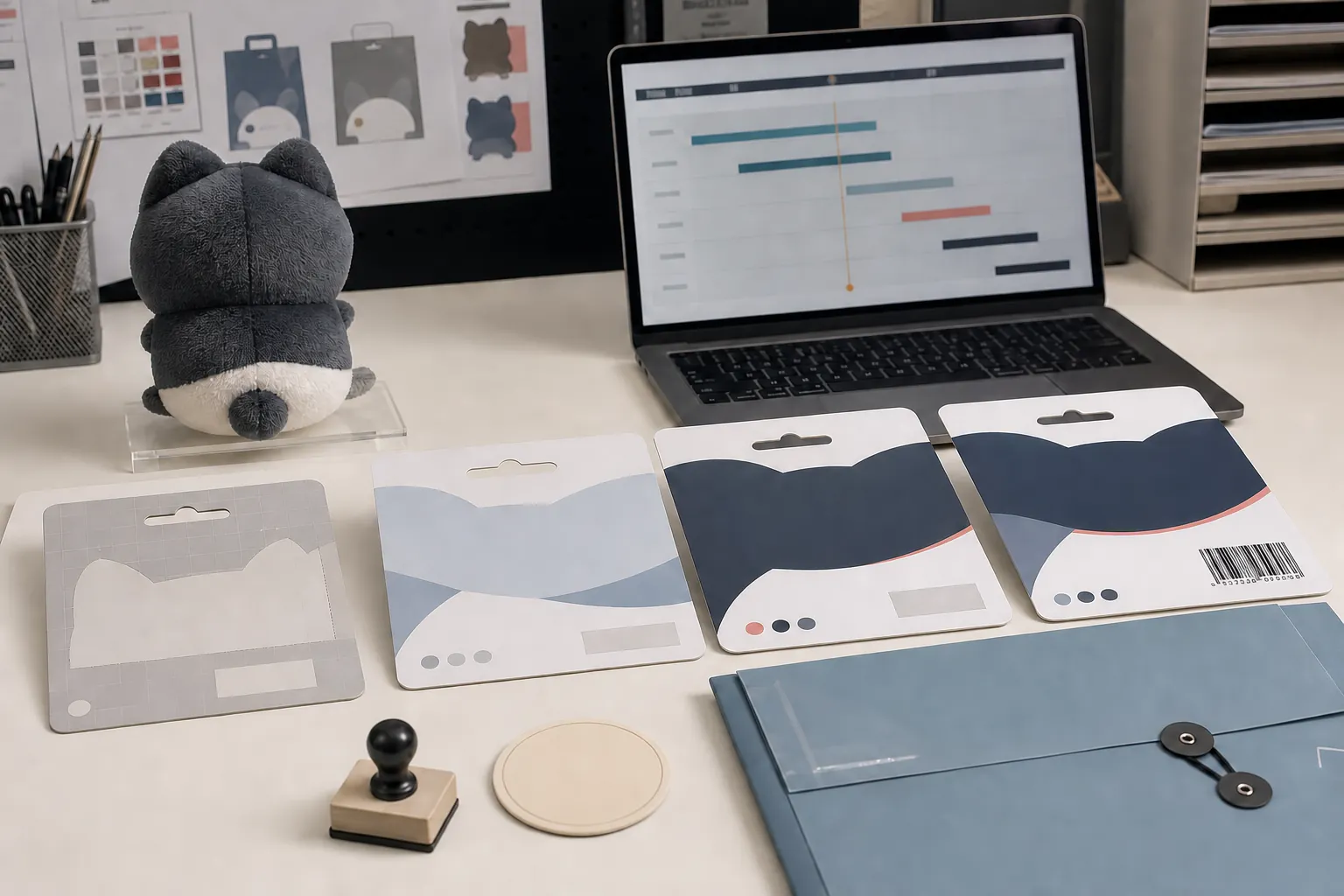
The practical freeze point is before print approval, not after the packing materials arrive. A designer can reserve a placeholder area earlier, but the production file should not be released until the product definition and SKU-to-GTIN relationship are approved.
Build one SKU-to-GTIN master before artwork release
A barcode image alone is not a safe production instruction. Create one controlled master that the merchandise, artwork, factory, printer and logistics teams can reference.
- Internal SKU and revision status
- Customer-facing product name and variant
- Character, color, size and set contents
- Selling unit, pack quantity and packaging level
- Approved GTIN and human-readable digits
- Barcode symbol type and approved artwork file
- Backing card, label, bag or carton specification
- Artwork version, approver and approval date
- Retailer item-setup status and required deadline
Use version control that distinguishes a working file from the production-approved record. If the item definition changes after allocation, review the current GS1 rules before keeping or replacing the GTIN.
Direct print or a separate barcode label?
| Method | Best fit | Advantage | Production risk to control |
|---|---|---|---|
| Printed on backing card | Stable SKUs, approved specifications and repeat volume | Fewer labeling steps and a cleaner package appearance | A number change can require new artwork or printed stock |
| Applied barcode label | Low volume, many SKUs or channel-specific data | Easier SKU switching and late-stage data separation | Wrong label, poor placement, skew, peel-off or double application |
| Carton identification | Warehouse or logistics units | Supports case-level handling | Do not confuse a carton identifier with the consumer unit |
A label is not a workaround for unclear master data. Both methods require a controlled artwork source, defined placement and a packing instruction that connects the correct product to the correct code.
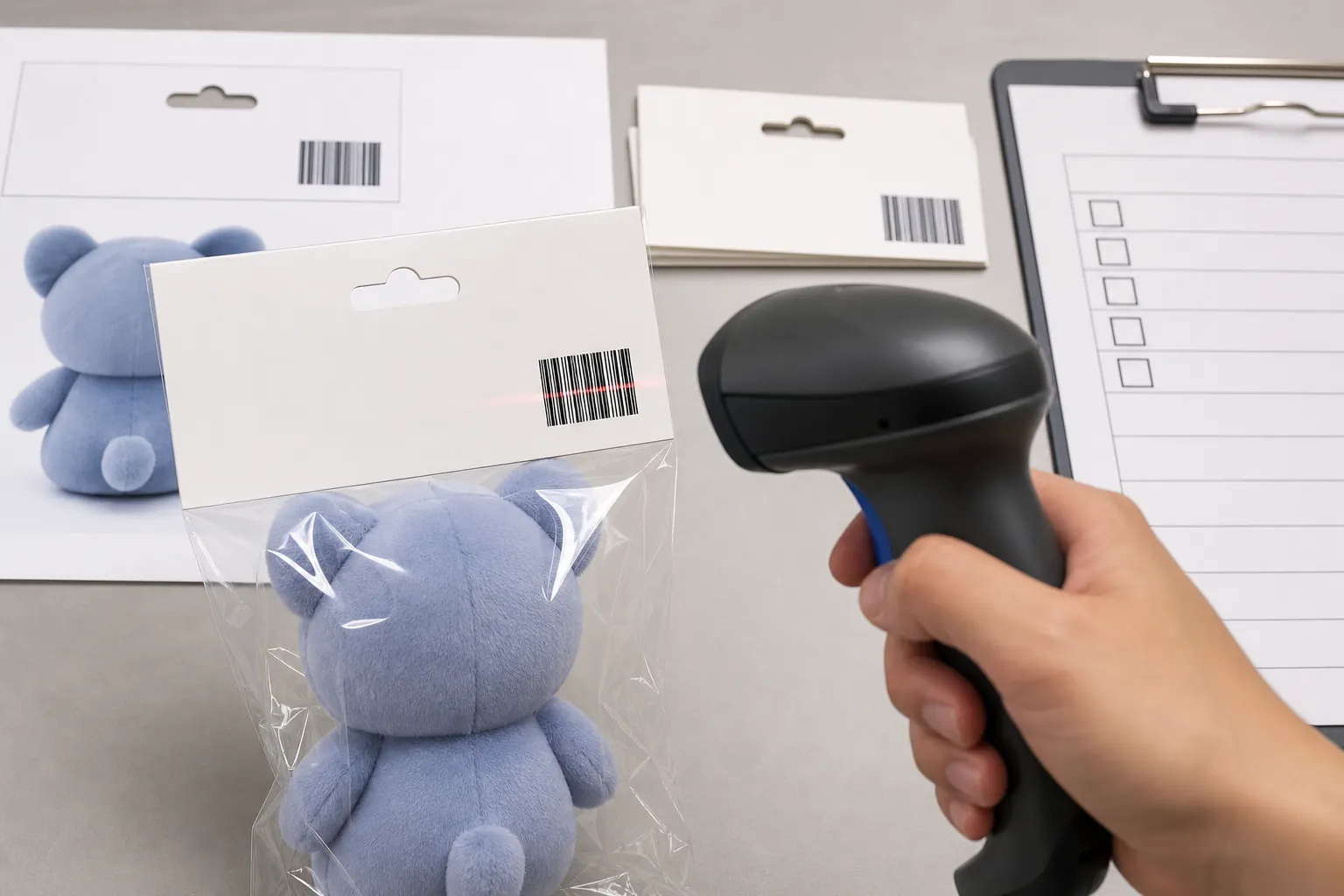
Check the printed result, not only the PDF
A clean symbol on screen does not prove that a finished card or label will scan reliably. Coated paper, gloss film, curves, folds, seams, low contrast, print growth and a reduced quiet zone can all affect the result.
- Compare the encoded and human-readable digits with the approved master.
- Confirm symbol dimensions, quiet zones, contrast and orientation against the applicable specification.
- Print on the intended card, label or film rather than a generic office sheet.
- Keep the symbol away from folds, bag seams, curves, glare and likely damage areas.
- Perform the project-required scan or verification check and retain the approved sample.
- Recheck after a printer, substrate, scale, placement or artwork-version change.
Prevent product, package and carton mismatches
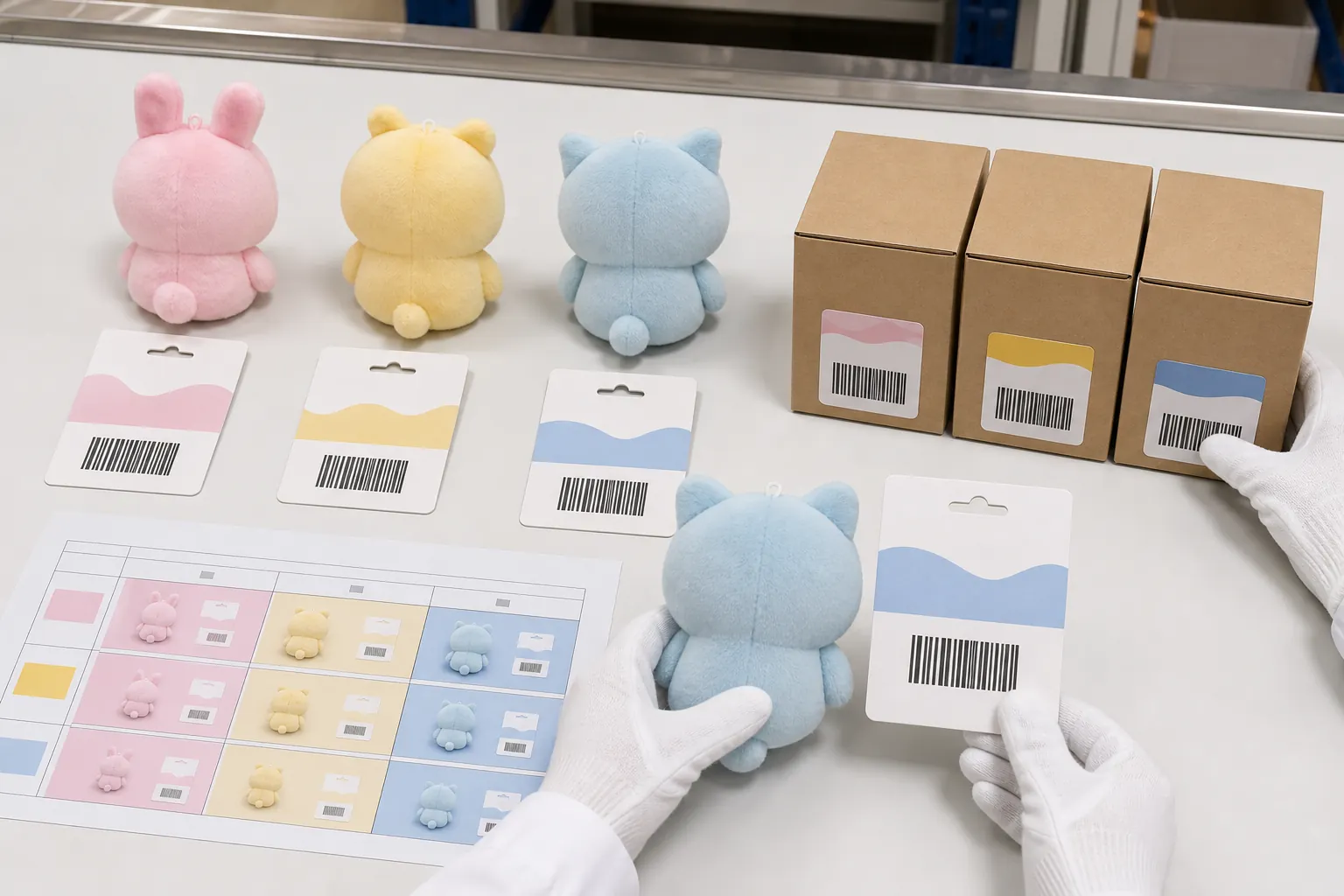
The final control is a three-way match: the plush product, its retail package and the packing or carton record must point to the same approved SKU and GTIN. This is especially important for similar character colors and multiple small variants.
- Correct number on the wrong color or size
- Old artwork used after a SKU revision
- Single-item code placed on a set package
- Retail label applied to the wrong channel edition
- Human-readable digits differ from the encoded data
- Consumer-unit and carton identifiers are swapped
What to send with a custom plush RFQ
The GTIN does not need to be allocated before the first quotation, but the factory needs enough information to price the packaging and control method correctly.
- Number of designs, variants and internal SKUs
- Planned selling units, sets and pack quantities
- Destination markets and sales channels
- Retailer or warehouse item-setup deadline
- Backing card, bag, label and carton requirements
- Direct-print or separate-label preference
- Whether approved GTIN data already exists
- Proof, scan, verification and inspection requirements
Related custom plush production guides
Frequently asked questions
Does the OEM factory assign the GTIN or UPC for my custom plush product?
Normally, the brand owner or other organization responsible for the trade-item specifications allocates the GTIN through its GS1 licensing arrangement. The OEM factory should receive the approved SKU-to-GTIN master and barcode artwork, then place that data on the backing card, label, bag or carton. Confirm exceptions with the relevant GS1 Member Organisation and your trading partner.
Does every internal SKU need a separate GTIN?
Not automatically. A SKU is an internal stock identifier, while a GTIN identifies a trade item. A different color, size, set, pack quantity or packaging level may need a separate GTIN when buyers can order, price, sell or inventory it separately. A production-only suffix may not. Apply the current GS1 GTIN Management Standard to the actual selling unit.
When should the GTIN be finalized for each plush SKU?
Finalize it after the product name, variant, dimensions, set contents, selling unit and packaging specification are approved, but before the backing-card or label artwork is released for printing. If a retailer needs item setup earlier, work backward from that registration deadline and freeze the master data sooner.
What is the difference between GTIN, UPC, EAN and JAN?
GTIN is the identifier for a trade item. UPC-A commonly carries a GTIN-12 in North America, while EAN-13 commonly carries a GTIN-13. JAN is the Japanese use of the EAN-13 or GTIN-13 system. The destination market and trading partner determine which data carrier and registration process apply.
Should the barcode be printed on the backing card or applied as a label?
Direct printing suits stable specifications and repeat volumes because it removes a labeling step. A separate label can be easier for low-volume, multi-SKU or channel-specific projects. Either method needs an approved size, quiet zone, contrast, placement and scan check on the real material before mass production.
Is a retail barcode required for every custom plush order?
No. A giveaway, event item or direct-distribution project may not require a retail GTIN. Requirements depend on the sales channel, retailer, warehouse and market. If later retail or ecommerce distribution is possible, reserve an appropriate area on the package and confirm the data requirements before the artwork is locked.
Official references
Prepare the SKU and packaging plan before print approval
Share the variants, selling units, target channels, packaging method and item-setup deadline. We can then scope backing-card or label production, proofing and SKU matching for your custom plush quotation.
Discuss your plush packaging requirements