
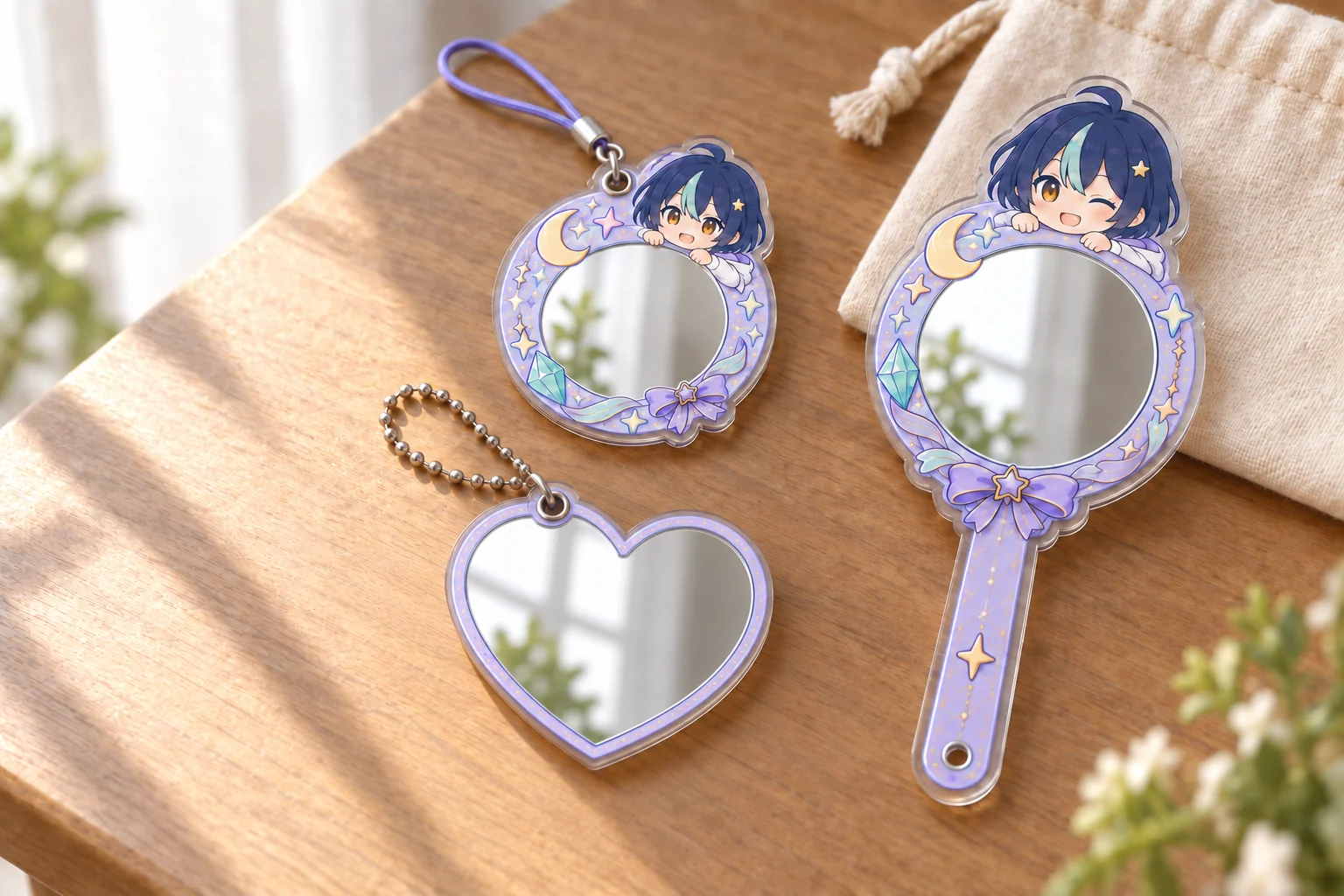
Custom acrylic mirrors B2B OEM & bulk production
Custom Acrylic Mirror Keychains for Merchandise Handheld, Pocket & Slide Mirrors
Custom acrylic mirror keychains and other portable mirror merchandise can be planned as tags, slide and pocket mirrors, handheld mirrors, and project-specific convex photo props.
Before sampling, define the usable mirror area, artwork and white-ink zones, edge and attachment structure, protective-film direction, individual packaging, SKU mix and approval criteria. MOQ and timing are quoted by format, size, design count, packaging and revision cycle.
00 / Scope & direct answer
What is custom acrylic mirror merchandise?
It combines a reflective mirror component with printed or clear acrylic parts to create portable character merchandise such as mirror keychains, slide mirrors, pocket mirrors and handheld mirrors.
This page is for finished merchandise, not cut-to-size mirror sheets or architectural panels. Unlike an ordinary acrylic keychain, the approval must cover real reflection, surface protection, edge and hardware contact, layer alignment and individual packing—not print appearance alone.
01 / Decide before quotation
Fix four decisions before comparing prices
These choices determine construction, sampling, inspection and packaging assumptions.
What must the mirror show?
Define the usable reflective area, decorative border and finger-contact zones.
How should the layers work?
Confirm a single exposed mirror, a printed backing layer, or a rotating cover construction.
How will it be carried?
Choose a ball chain, strap, clasp, eyelet or handle for the intended use.
How will it arrive protected?
Specify film, interleaf, card, OPP, tray, blind pack and carton contact.
02 / Product decision matrix
Choose the mirror format by use
Compare protection, carrying method, mirror area and photo use before selecting a construction.
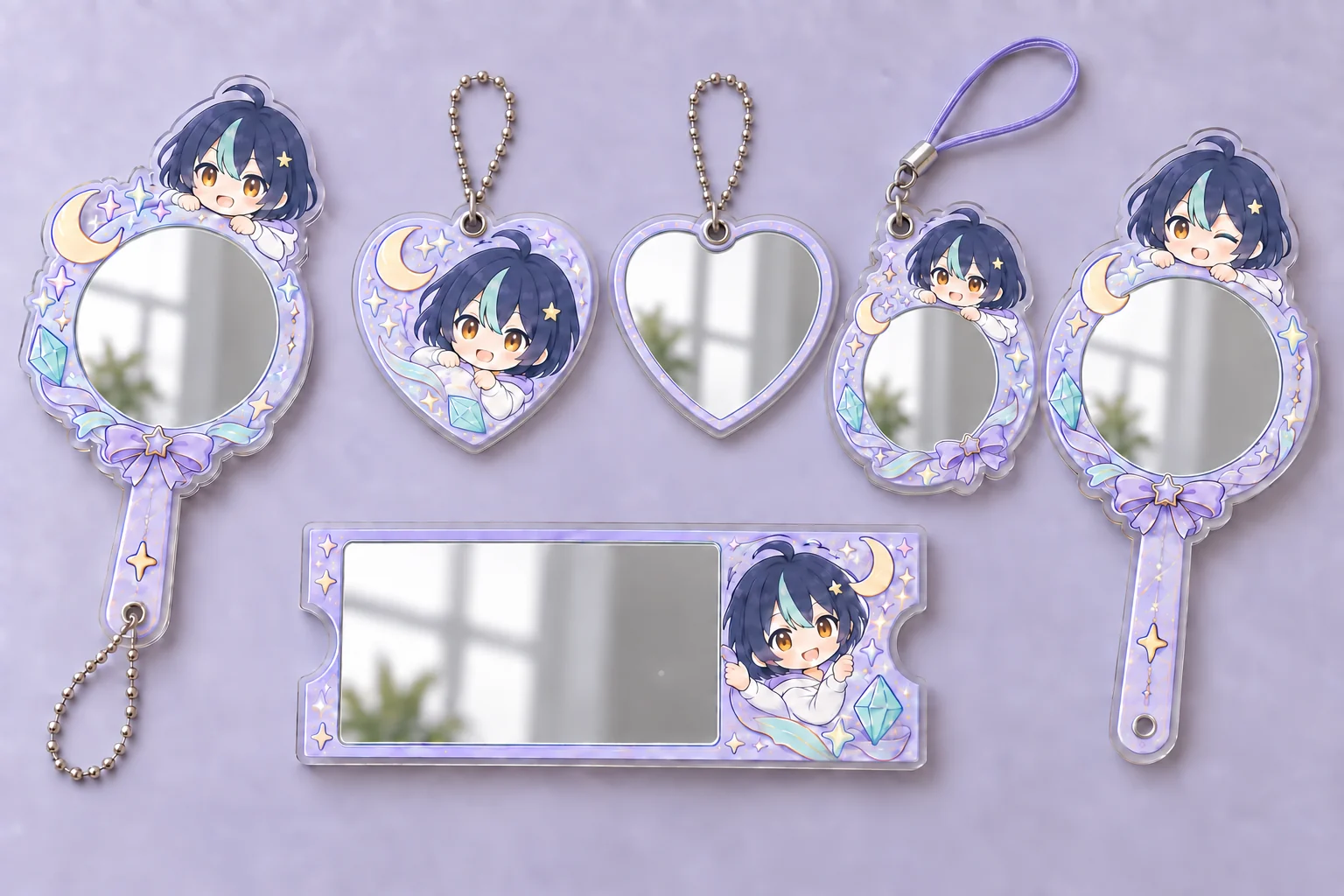
Selection principle
Choose by function and protection—not outline alone
A slide mirror is mainly a construction choice, a mirror keychain is a carrying choice, a handheld mirror prioritizes usable area, and a convex prop prioritizes its photographic effect.
- Must the mirror be covered in a bag?
- Will it attach to a pouch or key ring?
- How much practical mirror area is needed?
- Is reflection part of a photo experience?
- How is the surface protected inside the pack?
01 / Covered in transit
Acrylic slide or pocket mirror
A mirror insert sits in a recessed base. A matching printed cover shares one pivot point and rotates to the right, then aligns with the base when closed.
- Use
- Limited merchandise and portable accessories
- Carry
- Pouch storage or project-specific hardware
- Protection
- Closed cover shields the mirror face
- Structure
- Recessed base + mirror insert + matching cover + shared pivot
- Sample
- Closed outline, pivot alignment, opening direction, friction and layer contact
02 / Attach to a bag
Mirror keychain or mirror tag
A simple usable mirror shape—often round or heart-shaped—is combined with a decorative backing board and carrying hardware.
- Use
- Event merchandise, retail goods and promotions
- Carry
- Ball chain, strap or selected fitting
- Protection
- Surface film and individual pack for the exposed face
- Structure
- Simple mirror face + printed backing board + hardware
- Sample
- Mirror shape, centered backing hole, edges, hardware and pack contact
03 / Prioritize viewing area
Custom acrylic handheld mirror
A larger flat mirror area and an acrylic handle are planned as one practical merchandise format.
- Use
- Beauty goods, lifestyle retail and fan merchandise
- Carry
- Handle with an optional hanging point
- Protection
- Backing card and OPP sized for a broad exposed face
- Structure
- Flat mirror + printed acrylic handle or frame
- Sample
- Grip, reflection, edge finish and package dimensions
04 / Photo & fan-event prop
Convex mirror photo stick
A round reflective head and a sufficiently wide handle can be reviewed for photo, live-event or fan-activity concepts.
- Use
- Live events, photo spots and campaign props
- Carry
- Wide handle with an optional hanging point
- Protection
- Individual pack that avoids pressure on the curved face
- Structure
- Round convex mirror + acrylic handle
- Sample
- Mirror diameter, reflected range, image deformation and handle balance
Available mirror materials and constructions must be confirmed for each project.
Variants & search boundary
Keep design variants separate from different product categories
Ticket-shaped or semi-reflective mirror
Use a practical rectangular mirror area with shallow ticket notches, then plan printed borders, white ink and any clear or semi-reflective zones through sampling.
Compact mirror
Some compact products use acrylic only as a decorative insert on a metal or plastic case. Confirm the case material and bonding method before treating it as an acrylic product.
Stand mirrors, tin mirrors and mirror sheets
Desktop mirrors, metal-backed pocket mirrors and architectural mirror sheets have different structures and procurement questions, so they are not the core formats on this page.
Planning fit / Buyer profiles
Who plans custom acrylic mirror products?
These formats suit projects that combine an IP or brand world with a portable, functional item. Start from the sales channel and opening experience.
Possible planners include anime and game licensors, publishers, live-merch teams, pop-up and retail operators, trading-goods planners, promotional agencies, lifestyle brands, visitor attractions and sports organizations.
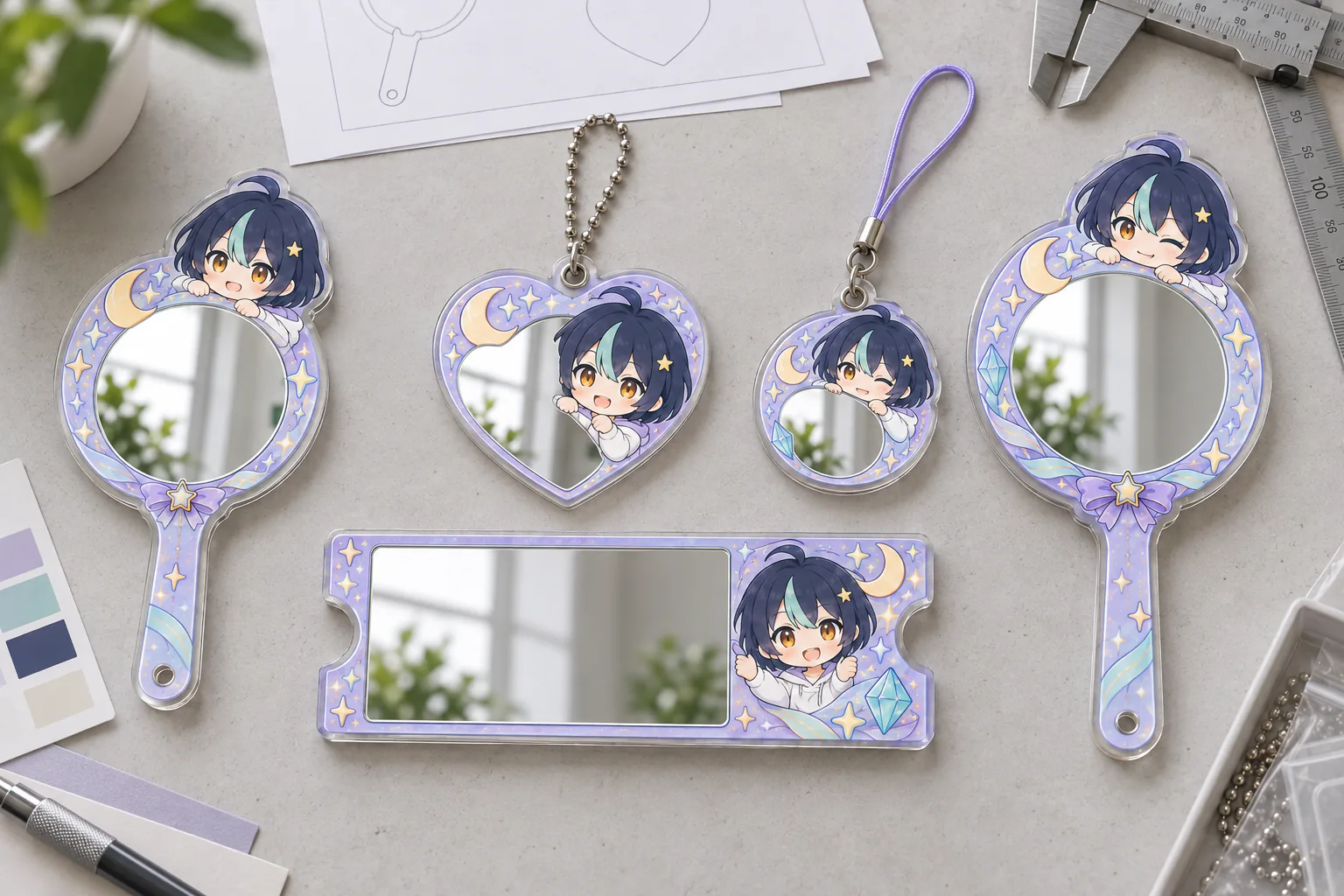
Anime, game, publishing and IP teams
Turn character art into a functional item for a launch, anniversary or licensed range.
- Programs
- New release, anniversary, licensed and EC-exclusive goods
- Formats
- Slide mirrors, mirror tags and handheld mirrors
- Confirm
- Approval rounds, style guide, design count and rights notice
Music, stage and live-event teams
Extend key visuals into venue merchandise or fan-club items.
- Programs
- Tour goods, commemorative events and member-only ranges
- Formats
- Handheld mirrors, photo sticks and slide mirrors
- Confirm
- On-sale date, venue rules, split delivery and pack labels
Pop-up, event and retail planners
Balance shelf presentation, handling and portability for limited retail programs.
- Programs
- Pop-ups, exhibitions, collaboration stores and specialty retail
- Formats
- Mirror tags, handheld and ticket-shaped mirrors
- Confirm
- Backing card, barcode, hanging method and restock plan
Blind-box, lottery and trading-goods planners
Build collectible mirror SKUs around a hidden opening experience.
- Programs
- Blind assortments, lottery prizes and trading series
- Formats
- Mirror keychains and compact portable formats
- Confirm
- Mix ratio, inner pack, individual carton, display box and evidence
Agencies and promotional-goods teams
Use a practical mirror item for a campaign, membership offer or bundled gift.
- Programs
- Launch campaigns, premiums, membership and purchase gifts
- Formats
- Mirror tags, slide mirrors and handheld mirrors
- Confirm
- Brand color, insertion work, delivery destinations and deadline
Beauty, fashion, attractions and sports teams
Combine practical viewing with a brand, venue or team identity.
- Programs
- Beauty goods, souvenirs, fan goods and commemorative items
- Formats
- Handheld, slide and project-specific photo mirrors
- Confirm
- Use scene, mirror area, brand palette and retail pack
These are general planning profiles visible in the market. They do not identify CCG clients or prove adoption by any named company. Rights, approvals, labeling and sales rules must be reviewed per project.
Video / Shape & construction
Review physical movement and production decisions
The physical-reference video helps assess portable scale, attachments and opening movement. The original explainer summarizes format, print, mirror structure, QC and packaging.
- Portable scale, opening movement and attachment behavior
- Mirror tag, handheld mirror and photo-stick formats
- Mirror protection, QC and individual packing checkpoints
Physical shape reference
Original product explainer
03 / Print, white ink & reflection
Plan artwork around the usable mirror area
Separate the printed surface, usable mirror area, white-ink layer and clear area in the production artwork.
Protect the reflected area
Keep the functional mirror area clear of decoration, hardware and finger-contact zones.
Control color with white ink
White ink changes how printed colors read over clear or reflective layers, so approve the intended effect on a sample.
Record the layer order
For multi-layer or rotating formats, identify front, back, pivot direction, registration and permitted movement.
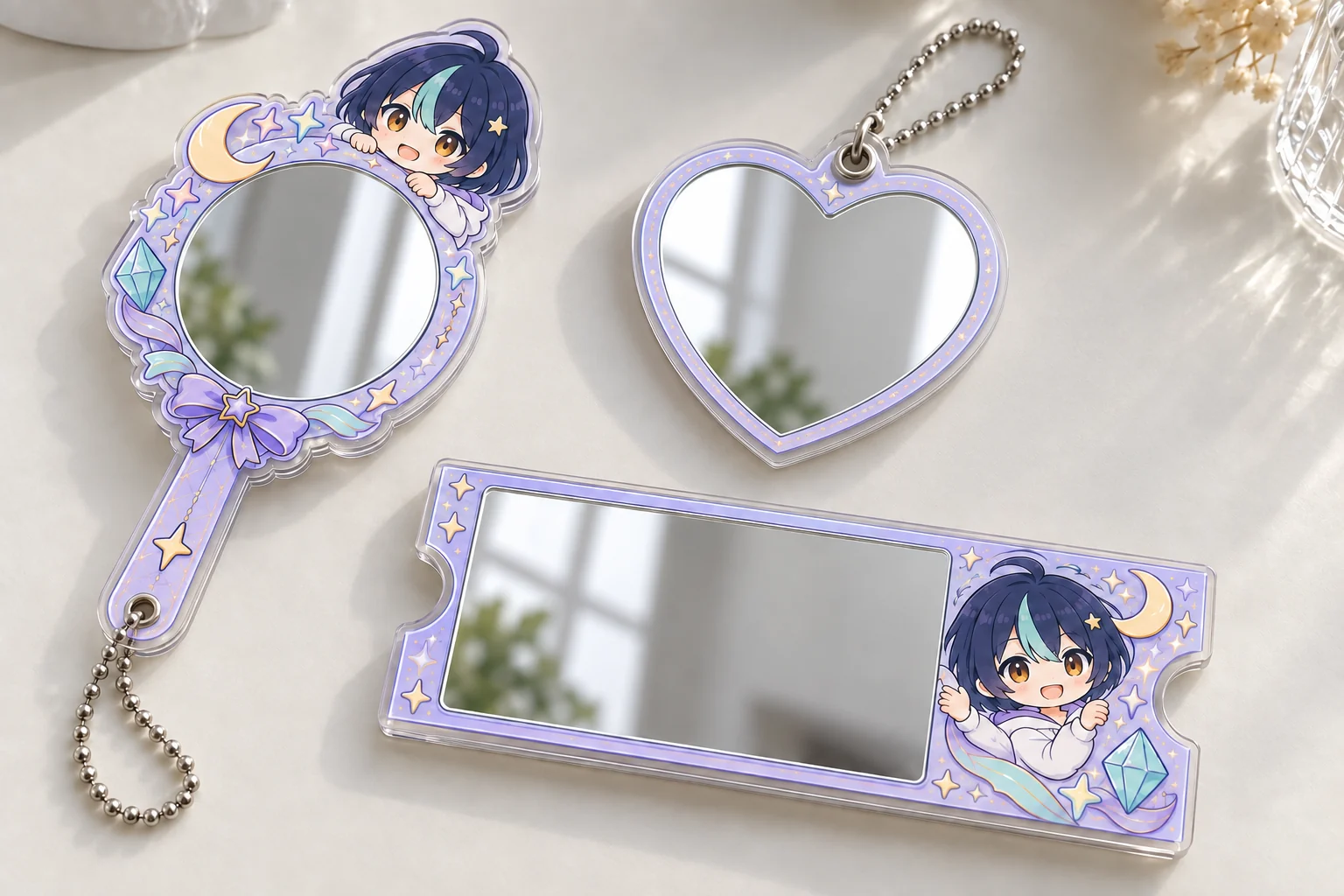
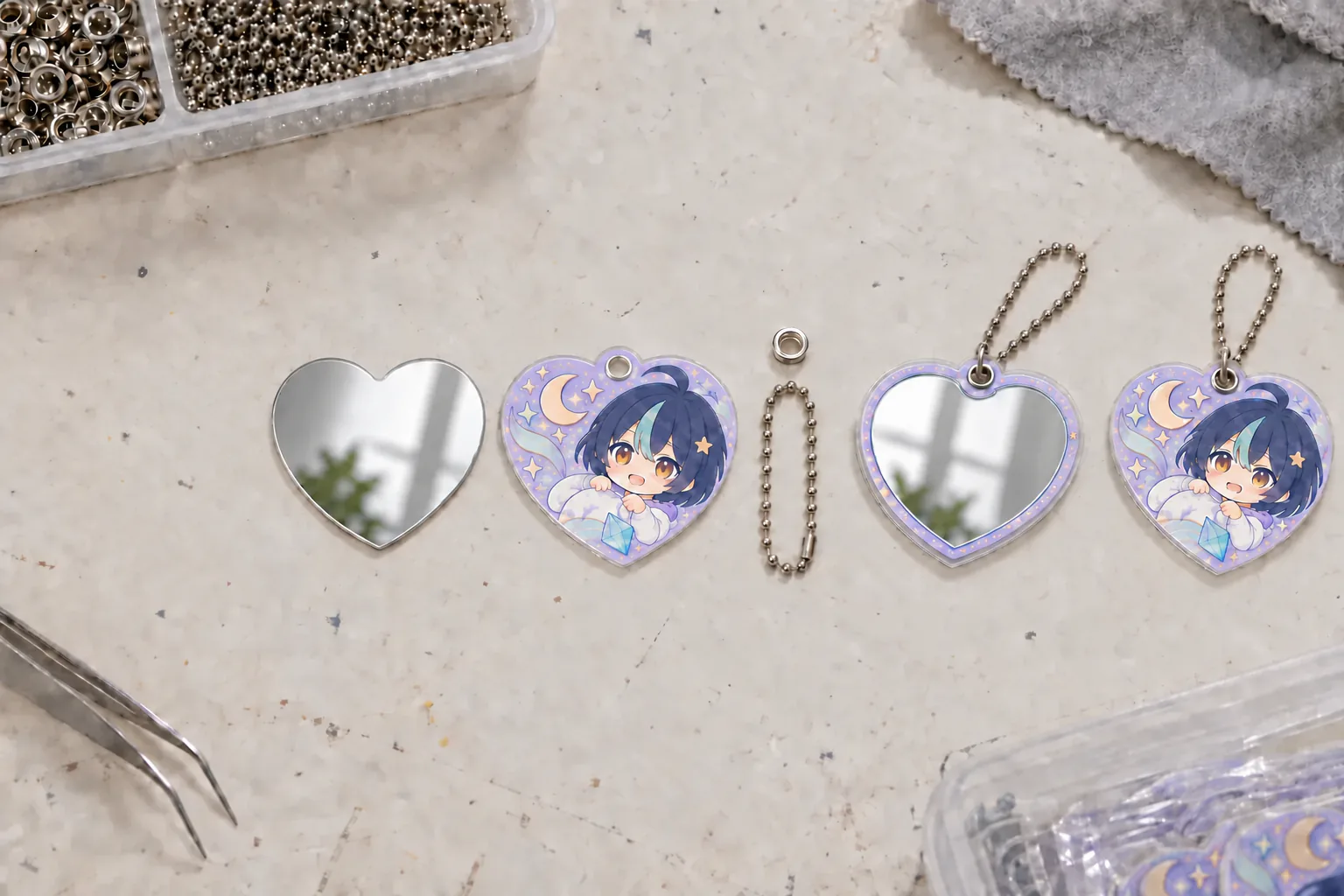
04 / Mirror-keychain structure
Separate the film, mirror and printed backing board
This exposed mirror tag has no moving cover. A removable surface film protects the hole-free mirror, while the attachment hole sits in the matching printed backing board.
Removable protective film
Cover the usable mirror face and record the removal side, tab position and whether film remains at delivery.
Hole-free mirror insert
Keep the mirror face unperforated to preserve usable area. Confirm reflection, edge condition and the selected substrate on the approved sample.
Matching printed backing board
Use a matching outer profile to support the mirror and place the attachment hole at the top center of the backing board.
Eyelet and ball chain
The eyelet is an attachment point, not a rotating hinge. Review hole clearance, hardware orientation and chain contact.
Do not approve the product from a material label alone. Mirror substrate, thickness, dimensions and compatibility with the proposed construction are confirmed per project with the selected production partner.
05 / Specification
Build the quotation around nine inputs
Start from product use instead of forcing a fixed size, material or thickness before feasibility review.
| Input | What to specify | Pre-production decision |
|---|---|---|
| Format | Slide / pocket, mirror keychain or tag, handheld, convex photo stick | Does it fit the carrying and sales method? |
| Mirror | Available substrate and flat, convex or semi-reflective expression | Review reflected range and image appearance on a sample |
| Layers | Exposed mirror, backing board, rotating cover or handle | Confirm total build, steps, movement and protection |
| Print side, full-color area, white ink, clear zone and front/back direction | Prevent print from reducing the usable mirror area | |
| Outline | Finished dimensions, cut line, corners and narrow projections | Review grip, edge appearance and breakage risk |
| Hardware | Hole position, eyelet, chain, strap, clasp or handle | Confirm connection, direction and strength around the attachment point |
| Protection | Film side, removal instruction, interleaf, card and OPP orientation | Reduce surface contact from inspection through opening |
| SKU | Design count, quantity by SKU, mix ratio, random pack, card and barcode | Prevent design mixing and support warehouse identification |
| Delivery | Target date, destination, carton allocation and delivery terms | Can the schedule be planned back from sample approval? |
06 / Responsibility
Separate project control from factory production
CharacterCraft Gift coordinates the buyer-facing specification and project record. Production is matched with a partner factory after the required mirror construction and finishing are known.
CharacterCraft Gift
Specification, approval and delivery coordination
- Buyer requirements and open-point review
- Artwork and specification checklist
- Sample arrangement and approval records
- Inspection criteria and evidence planning
- SKU packaging and destination requirements
- NDA and rights-data handling discussion
Partner factory
Feasibility, manufacturing and process control
- Available mirror substrate review
- Cutting, printing and assembly feasibility
- Production against the approved sample
- In-process appearance and position checks
- Specified individual packing and cartoning
- Equipment or certification documents subject to project availability
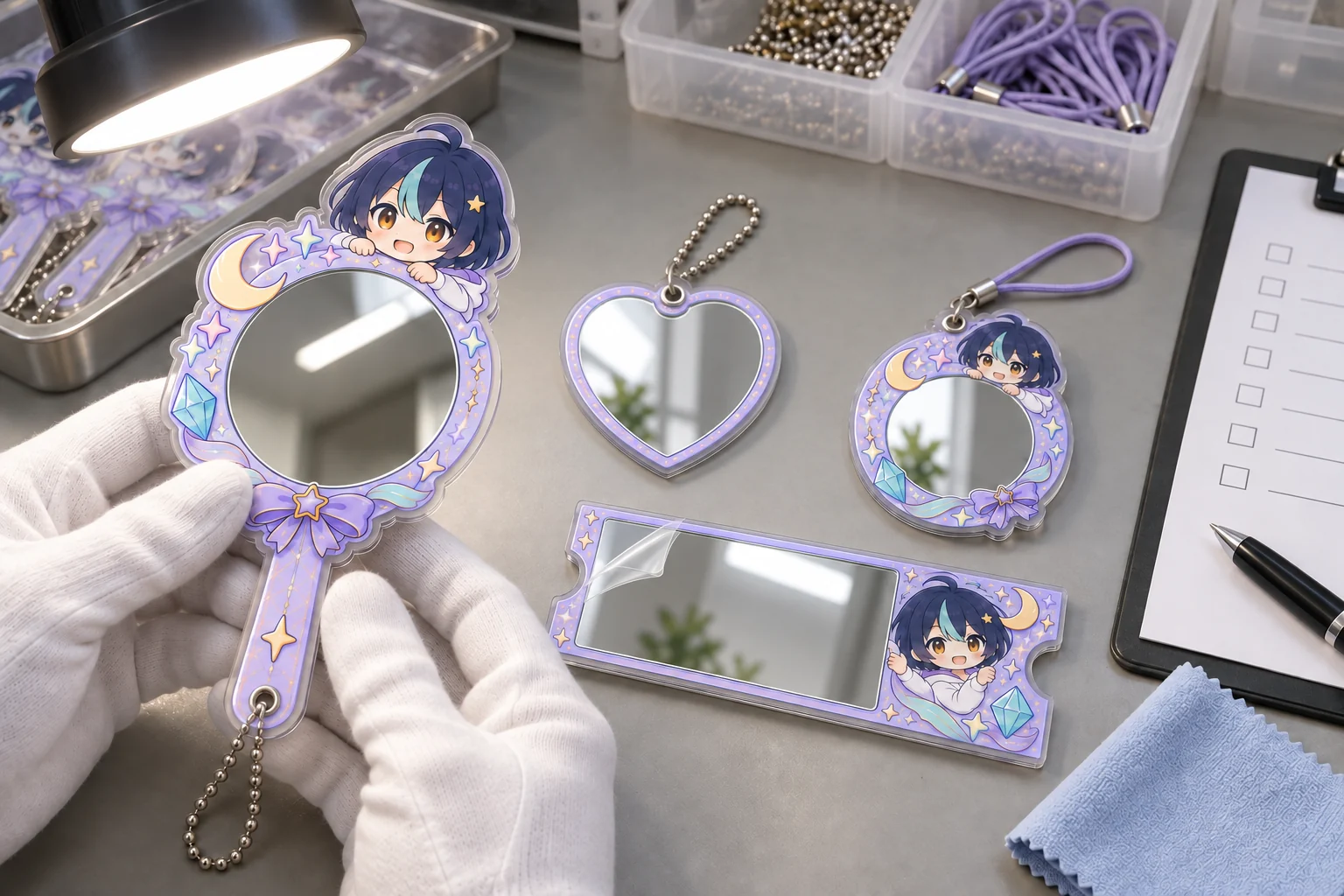
07 / Mirror-specific QC
Turn “no scratches” into an inspectable standard
Agree on the viewing condition and acceptable range instead of using an absolute surface promise.
Dots, lines and fingerprints
Identify priority and non-priority surfaces, viewing distance and lighting.
Reflection variation
Change the angle and background to review project-relevant distortion or uneven reflection.
Protective-film direction
Record which film remains, removal side, tab position and packing orientation.
Edges, holes and hardware
Check chips, marks, hole clearance, eyelets, hardware direction and layer registration.
08 / Protective packing & SKU
Prevent mirror-to-hardware and mirror-to-mirror contact
A clean surface at inspection can still be marked during individual packing, cartoning or transport. For exposed mirror tags, define the protective-film side and the contact direction of the interleaf, backing card and hardware.
- ProtectionKeep mirror film → add interleaf if required → pair with card → pack in OPP
- Card designReview contact between the mirror, card, chain and fittings
- SKU IDPlace barcode or identification on the card back, outer pack or carton label
- Carton layoutSet stacking direction, dividers, inner quantity and destination allocation
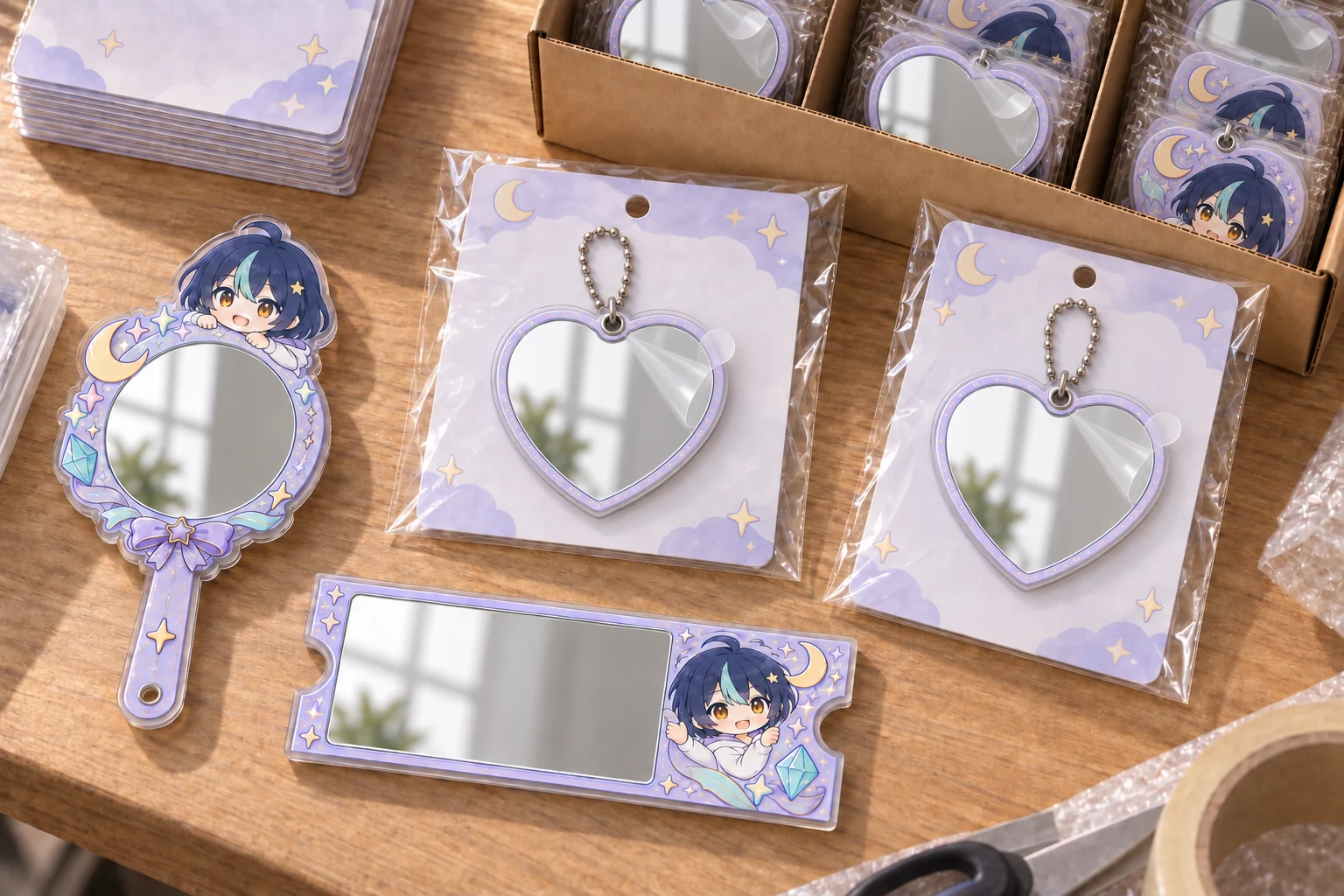
Packaging options / Sales format
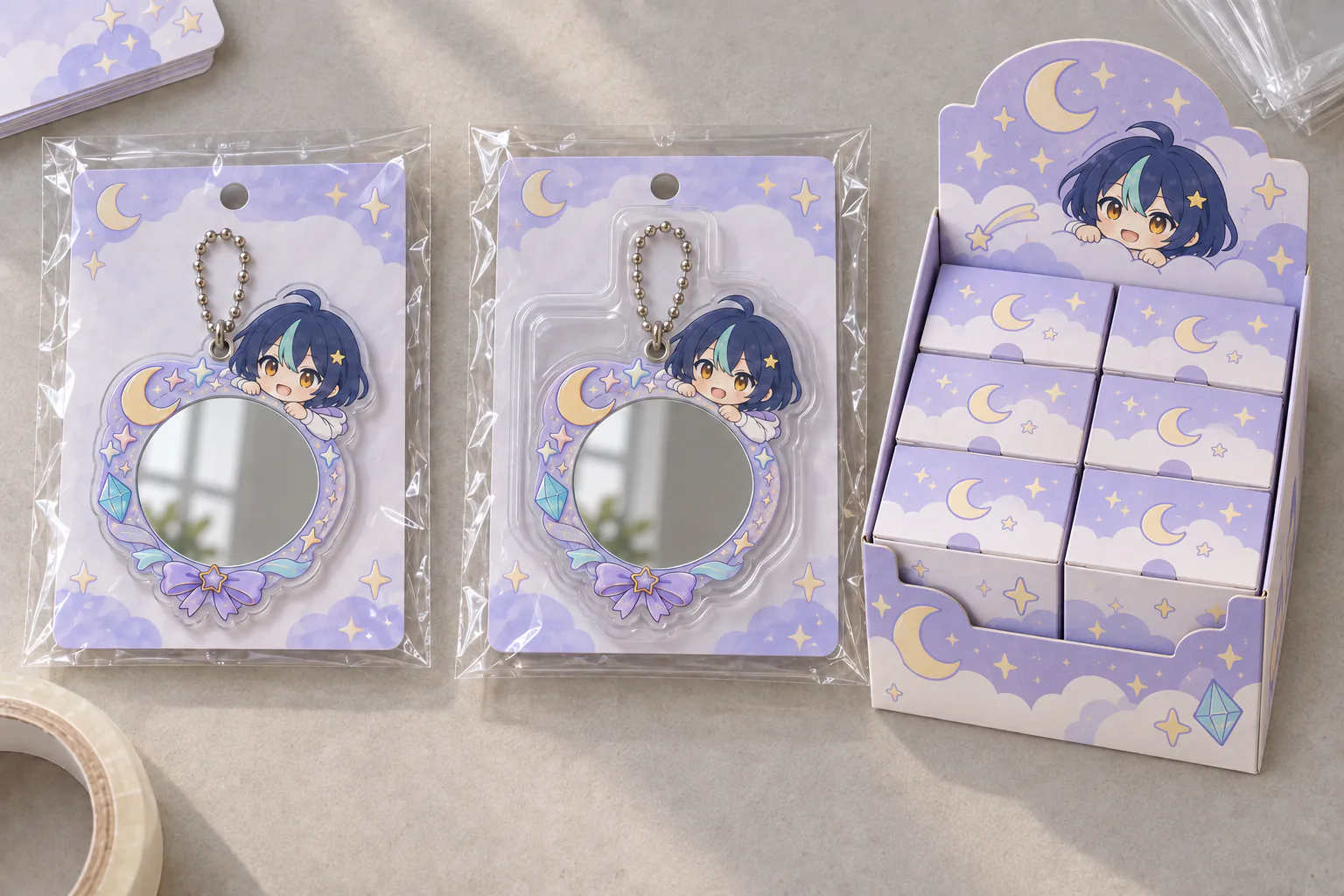
Choose one of three retail pack structures
Visible display, formed protection and secret opening require different materials and approval points.
Backing card + OPP bag
A transparent pack that keeps the product and printed card visible for hanging retail, event sales or ecommerce fulfillment.
- Basic build
- Protective film → optional interleaf → printed backing card → OPP bag
- Confirm
- Mirror contact, hanging hole, barcode or warnings and seal position
Blister tray + card + OPP bag
A formed clear tray locates the mirror and hardware, then combines with a printed card and an outer OPP bag.
- Basic build
- Protective film → blister tray → printed backing card → outer OPP bag
- Confirm
- Tray depth, mirror contact, hardware pocket, card retention and total thickness
Individual blind cartons + retail display box
Fully closed single-item cartons hide the design and are arranged in an open-front retail display box for random sales.
- Basic build
- Protective film → optional metallized inner bag → opaque individual carton → retail display box
- Confirm
- SKU mix, inner bag, carton size, seal, display quantity and front/side labeling
A metallized inner bag is optional and depends on the item and sales rules. Quote the retail display box separately by carton count, orientation and display-face requirements. Approve dimensions, contact, sealing and opening behavior with physical packaging samples.
09 / Commercial conditions
What changes MOQ, cost and schedule?
Compare quotations against the same construction, SKU, packaging and inspection scope.
Quantity by design
The same total quantity can produce different conditions when split across many SKUs.
Mirror and layer construction
Substrate, printed backing, rotating parts, fittings and print coverage change the process.
Approval and packaging
Sample revisions, printed cards, barcodes and split destinations affect schedule planning.
Inspection evidence
Priority surfaces, SKU checks, packaging checks and requested reporting affect the scope.
MOQ, sample cost and timing vary with the selected format, available materials, design count, packaging, quantity and production period. Confirm actual conditions in the project quotation.
10 / Project flow
Approve the real reflection before bulk production
- 01Use & format
Share sales method, mirror use, quantities and target date
- 02Construction & artwork
Review mirror area, layers, white ink, hardware and pack
- 03Quotation
Separate confirmed assumptions from open conditions
- 04Sample approval
Review reflection, print, surface criteria, movement and film
- 05Bulk & QC
Produce and inspect against the approved reference
- 06Pack & deliver
Confirm SKU, barcode, carton allocation and destinations
11 / Quote-ready brief
Send what is known—and label what is open
You do not need to guess every specification. Mark undecided points as open so the next feasibility and cost decisions are visible.
Send a project brief View the artwork data guide ↗12 / Buyer FAQ
Custom acrylic mirror production questions
Ten answers covering format, artwork, mirror appearance, surface protection, blind packaging and quotation planning.
How do I choose between a mirror keychain, slide mirror, handheld mirror and convex photo mirror?
Choose a slide or pocket mirror when the mirror should be covered in transit, a mirror keychain or tag when attachment to a bag or pouch matters, a handheld mirror when a larger usable mirror area matters, and a convex format when the project is mainly a photo or fan-event prop. Final feasibility depends on size, hardware, packaging and the selected mirror construction.
Can custom acrylic mirrors be die cut into custom shapes?
Custom outer shapes can be reviewed, but narrow projections, sharp corners, edge clearance around holes, handle strength and visible edges must be checked. The mirror area itself is often kept simple for usability, and the final cut line should be approved with a production sample.
How should artwork, white ink and mirror areas be prepared?
Separate the printed area, white-ink area, clear area and usable mirror area in the artwork. Also identify the front and back, layer order, cut line and attachment position. Color, transparency and the way print overlaps the reflection should be confirmed on a physical sample.
How do acrylic and glass mirrors differ for merchandise?
Reflection, weight, edge treatment, impact behavior and compatibility with printed or layered structures can differ. Do not select a material name in isolation. Share the intended use and required appearance so the available mirror substrate and construction can be reviewed for the actual project.
When should I choose a flat mirror or a convex mirror?
A flat mirror is the usual starting point for practical face or object viewing. A convex mirror can be considered for a wider reflected scene or a visual effect in photography and fan-event props. Convex formats require project confirmation for reflected range, image deformation, balance and handle strength.
How are scratches and reflection distortion checked?
Agree on the viewing distance, lighting, angle, priority surface and acceptable range for the project, then compare bulk units with the approved sample and inspection criteria. Acceptance should be defined for the sales use instead of relying on an absolute scratch-free or distortion-free promise.
How should protective film and individual packaging be specified?
Record which surface keeps or removes the protective film, the pull-tab position, any interleaf, the backing-card contact points and the OPP bag orientation. Also confirm the opening instructions, hardware position and stacking direction inside the carton.
Can you support multiple SKUs and blind-box packaging?
Multiple SKUs and random packing can be reviewed with a quantity-by-SKU table, mix ratio, inner bag or individual carton, backing card, barcode position, retail display-box quantity, carton marks and destination split. The packing evidence and inspection scope are confirmed per project.
What are the MOQ, sample time and bulk production lead time?
They depend on the format, mirror substrate, layer construction, number of designs, packaging, quantity, revision cycle and required delivery date. Share any event or launch date before quotation so sampling, approval, production, inspection and shipping can be reviewed as one schedule.
What information is needed for a quotation and artwork review?
Send the finished dimensions, usable mirror area, layer construction, print and white-ink areas, clear areas, cut line, front and back, quantity, design count, hardware, packaging, target date and delivery destination. Mark undecided items as open so the next decisions can be identified.
Start with the open questions
Turn an unfinished mirror concept into a quote-ready brief.
Share the format, usable mirror area, design count, quantity, sales method and target date. We can identify which construction, sample and packaging decisions remain open.
CharacterCraft Gift
Custom character merchandise production