
Printable insert and specialty paper
The artwork paper sits between the metal shell and clear film to create the printed image and reflective effect.
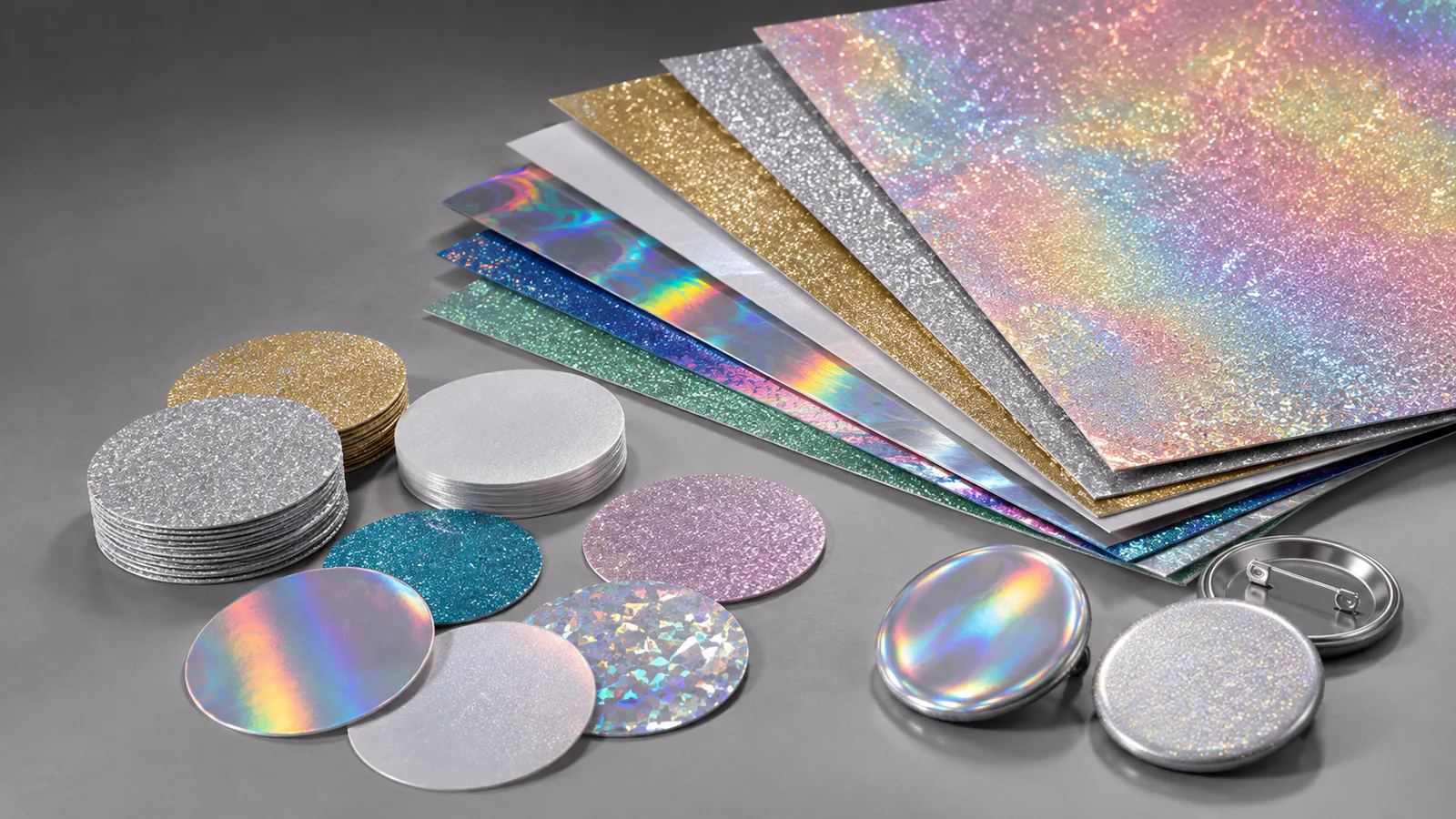
Specialty paper manufacturing & wholesale
Specify glitter, brushed-metal, holographic and pearl-effect paper by basis weight, surface pattern, print method and cut format. We organize A4 sheets, custom sizes, round badge blanks and physical sample approval for B2B sourcing.
Direct answer
Separating these two materials prevents paper-weight mistakes and unclear requests for quotation.
For wrap-around metal button badges, 120–160 gsm is a practical trial range for many coated specialty papers, not a universal machine limit. The referenced 120/128 gsm papers sit in this range. Stiffer 200–250 gsm stock is often better treated as a backing card or separately tested insert because total thickness, spring-back, film and press tooling must work together.
The artwork paper sits between the metal shell and clear film to create the printed image and reflective effect.
This is the rigid display card that holds a finished badge inside an OPP bag. It uses a different thickness, slit and packaging specification.
Paper weight
Basis weight does not equal measured thickness. Coatings, laminated layers and holographic films can change stiffness and press behaviour even at the same gsm.
| Trial range | Typical use | Trade-off | Check before production |
|---|---|---|---|
| 80–100 gsm | Light holographic paper or laminated constructions | Easier to wrap, but opacity and waviness may need attention | Opacity, printer feed and backing support |
| 120 / 128 gsm | Starting point for coated specialty insert paper | Useful balance of print surface, stiffness and wrapability | Measured thickness, total stack and edge creasing |
| 128–160 gsm | General coated or art papers when the press permits | Stronger hand feel, but machine limits vary | Manufacturer thickness limit and test press result |
| 200–250 gsm | Rigid inserts, backing layers or cards | May cause spring-back, film damage or incomplete assembly | Do not standardize without a press test |
| Packaging card stock | Retail display in an OPP bag | A separate packaging component | Slit position, holding strength and bag size |
Important: Specify gsm together with measured thickness, surface layer, print method, button machine and clear-film construction. A supplier weight label alone does not prove press compatibility.
Finish families
The numbered physical references provide a common language for sampling. They are not a promise that every pattern is always in stock.
Gold, silver, white, blue, cyan, purple, green, red, pink, grey, black and pearl-like colours.
Strong colour field / fine sparkleRainbow, polished silver and directional gold, purple, red, blue and black hairline effects.
Metal feel / directional reflectionSmooth rainbow, fine sand, flowing stars, dots, cracked glass, cloud, flame, light column and grid patterns.
Angle change / visible pattern / raritySilver, gold, pink and iridescent blue with fine fibre-like light streaks.
Soft gloss / delicate surfaceIridescent pearl blue, pink and purple with restrained interference colour.
Light artwork / refined colour shiftRainbow white, iridescent white and purple-toned fine scattered reflection.
White base / small-area sparkleReflective, white-ceramic and coloured-ceramic looks for special themes.
Limited concepts / unusual surfacesFinish names can vary by material maker and production lot. Approve a physical swatch number, colour, particle size, reflection direction and lot-control method rather than relying on the name alone.
Applied effect
The moon-and-star artwork is held constant across twelve referenced finishes so the substrate difference remains easy to compare.
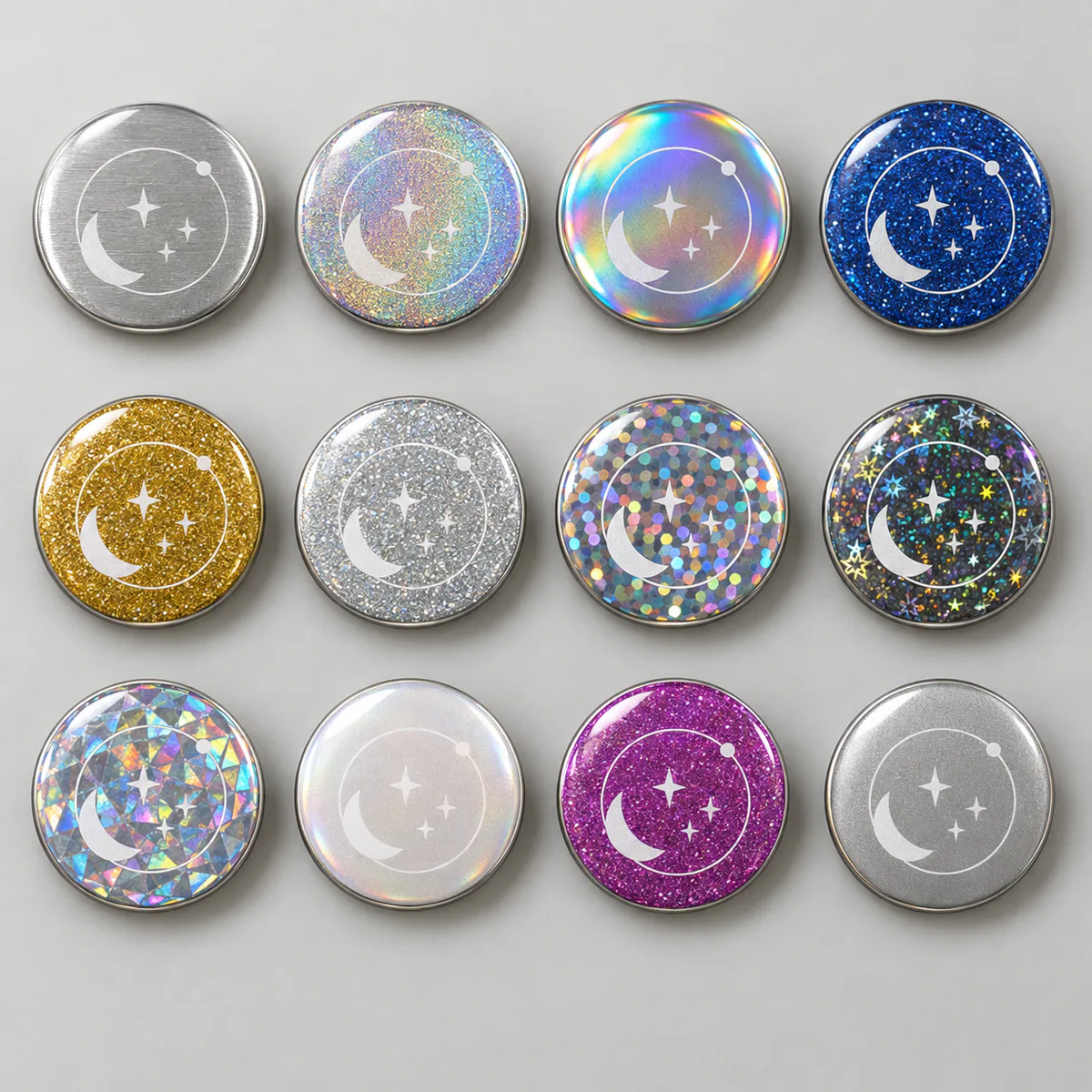
Ink printed directly over a holographic or metallic layer can become translucent. A full or selective white underbase separates the areas that must remain readable from the areas intended to reflect.
Preserves strong reflection; the substrate pattern enters the printed colours.
Stabilizes text, skin tones and pale colours for clearer artwork.
Keeps the subject readable while allowing the background or accents to reflect.
Physical review: Inspect readability, colour shift, reflection density and edge wrinkles under front light, angled light and normal indoor conditions.
Original artwork application
The same original character, crop and selective white-underbase plan are applied to eight papers. This reveals how skin tones, white areas, dark outlines and reflective backgrounds behave together.
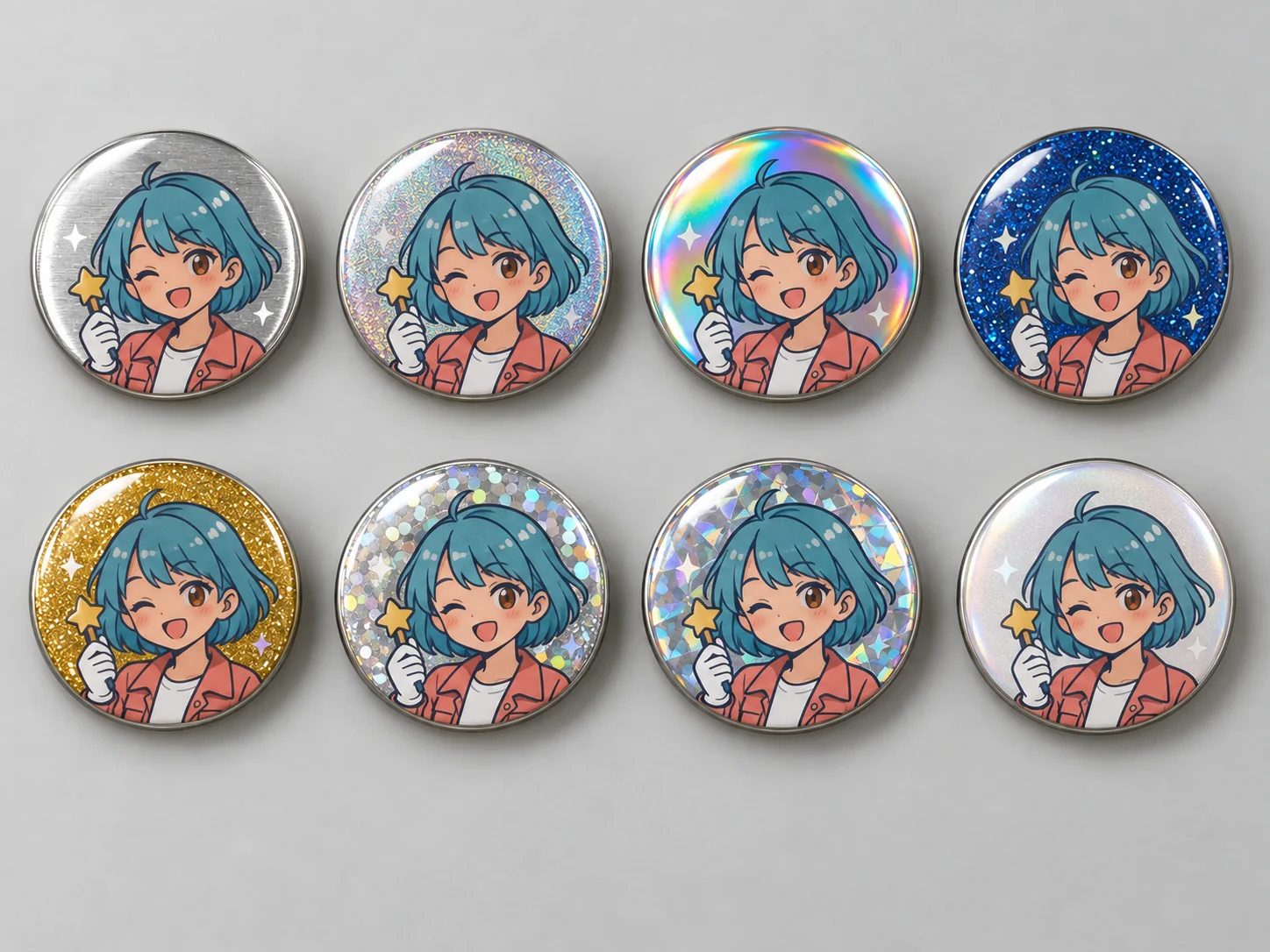
Use white underbase below skin, eyes, clothing and gloves to limit substrate colour cast.
Check that facial details and key outlines remain readable on high-reflection stock.
Remove underbase selectively so glitter, holographic or brushed patterns enter the background.
After narrowing the paper, approve colour, reflection, edge condition and readability on a full-size press sample.
Artwork handoff: Supply separate colour art and white-underbase layers plus finished and die-cut diameters. The character shown is an original comparison design and does not use third-party IP.
Format & wholesale
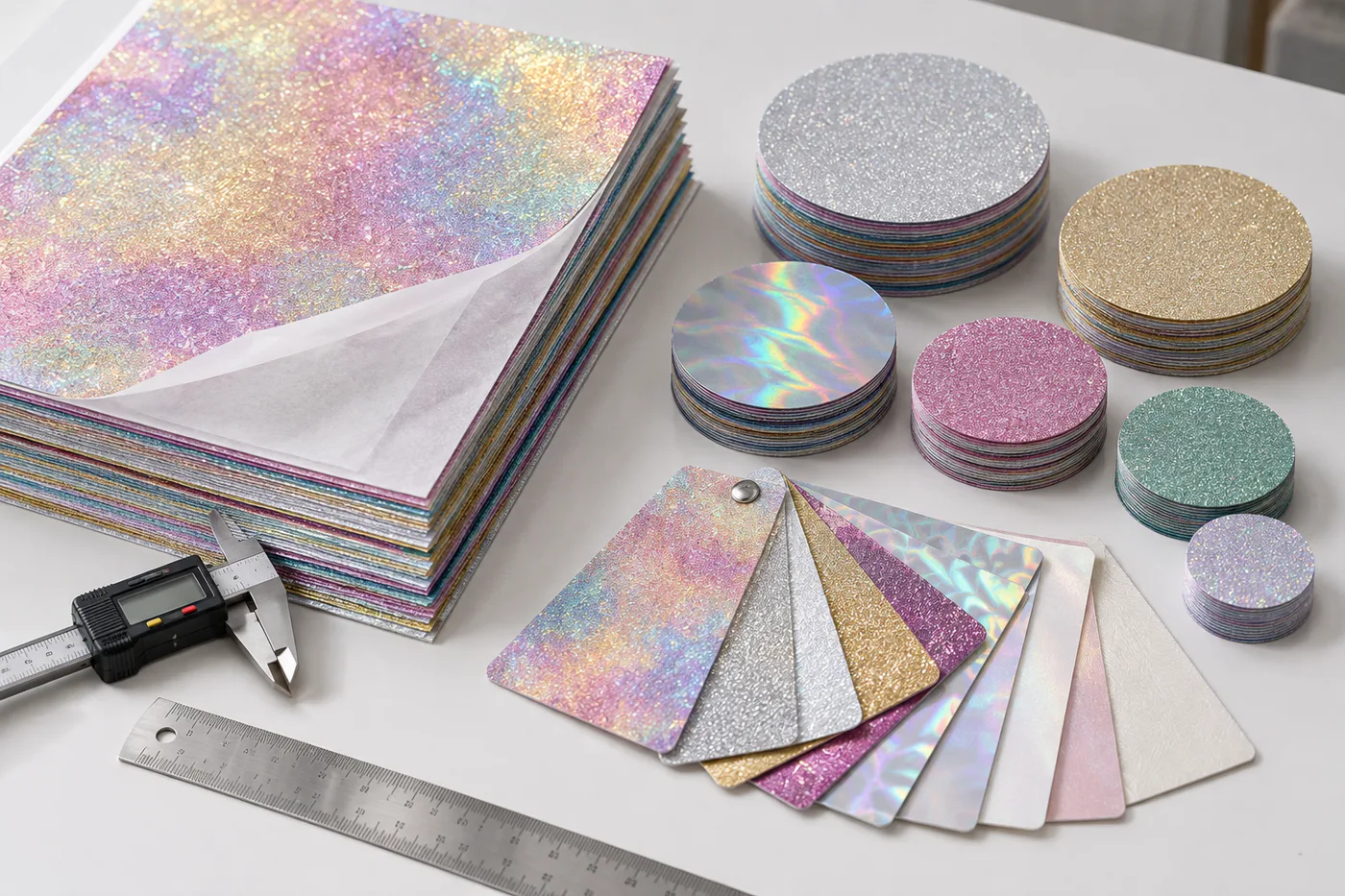
Sheet supply and press-ready round blanks require different dimensions, tolerances and packing instructions.
The physical references include A4 sheets and round formats used for approximately 58–75 mm finished badges. For production, specify the artwork and die-cut diameter required by the selected tooling, including wrap allowance.
210 × 297 mm for sampling, in-house cutting or mixed-finish evaluation.
Confirm cut dimensions, tolerance, grain direction and quantity.
Control the die-cut diameter required by the machine, not only the finished badge size.
Define pieces per finish, colour and diameter plus interleaf, bag and carton units.
Processing options
Availability depends on the selected paper, artwork, quantity and equipment. These are evaluation routes, not blanket production guarantees.
Offset, digital, UV and white-underbase tests for ink adhesion and colour.
A4, strips, circles or specified shapes; check tolerance, fibre and edge chips.
Backing paper, adhesive layers or film lamination; control total thickness and peel strength.
Prototype the area and relief so effects do not conflict with substrate reflection.
Evaluate discoloration, burn marks and reflection changes on a small sample.
Check total film stack, wrapping, wrinkles, edge condition and component retention.
B2B workflow
Approve a physical swatch, measured thickness and machine fit instead of ordering from screen appearance alone.
Confirm wrap-around insert, backing layer or packaging card.
Narrow the family, pattern, colour, gsm and surface layer.
Check underbase, colour, wrapping and edge wrinkles.
Record swatch number, lot, tolerance and packing unit.
Cut, inspect and reconcile quantities by SKU.
A finish name alone may not identify the same pattern. Include a reference image, use, dimensions and quantity to reduce specification rounds.
FAQ
Key questions about weight, terminology, finishes, white underbase, cutting and approval.
For the referenced coated specialty papers, 120–160 gsm is a practical trial range for wrap-around metal badges, but it is not a universal press limit. Lighter papers can wrap more easily, while coated layers and films change measured thickness. Follow the machine limit and verify a press sample.
It depends on the construction. It may suit a rigid insert, backing layer or packaging card, but standard wrap-around badges can develop wrinkles, film damage or incomplete assembly. Measure the total stack and run a machine trial before approval.
No. This page covers printable insert and specialty paper that creates the front artwork and reflective effect. A retail backing card holds the finished badge inside its bag and has a separate thickness, slit and packaging specification.
The physical references cover glitter, brushed metallic, holographic, silk texture, pearlescent, sprinkle and other reflective effects across 66 numbered examples. Current availability, weight and colour tolerance must be confirmed against a swatch number.
A4 sheets, specified dimensions and round blanks can be evaluated. For 58–75 mm-class finished badges, specify the die-cut diameter required by the selected tooling, including wrap allowance, rather than ordering by finished size alone.
Without white, the reflective substrate enters the printed colours and pale areas become translucent. Full white improves artwork clarity. Selective white keeps the character or text readable while allowing the background to reflect.
A photo can narrow the options, but reflection changes with lighting and angle. Approve a physical swatch, pattern number, colour, gsm, surface layer, production sample and lot-control method before bulk production.
Share the use, reference image, button machine, finished size and quantities by SKU. We will organize the finish candidates and sample checks required before quotation.
Discuss button badge specialty paper →