How to stabilize facial expressions and delivery times in OEM mass production of stuffed animals
1. Why facial expression reproduction is important for stuffed animal OEM
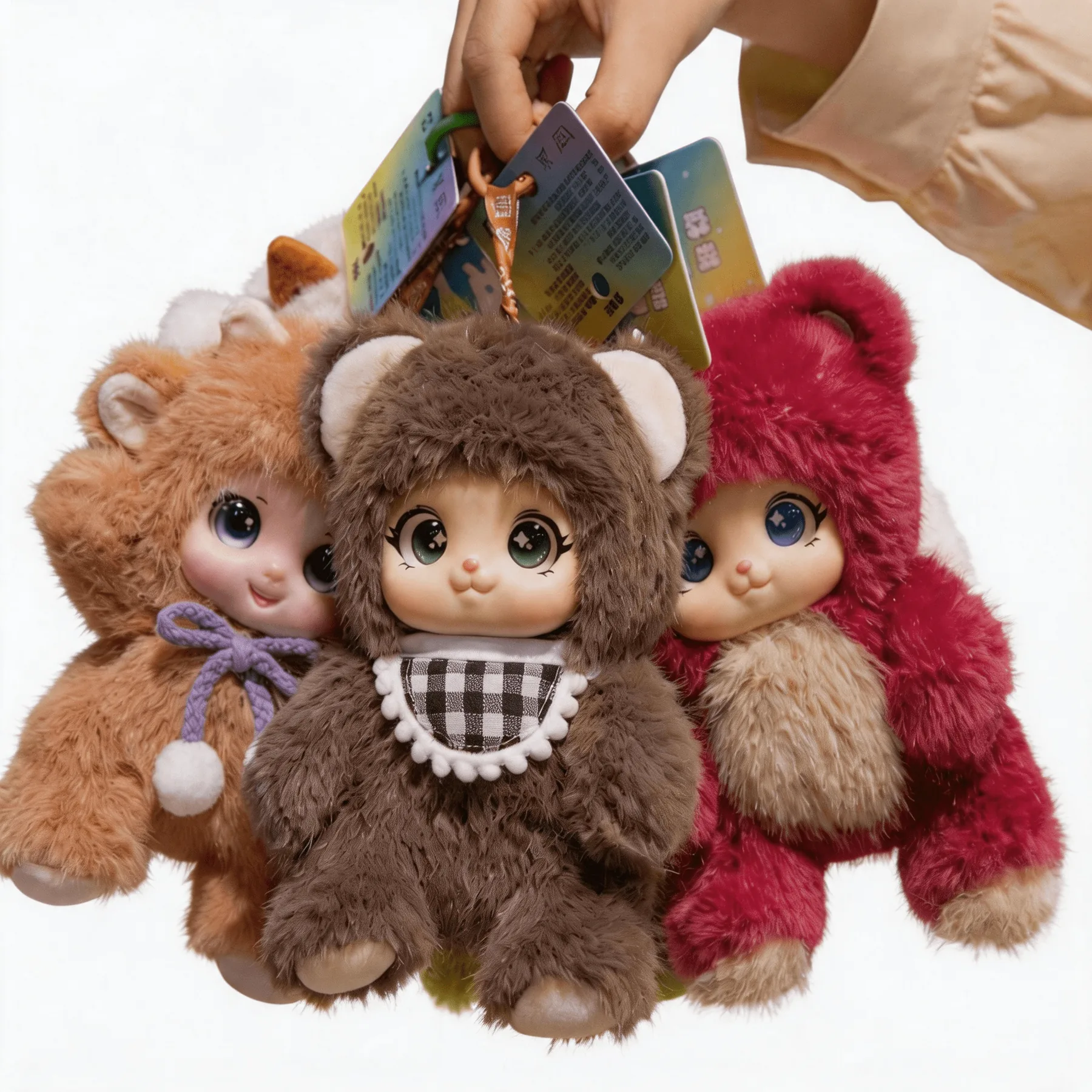
Unlike acrylic goods and tin badges, the product value of character stuffed animals and stuffed animals is greatly influenced by their three-dimensional appearance, softness, and facial expressions.
Especially for IP products, anime goods, game goods, and oshi-katsu goods, even slight changes in the eyes, mouth, eyebrows, roundness of the face, or body balance can cause the character to lose its character.
Therefore, when mass producing OEM stuffed animals, it is important not only to simply make samples, but also to organize facial expression reproduction, embroidery position, fabric selection, cotton amount, master sample, and inspection standards in advance.
In this article, we will explain how to stabilize expressions and delivery times during OEM mass production of stuffed animals.

2. Main causes of facial expression changes
A stuffed animal's expression changes depending on multiple factors.
Main cause:
- The embroidery positions of the eyes and mouth are misaligned.
- The color of the embroidery thread is different from the design
- The roundness of the face is different from the sample
- Too much or too little cotton
- The pile of the fabric makes it difficult to see the embroidery.
- Sewing lines change the shape of the face
- Small size makes it difficult to reproduce details
- The design drawing and the appearance after 3D are different
Even if it looks natural in the design drawing, the balance may change when you make it three-dimensional. Therefore, it is important to check the appearance from the front, side, diagonal, and back at the sample stage.

3. Design materials to be prepared before mass production
In order to proceed smoothly with plush toy OEM estimates and sample production, it is helpful to have the following materials available.
| Materials | Content |
|---|---|
| front design | Face, body, clothing, color, overall balance |
| Side/back design | Hairstyle, tail, back of clothes, three-dimensional structure |
| size specification | Height, width, thickness, sitting/standing posture |
| Facial expression instructions | Eyes, mouth, eyebrows, cheeks, embroidery position |
| Fabric specification | Short hair, boa, soft boa, chewy fabric, etc. |
| Color specification | Pantone, reference color, color swatch |
| accessories | Clothes, hats, ribbons, tags, charms |
| Packaging specifications | OPP bag, paper tag, JAN seal, individual packaging |
Even if the documents are not complete, if you know the reference images, desired size, purpose, and quantity, it will be easier for the factory to propose specifications.
4. Points to check for fabric, embroidery, and amount of cotton
Fabric selection
The fabric affects the impression of the stuffed animal and the unit price.
Check points:
- hair length
- Color
- touch
- Thickness
- elasticity
- Compatibility with printing and embroidery
Depending on the mood of the character, choose short hair, boa, soft boa, chewy fabric, etc. Fabrics with long piles may look soft, but fine embroidery may be difficult to see.
embroidery
The embroidery position and thread color are important for facial parts such as eyes, mouth, eyebrows, and cheeks.
Check points:
- embroidery position
- thread color
- line thickness
- Left and right balance
- Compatibility with hair
- Reproducibility of small parts
When creating embroidery data, rather than simply reproducing the design image, the line width may be adjusted to make it easier to see at the actual size.
Cotton amount
The amount of cotton affects the roundness of the face, the shape of the body, and the feel of the fabric.
Check points:
- roundness of face
- body thickness
- shape of limbs
- sitting posture
- softness
- Variations during mass production
If there is too much cotton, the look will be drawn out, and if there is too little, the shape will easily collapse. It is important to determine the standard using a master sample.
5. Mass production standards determined by master samples
For plush toy OEMs, master samples are finalized before mass production. This is a standard sample for mass-produced products.
Items to check with the master sample:
- facial expression
- embroidery position
- fabric color
- Cotton amount
- size
- sewing line
- accessories
- tag position
- Packaging specifications
During mass production, not all parts are exactly the same. Since stuffed animals involve many manual processes, it is necessary to decide in advance how much individual variation will be tolerated.
By determining the acceptable range, it becomes easier to make decisions during inspection and reduces the risk of re-inspection and corrections.
6. Progress management to stabilize delivery dates
For stuffed animal OEMs, it may take more time to prepare samples than for acrylic or badges. This is because there are many items to check, such as facial expressions, patterns, fabrics, embroidery, and amount of cotton.
Key points to stabilize delivery times:
- Organize specifications as much as possible at the time of initial estimate.
- Anticipate the number of design revisions
- Check the fabric and embroidery thread early
- Faster response for sample confirmation
- Determine common specifications for multiple characters
- Finalize packaging specifications before starting mass production
- Check the delivery destination and DDP conditions early
Especially for projects with fixed delivery dates, such as event sales or lottery prizes, it is important to create a schedule that includes time for sample corrections.
7. Items to be confirmed during product inspection, needle detection, and packaging
When it comes to stuffed animals, you need to check not only their appearance, but also their safety and packaging.
Inspection items:
- Expression, embroidery, facial balance
- Size, cotton amount
- Poor sewing
- Dirt, thread residue
- Installing accessories
- tag position
- Meter reading
- Individual packaging
- carton display
For products sold in Japan, meter inspection, tags, JAN seals, individual packaging, and carton display are also important. When mass producing multiple characters at the same time, check the quantity by SKU and carton display.
8. Frequently asked questions
QCan you give me an estimate based on design drawings only?
A rough estimate is possible. For a more accurate quote, it will be easier to proceed if you have the desired size, quantity, fabric, accessories, and packaging specifications.
QCan I change the facial expression?
It can be adjusted at the sample stage. Make corrections while checking the embroidery position, amount of cotton, roundness of the face, fabric, etc.
QCan I mass produce multiple characters at the same time?
It's possible. Deciding on common sizes, common fabrics, and common packaging will make mass production management easier.
QCan you handle needle inspection and individual packaging?
It is possible. For products sold to Japan, we check meter reading, tags, OPP packaging, JAN seals, etc. in advance.
QCan we discuss DDP delivery?
It's possible. After confirming the delivery destination, quantity, carton size, and desired delivery date, you can consider a quote based on DDP conditions.
9. Related product pages
Please contact us first to arrange mass production specifications.
If you send us information on the product category, quantity, number of SKUs, desired delivery date, and delivery destination, we will organize and guide you through the specifications, inspection, packaging, and delivery conditions that are easy to mass produce.
Click here for free estimate and specification consultation