Rubber Keychain Hardware Strength and Pull Testing: Pre-Production Test Conditions and Acceptance Criteria
1. There Is No Single Universal Strength Value for Rubber Keychains
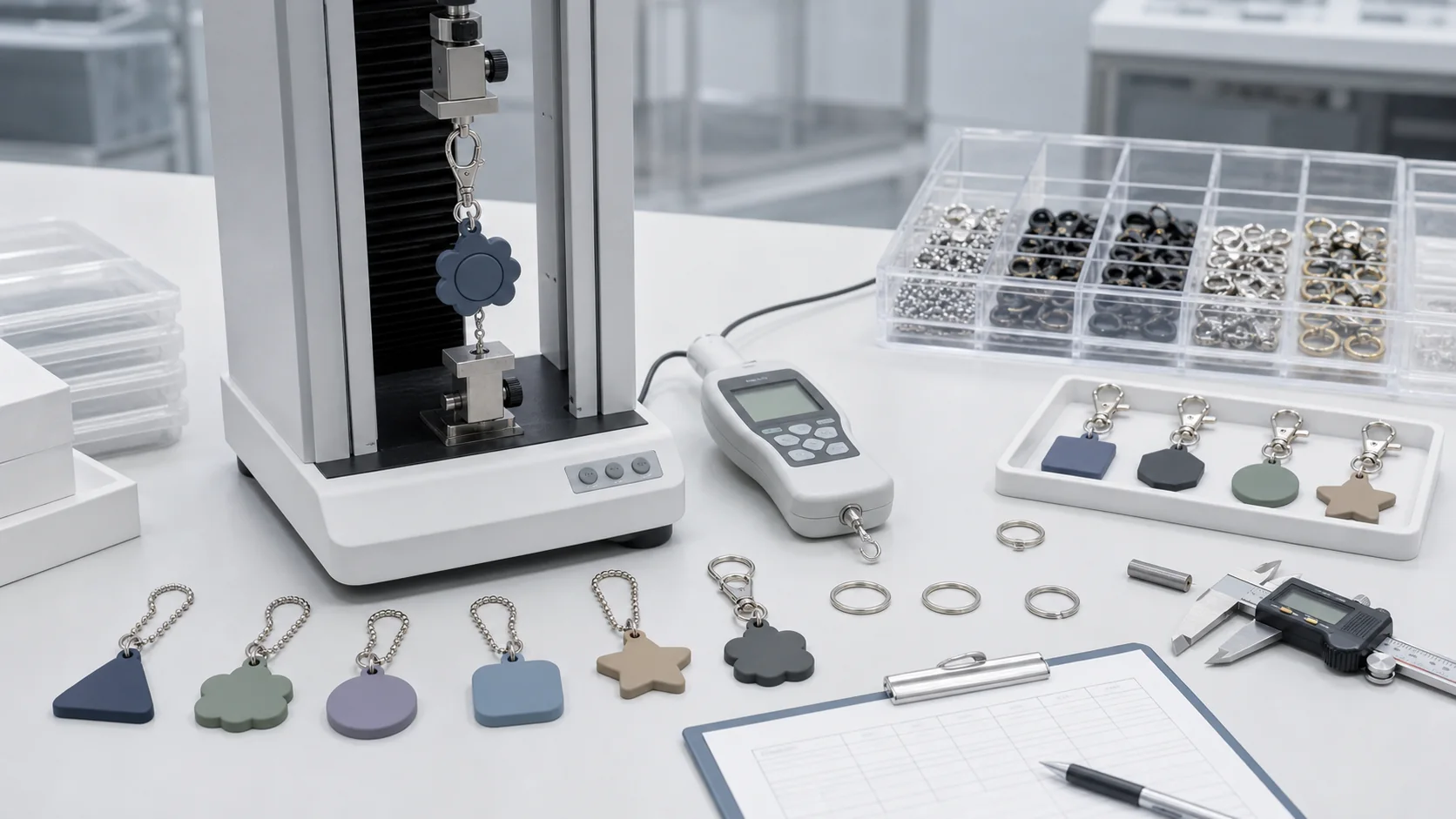
Ball chains, lobster clasps, split rings, D-rings, and strap fittings vary greatly in material, wire diameter, geometry, and connection method. Required strength also changes with charm weight, intended use, target age, and attachment location.
For OEM production, define a finished-product test that represents actual use and agree project-specific acceptance criteria before mass production.
2. Common Failure Risks by Hardware Type
Ball chain
Connector release, link separation, plating wear, or incomplete closure.
Lobster clasp
Spring fatigue, gate opening, swivel pullout, or casting cracks.
Split ring / D-ring
Gap opening, permanent deformation, wire breakage, or detachment.
Hardware checks
- Material, wire diameter, thickness, and plating
- Spring, swivel, weld, and crimp condition
- Ring closure and opening orientation
Rubber charm checks
- Attachment-hole wall thickness and edge distance
- Reinforcement and fit
- Stress concentration under the intended load direction
3. Six Test Conditions to Define Before Testing
| Condition | Define | Why it matters |
|---|---|---|
| Test specimen | Hardware alone, connection, or complete product | The weakest location may change |
| Fixture | Grip geometry, position, and slip prevention | Avoid fixture-induced damage |
| Load direction | Vertical, angled, lateral, or actual-use direction | Changes ring opening and hole stress |
| Load mode | Constant-load hold, stepped load, or pull to failure | Defines the measurement result |
| Speed and time | Crosshead speed, hold duration, and rest time | Separates impact from sustained load |
| Acceptance | Breakage, release, gap opening, permanent set, or loss of function | Prevents an ambiguous “not broken” pass |
4. Static Pull and Load-Hold Testing
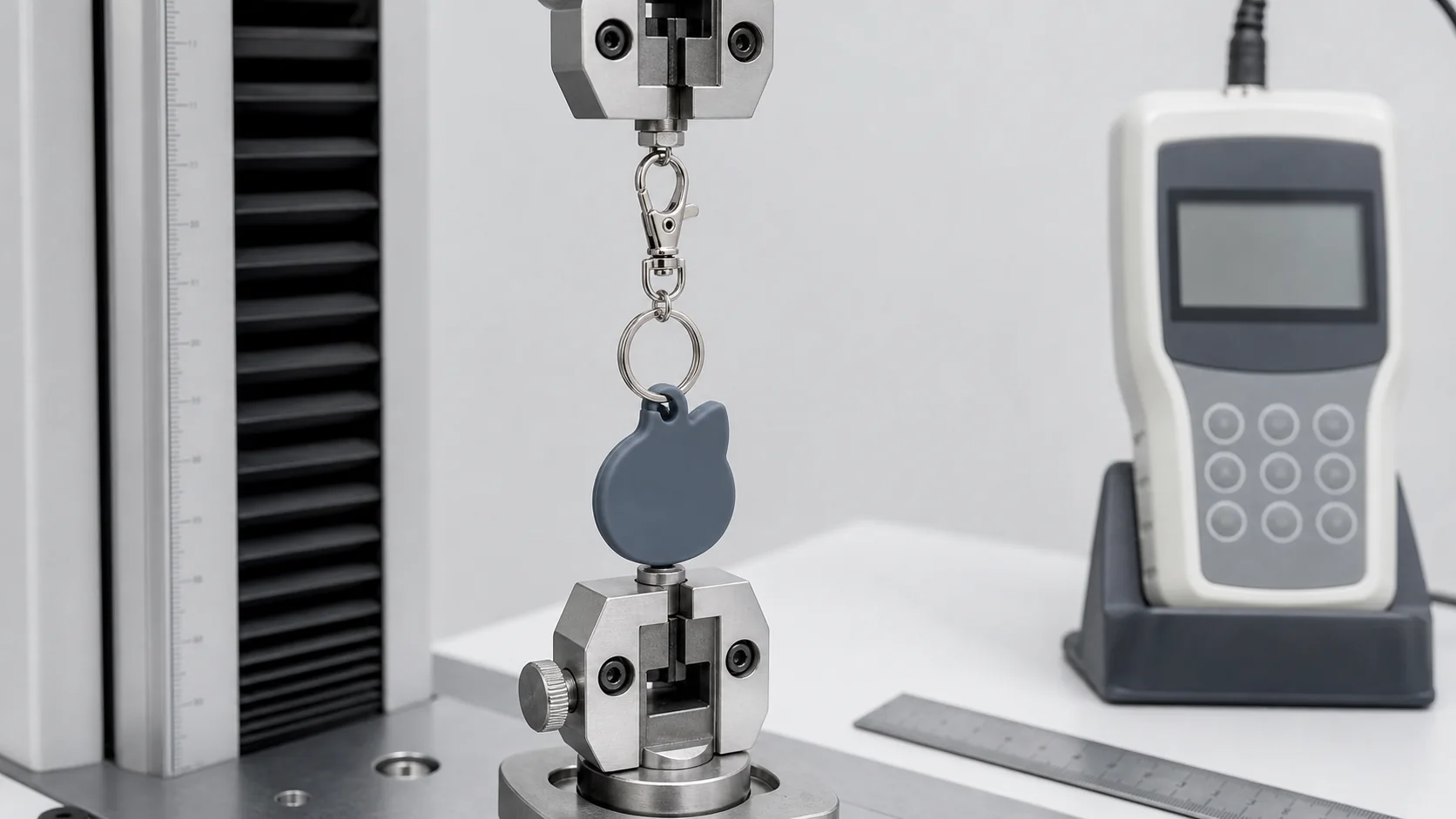
Mount the finished product so the load path runs through the hardware, connector, and rubber charm in a realistic direction. Record ring opening, elongation, slip, permanent deformation, and maximum force—not only final breakage.
- Identify specimensRecord item, hardware lot, dimensions, and initial appearance.
- Mount fixturesAvoid cutting the rubber and align the hardware naturally.
- Apply preloadRemove slack and record the initial position.
- Load and holdReach the agreed load and hold, or continue to failure.
- UnloadCheck permanent set and remaining function.
- Record resultsSave force, displacement, failure location, photos, and decision.
5. What Cyclic Durability Testing Should Check
A part may survive one pull but deteriorate after repeated attachment, swinging, and clasp operation. Define load range, stroke, speed, and cycle count together.
- Does the lobster-clasp gate return fully after repeated opening?
- Has play increased in the swivel or crimp?
- Has the split-ring gap opened?
- Has the ball-chain connector lost holding force?
- Is there whitening, tearing, or elongation around the rubber hole?
- Are there plating cracks, flakes, or metal powder?
Counts such as 1,000 or 2,000 cycles are project examples. Cycle count alone is not reproducible without the force, stroke, and rate.
6. Common Failure Modes and Corrective Actions
| Failure | Possible cause | Improvement |
|---|---|---|
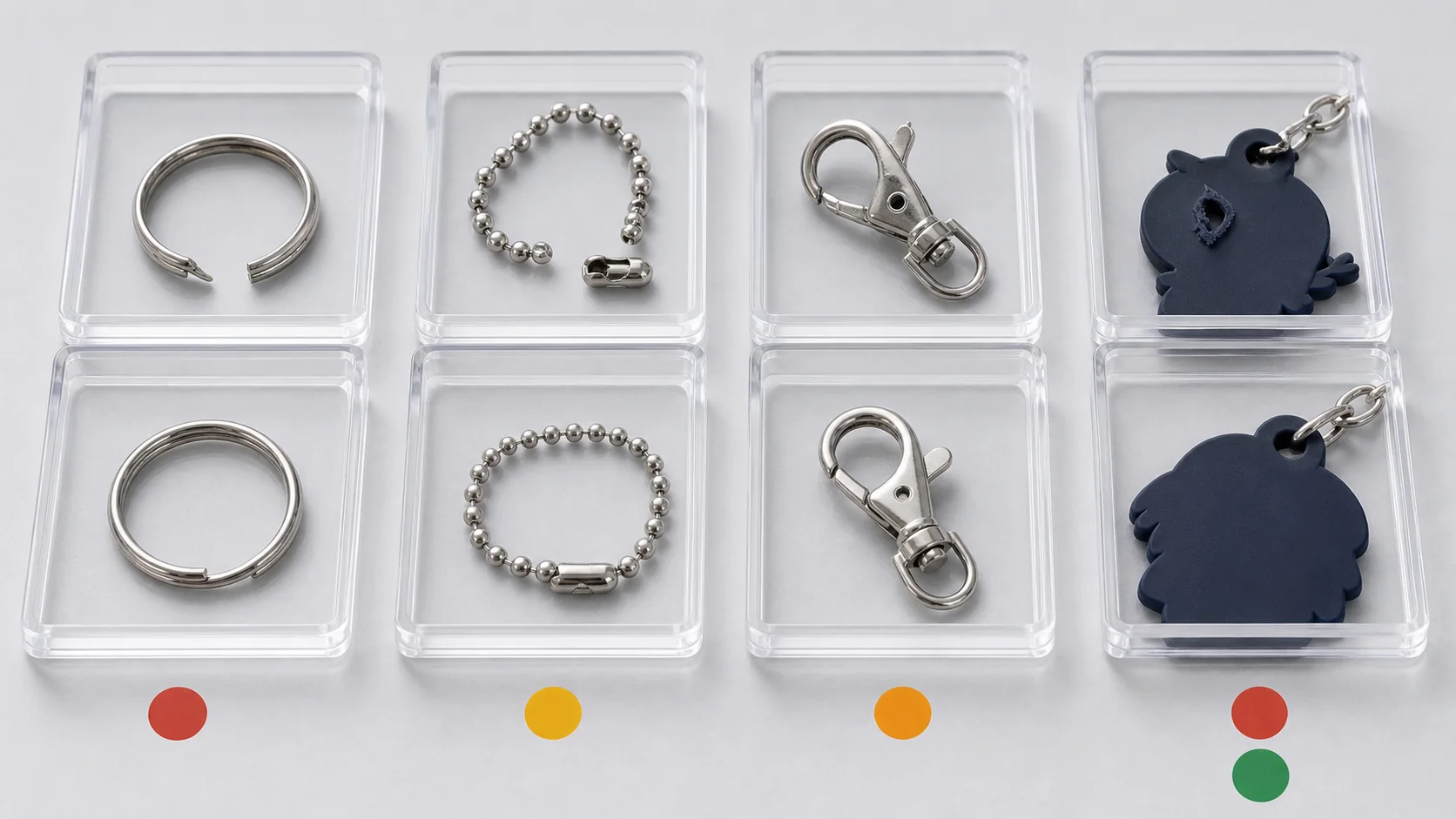
| Split-ring gap opening | Insufficient wire diameter or unfavorable opening direction | Change material/diameter, use a double ring, rotate the opening |
| Ball-chain release | Connector dimensional error or incomplete connection | Control fit, standardize assembly, add holding-force sampling |
| Clasp does not return | Spring material, heat treatment, or plating interference | Revise spring specification and opening-cycle test |
| Rubber hole tears | Insufficient edge wall or stress concentration | Change hole location, diameter, wall thickness, or reinforcement |
| Crimp/swivel pullout | Insufficient processing dimension or part variation | Control crimp height and audit the hardware process |
7. Mass-Production Inspection and Sampling
Pull-to-failure testing destroys specimens, so it is normally designed as lot sampling. Ring closure, clasp return, orientation, scratches, plating, and corrosion can be included in non-destructive production inspection.
Destructive and durability tests
- First sample, hardware change, and first production lot
- Sampling by hardware or production lot
- Additional testing and lot hold after a failure
Production visual/function checks
- Ring closure, chain connection, and gate return
- Orientation, looseness, plating, and corrosion
- Rubber-hole tearing, whitening, and deformation
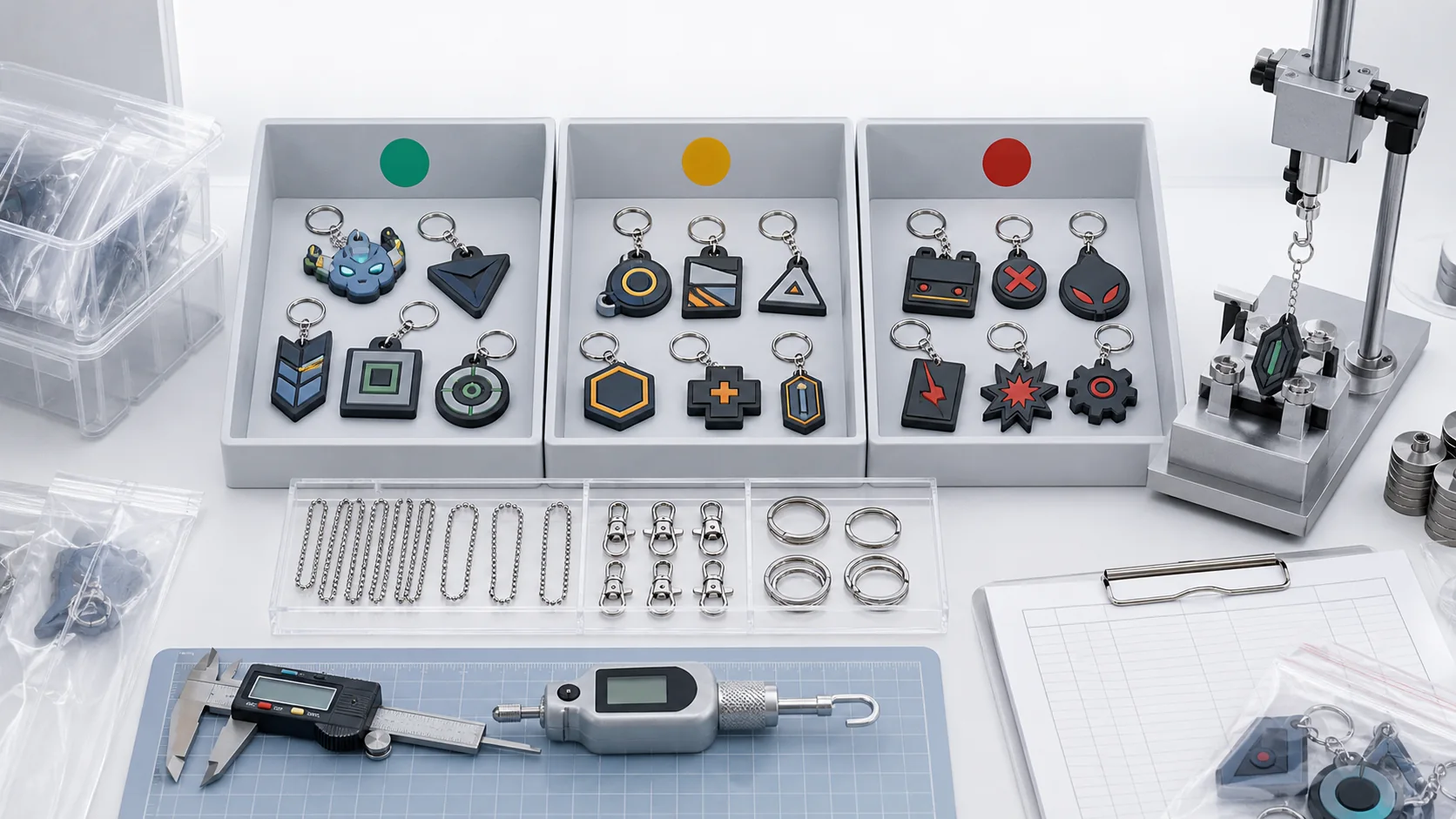
8. Hardware Strength Checklist Before OEM Ordering
- Specify hardware type, material, wire diameter, thickness, and plating
- Define charm weight, hole diameter, and edge wall thickness
- Test the finished product, not only loose hardware
- Specify direction, fixture, speed, load, and hold duration
- Judge gap opening, release, permanent set, and loss of function
- Define cycle count together with force, stroke, and rate
- Set the test frequency for samples and production lots
- Define lot hold, retest, and replacement actions after failure
- Record photos, video, force curve, and specimen ID
9. Frequently Asked Questions
QDoes holding 3 kg for one minute guarantee acceptance?
No. It is only an example condition. Select criteria for the product, use, hardware, and market, and evaluate deformation and function as well as breakage.
QIs testing loose hardware enough?
It helps with incoming inspection, but the split ring, crimp, or rubber attachment hole may fail first in the completed product. Use both when appropriate.
QDoes every unit need pull testing?
Destructive testing is normally sampled. Non-destructive connection, clasp, orientation, and appearance checks may be full or sampled according to risk.
QWhat belongs in the report?
Specimen ID, hardware lot, fixture, direction, speed, force, hold time, displacement, failure location, photos, and decision.
Related Products and Services
Confirm Hardware and Test Conditions Before Mass Production
Share the charm weight, hardware type, intended use, and quantity. We can organize pull load, hold time, durability cycles, and sampling for the project.
Request a Free Quote or Test Review