
RoHS, REACH, and EN 71 for PVC Goods: A Product-Classification Guide

1. Start With Product Classification
Non-electrical PVC goods
Start with relevant REACH restrictions and communication duties, plus other product-safety requirements.
Light, sound, USB, or circuits
If the finished product is EEE, assess RoHS and evaluate REACH separately.
Products intended for play
Assess EU toy-safety legislation and EN 71. Electronic toys may also involve RoHS.
2. Which Framework Applies to Your Product?
Use this sequence before requesting a quotation to reduce both unnecessary blanket testing and missed requirements.
- Confirm sales marketsList EU Member States, the UK, Japan, the US, and other destinations.
- Identify the main functionDecoration, electrical/electronic function, or use in play.
- Define age and contactConsider mouthing, skin contact, and foreseeable use by children.
- Break down materials and partsPVC body, pigments, print, metal fittings, battery, circuit board, and packaging.
- Separate law from customer standardsDistinguish legal duties, retailer specifications, and licensor requirements.
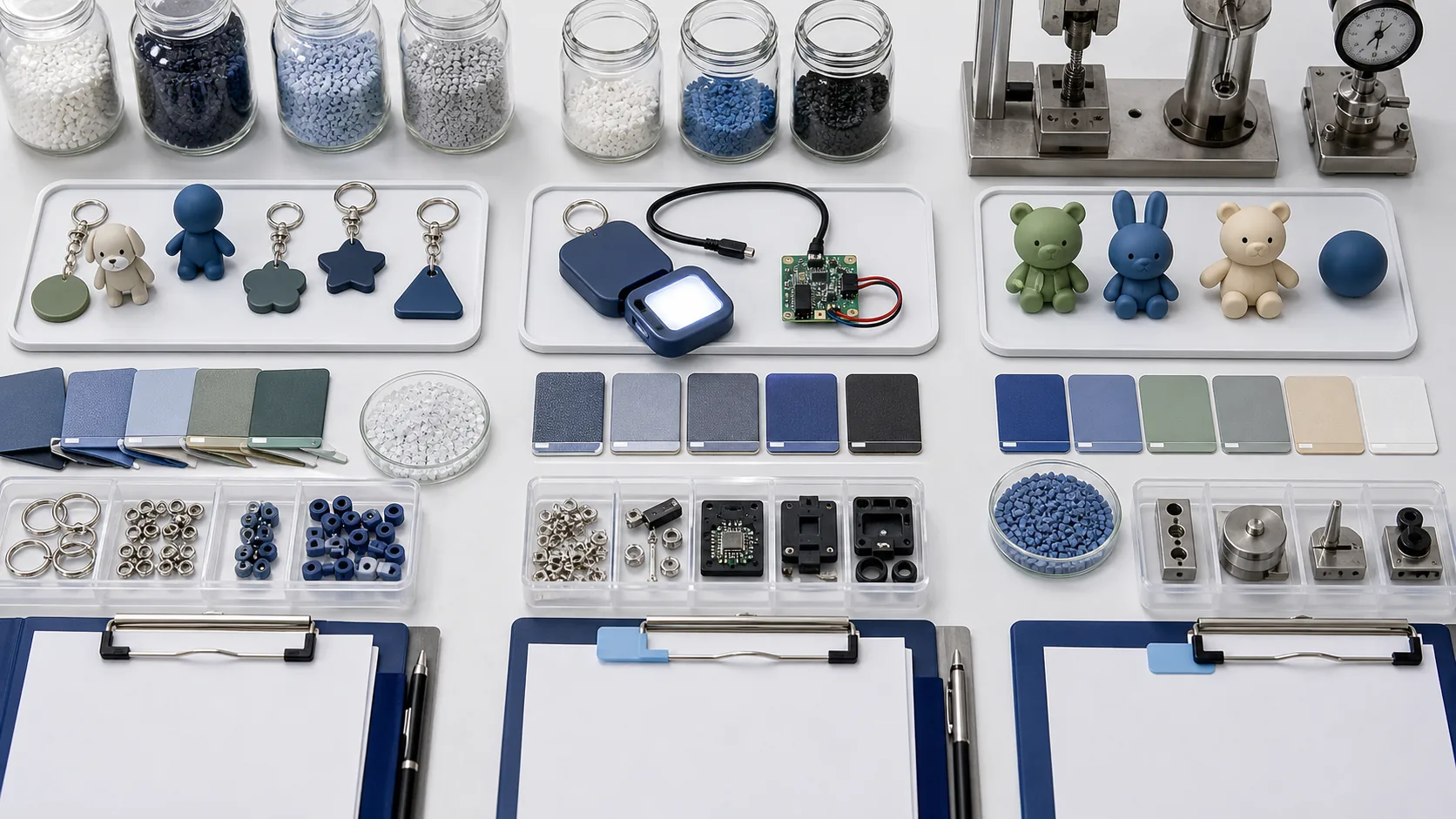
3. RoHS: When the Product Is Electrical or Electronic
Directive 2011/65/EU restricts specified hazardous substances in electrical and electronic equipment (EEE). A normal non-electrical PVC keychain is not generally assessed under RoHS merely because it is made of PVC. Products with LEDs, sound, USB functions, batteries, or electronic circuits require a scope review.
| Restricted substances | Maximum in homogeneous material | Possible PVC-goods sources |
|---|---|---|
| Lead, mercury, hexavalent chromium, PBB, PBDE | 0.1% each | PVC formula, pigments, solder, components |
| Cadmium | 0.01% | Pigments, stabilizers, metal finishes |
| DEHP, BBP, DBP, DIBP | 0.1% each | Flexible PVC, cables, plastic parts |
RoHS limits apply at homogeneous-material level, not as an average over the finished product. Separate PVC colors, cable insulation, solder, plating, and other mechanically separable materials according to risk.
4. REACH: Priority Checks for PVC Articles
REACH is a broad EU chemicals regulation covering substances, mixtures, and articles. There is no single universal “REACH test.” Define the relevant Annex XVII restrictions, Candidate List communication duties, and possible SCIP obligations for the product and supply-chain role.
Lead in PVC
Regulation (EU) 2023/923 generally restricts PVC articles containing lead at 0.1% or more by weight of the PVC material from 29 November 2024. Conditional derogations apply to specified recovered-PVC uses. The listed exclusions, including certain products already covered by RoHS or toy legislation, must also be reviewed.
Phthalates in plasticised material
REACH Annex XVII Entry 51 restricts articles containing DEHP, DBP, BBP, and DIBP at a combined concentration of 0.1% or more by weight of plasticised material. Entry 52 separately addresses DINP, DIDP, and DNOP in toys and childcare articles that can be placed in the mouth.
Candidate List communication
If a Candidate List substance is present above 0.1% by weight in an article, REACH Article 33 communication duties may apply. Suppliers placing articles on the EU market may also have SCIP duties under the Waste Framework Directive. Check the current list and the responsible legal entity at production.
5. EN 71: When the Product Is a Toy
EN 71 is a family of European standards used to support conformity with EU toy-safety legislation. First determine whether the product is designed or intended for use in play by children under 14.
| Common standard | What it covers | PVC-goods examples |
|---|---|---|
| EN 71-1 | Mechanical and physical properties | Small parts, fitting detachment, tension, sharp points, cords |
| EN 71-2 | Flammability | Ignition and flame-spread requirements |
| EN 71-3 | Migration of certain elements | PVC, pigments, coatings, and printed material categories |
Additional standards such as EN 71-9 or other chemical tests may be selected according to product risk and customer requirements. A toy does not automatically require every EN 71 part.
6. Practical Product Matrix
| Product example | Start with | Typical evidence |
|---|---|---|
| Non-electrical PVC keychain | REACH Annex XVII, Candidate List, general product safety, customer specifications | Material declarations, lead and target-phthalate analysis, risk-based SVHC screening |
| LED, sound, or USB PVC accessory | RoHS, REACH, relevant electrical-product rules | Homogeneous-material RoHS, BOM, REACH evaluation, electrical documentation |
| PVC toy intended for children | EU toy safety, EN 71, REACH | EN 71-1/-2/-3, chemical safety assessment, technical documentation, additional risk-based tests |
| Electronic toy | Toy safety, RoHS, and REACH | Toy testing, homogeneous-material RoHS, material assessment, electrical documentation |
This is a scoping matrix, not an automatic test menu. Design, materials, age grading, sales presentation, and importer responsibilities can change the final plan.

7. Five Steps Before Mass Production
Record market, use, age group, electrical functions, and mouthing potential.
List PVC, pigments, prints, metal, electronics, and packaging by component.
Review SDS, declarations, and existing reports for identity, date, and substance scope.
Select high-risk materials, colors, and parts for homogeneous-material or toy-material testing.
Link test specimens to raw-material and production lots, with retest triggers for changes.
8. Evidence to Check in Test Reports
A statement that a report is “available and passed” may not prove the current product or production lot.
- Sample name, photo, color, material, and component match the actual product
- Legislation, substances, limits, methods, and units are identified
- The scope of multiple colors, materials, prints, and coatings is clear
- Report date, material lot, prototype, and production lot are traceable
- Retest triggers cover changes to formula, pigment, supplier, factory, and process
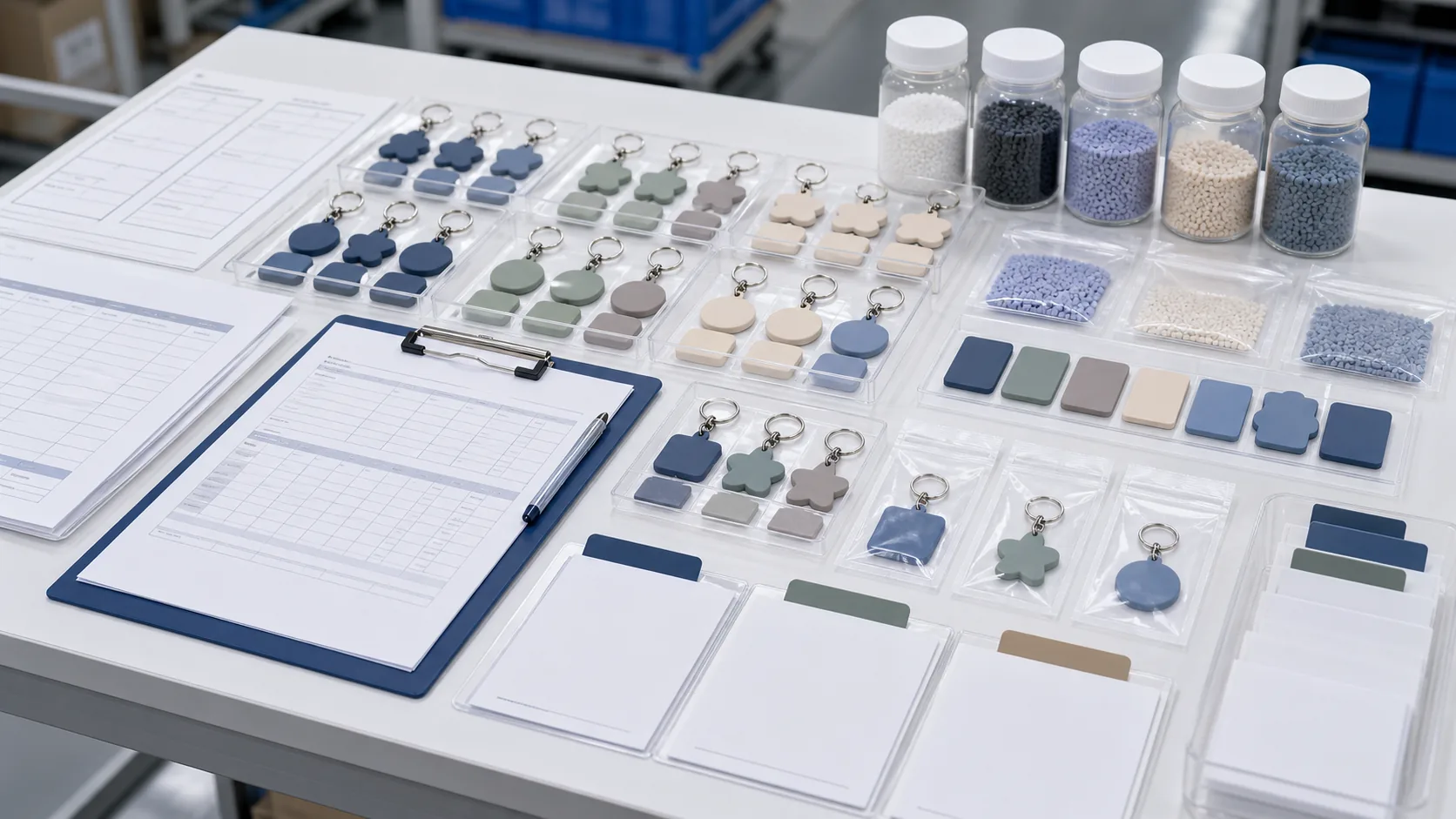
9. Information to Prepare Before Quotation
- Sales countries, importer, and sales channel
- Product name, intended use, age grading, and proposed warnings
- Battery, LED, sound, USB, or other electrical functions
- Dimensions, PVC hardness, colors, print, coating, and fitting specifications
- Whether the product is intended for play or can be placed in the mouth
- Retailer, licensor, or customer-specific standards
- Required report language, timing, and report holder
- Pre-production, post-production, or lot-based testing expectations
Sharing this information early lets the factory and laboratory use the same assumptions for classification, sample separation, documents, and testing.
10. FAQ and Official Sources
Does a normal PVC keychain need RoHS testing?
If it has no electrical/electronic function and is not EEE, RoHS is not normally the main requirement. Review relevant REACH restrictions and customer specifications.
Is testing RoHS, REACH, and EN 71 together the safest option?
More tests do not correct an incorrect classification, sample scope, technical file, label, or traceability system. Determine scope first, then build the required assessment.
Is an EN 71 report enough to sell a toy?
A report is only part of the technical documentation. Classification, design, safety assessment, declaration of conformity, CE marking, labeling, and traceability also matter.
Must every production lot receive every test again?
It depends on law, customer requirements, material risk, and change control. Fixed formulations, periodic testing, change-triggered testing, and production sampling can be combined.
Official sources
- EUR-Lex: Directive 2011/65/EU
- EUR-Lex: Delegated Directive (EU) 2015/863
- EUR-Lex: Regulation (EU) 2023/923
- ECHA: REACH restrictions
- ECHA: Candidate List
- European Commission: Harmonised toy-safety standards
- EUR-Lex: Regulation (EU) 2025/2509
This article provides general OEM quality-management information, not legal advice. Confirm the rules in force at production with the importer, laboratory, and qualified specialists for the market, classification, and material construction.
Related Products and Services
Define the Applicable Framework and Test Scope Before Production
Share the market, intended use, age group, electrical functions, and material construction so the evidence and test options can be scoped before quotation.
Request a Free Quote or Compliance Review